Sotatercept’s Multifaceted Role in Enhancing Exercise Capacity in Pulmonary Arterial Hypertension
Highlight
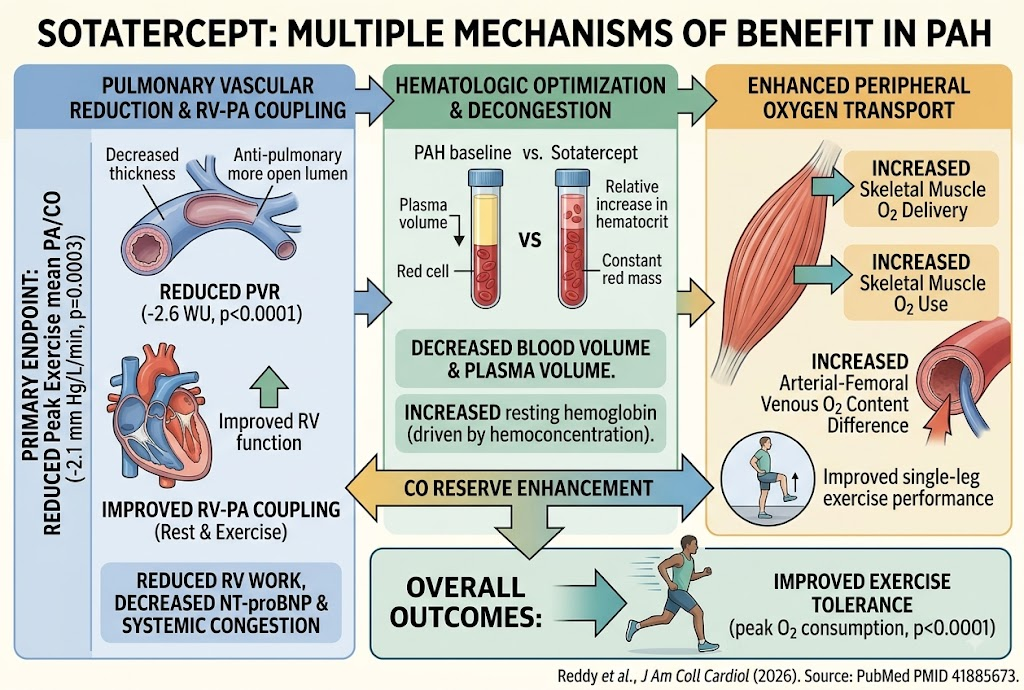
- Sotatercept significantly reduces pulmonary vascular resistance and mean pulmonary artery pressure, improving right ventricular-pulmonary artery (RV-PA) coupling in patients with pulmonary arterial hypertension (PAH).
- Systemic decongestion by sotatercept leads to hemoconcentration, elevating hemoglobin concentration without increasing red cell mass, thereby enhancing oxygen transport capacity.
- Despite a reduction in resting cardiac output (CO), sotatercept increases CO reserve during exercise, which correlates strongly with improved peak oxygen consumption and aerobic capacity.
- Skeletal muscle oxygen delivery and utilization are enhanced after sotatercept treatment, contributing to improved peripheral oxygen extraction and single-leg exercise performance.
Study Background and Disease Burden
Pulmonary arterial hypertension (PAH) is a progressive, life-limiting condition characterized by increased pulmonary vascular resistance (PVR) leading to right ventricular (RV) dysfunction and ultimately heart failure. Patients experience reduced exercise tolerance and quality of life due to impaired oxygen delivery and compromised cardiopulmonary function. Despite advances in PAH-targeted therapies, the need remains for treatments that directly improve functional capacity and cardiac efficiency. Sotatercept, an activin ligand trap, emerged as a promising agent in modifying pulmonary vascular remodeling and enhancing exercise capacity. However, the comprehensive mechanisms underlying its clinical benefits require elucidation to optimize its therapeutic application and broaden understanding of PAH pathophysiology beyond pulmonary hemodynamics.
Study Design
This prospective interventional study evaluated 30 patients with PAH (mean age 49.3 years, 70% women) undergoing 24 weeks of sotatercept therapy. The study integrated rigorous central and peripheral assessments of exercise physiology. Participants underwent supine invasive cardiopulmonary exercise testing (iCPET) with concurrent echocardiography, blood volume quantification, single-leg exercise catheterization, and femoral venous blood sampling. Seven paired hemodynamic assessments were conducted before and after treatment at rest, during nitric oxide inhalation, passive leg raise, incremental exercise (20 W), peak exercise, repeated baseline, and single-leg exercise phases. Key endpoints included changes in peak exercise mean pulmonary artery pressure to cardiac output ratio (mean PA/CO), pulmonary vascular resistance, right ventricular workload, and oxygen transport parameters.
Key Findings
Sotatercept treatment yielded significant improvements in multiple domains of cardiopulmonary function and oxygen transport:
1. Pulmonary Hemodynamics and Right Ventricular Function
The primary endpoint improved markedly with a reduction in peak exercise mean PA/CO by 2.1 mm Hg/L/min (95% CI, -3.1 to -1.1; P=0.0003). Pulmonary vascular resistance decreased by 2.6 Wood units (WU) (95% CI, -3.0 to -2.2; P <0.0001), and mean pulmonary artery pressure dropped substantially by 12.5 mm Hg (95% CI, -13.8 to -11.2; P <0.0001). RV workload diminished by 1.1 kg-m/min (P<0.0001), with significant improvements noted in RV-PA coupling across rest and exercise states. These hemodynamic benefits reflect effective pulmonary vascular remodeling and reduced RV afterload, critical to PAH pathophysiology.
2. Hematologic Effects and Systemic Congestion
Treatment resulted in systemic decongestion evidenced by decreased N-terminal pro-B-type natriuretic peptide (NT-proBNP, P<0.0001), right atrial pressure (P=0.04), and total blood volume (P<0.0001). This volume contraction manifested as hemoconcentration, raising resting hemoglobin concentrations by 1.7 g/dL (95% CI, +1.1 to +2.2; P<0.0001). Notably, red cell mass was unchanged (P=0.12), signifying that the hemoglobin rise was due to plasma volume reduction rather than increased erythropoiesis. Such hemoconcentration boosts oxygen-carrying capacity without exacerbating blood viscosity.
3. Cardiac Output and Exercise Performance
Although a decrement in resting cardiac output (mean decline 0.58 L/min; P<0.0001) was observed—likely attributable to increased hemoglobin concentration and resultant oxygen delivery efficiency—exercise cardiac output reserve improved significantly (+0.74 L/min; P=0.015). This increase in CO reserve correlated strongly with peak oxygen consumption (VO2) improvements (r=+0.69; P<0.0001), reflecting enhanced aerobic capacity. These findings delineate a complex interplay where resting CO declines while functional capacity is augmented through increased cardiac reserve.
4. Peripheral Oxygen Utilization
Single-leg exercise testing demonstrated improved peripheral muscle performance after sotatercept administration. Enhanced convective oxygen delivery during exertion (P=0.002) was accompanied by increases in arterial-femoral venous oxygen content difference (+1.1 mL/dL; P<0.0001), indicating superior skeletal muscle oxygen extraction. These peripheral adaptations suggest that sotatercept’s efficacy extends beyond central cardiopulmonary changes to include improvements in skeletal muscle oxygen utilization, a critical determinant of exercise tolerance.
Expert Commentary
This comprehensive mechanistic investigation by Reddy et al. provides pivotal insights into how sotatercept mediates exercise capacity improvements in PAH. By integrating central hemodynamics, hematologic changes, and peripheral muscle oxygen dynamics, the study reveals that sotatercept’s benefits transcend its vascular remodeling role. The observed systemic decongestion with plasma volume contraction and resultant hemoconcentration offers a novel explanatory framework for the enhanced oxygen delivery capacity. Moreover, improved RV-PA coupling and CO reserve underscore sotatercept’s cardiovascular benefits.
These findings align with emerging concepts emphasizing the importance of peripheral oxygen utilization and skeletal muscle function in PAH morbidity. The decline in resting CO despite increased exercise reserve challenges traditional assumptions and highlights the need for dynamic cardiopulmonary assessment in this population. Some limitations include the relatively small sample size and single-arm design, which may affect generalizability. Future randomized controlled studies with larger cohorts will be vital to confirm these findings and explore long-term outcomes.
Conclusion
Sotatercept significantly improves exercise tolerance in patients with pulmonary arterial hypertension through multifactorial mechanisms involving central, hematologic, and peripheral pathways. These include potent pulmonary vascular remodeling lowering PVR and RV afterload, systemic decongestion leading to hemoconcentration and increased hemoglobin, enhanced right ventricular-pulmonary artery coupling, increased cardiac output reserve during exertion, and augmented skeletal muscle oxygen extraction. This holistic improvement in oxygen delivery and utilization supports sotatercept as a promising therapeutic agent addressing complex PAH pathophysiology. Further studies are warranted to consolidate these mechanistic insights and optimize clinical application.
Funding and ClinicalTrials.gov
This study was registered as NCT06409026. Funding sources were not specified in the published article.
References
1. Reddy YNV, Frantz RP, Miranda WR, et al. Sotatercept in Pulmonary Arterial Hypertension: Central, Hematologic, and Peripheral Mechanisms of Benefit. J Am Coll Cardiol. 2026;88(4):415-432. doi:10.1016/j.jacc.2025.12.005
2. Simonneau G, Montani D, Celermajer DS, et al. Haemodynamic definitions and updated clinical classification of pulmonary hypertension. Eur Respir J. 2019;53(1):1801913. doi:10.1183/13993003.01913-2018
3. Humbert M, Lau EMT, Montani D, et al. Advances in therapeutic interventions for patients with pulmonary arterial hypertension. Circulation. 2014;130(24):2189-2208. doi:10.1161/CIRCULATIONAHA.114.007537
4. Tuder RM, Archer SL, Dorfmüller P, et al. Relevant issues in the pathology and pathobiology of pulmonary hypertension. J Am Coll Cardiol. 2013;62(25 Suppl):D4-12. doi:10.1016/j.jacc.2013.10.025
5. Brunner N, Visovatti SH, Yu Z, et al. Sotatercept analogues as potential treatment for pulmonary arterial hypertension. Nat Commun. 2019;10(1):2023. doi:10.1038/s41467-019-09994-7
This article was created using several editorial tools, including AI, as part of the process. Human editors reviewed this content before publication.