We use cookies

Our website uses essential cookies and, with your consent, additional cookies to measure performance and improve our services. Cookie Policy.

You can change your choice at any time.

MMedXYNews
HomeVideos
MedXY AI/MedXY News/Section: Cardiology

Advanced Right Ventricular Phenotyping Enhances Risk Stratification in Pulmonary Arterial Hypertension Follow-Up
MedXY Editorial Team•Aug 28, 2026•Cardiology
risk stratificationRight ventricular phenotypingechocardiographypulmonary arterial hypertension

Highlight

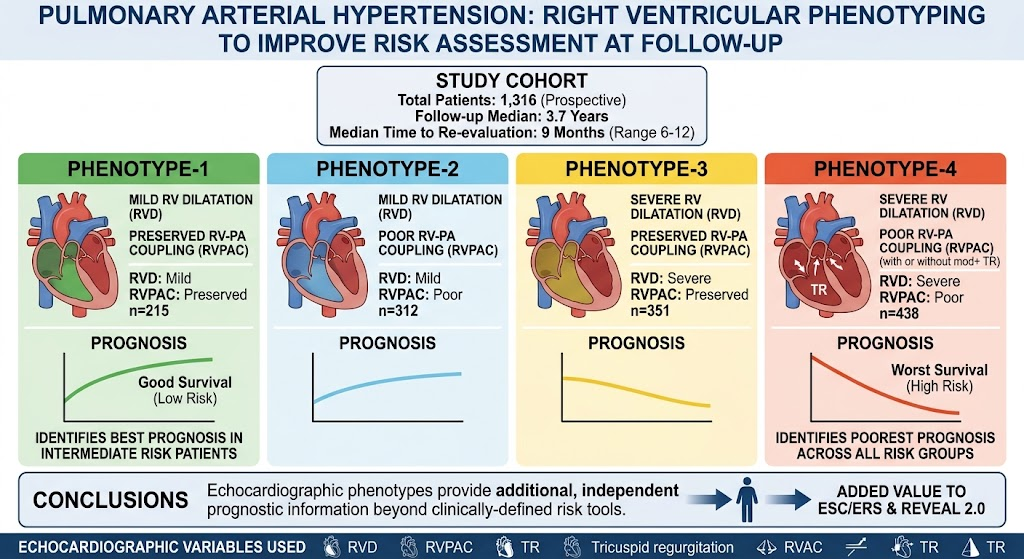
  • Echocardiography-derived right ventricular (RV) phenotypes identify distinct patterns of RV remodeling and dysfunction in pulmonary arterial hypertension (PAH) patients at first follow-up.
  • Four defined RV phenotypes correlate with mortality risk across ESC/ERS and REVEAL 2.0 risk categories, enhancing prognostic discrimination.
  • Severely dilated RV with poor RV-pulmonary arterial coupling (phenotype-4) predicts worse outcomes independently of established risk scores.
  • Mildly dilated RV with preserved coupling (phenotype-1) identifies better survival notably within intermediate risk groups, facilitating more personalized management.

Study Background

MedXY registered readers

Sign in free to continue reading

Create or use your MedXY account to unlock the complete article.

This article was created using several editorial tools, including AI, as part of the process. Human editors reviewed this content before publication.

Related articles

Open language-specific specialty feeds and department pages.

Cardiac Adaptations to Prolonged Spaceflight and Simulated Martian Gravity: Insights from a Longitudinal Observational StudyThis study explores cardiac structural and functional changes over prolonged spaceflight and simulated Martian gravity, revealing transient adaptations that stabilize without lasting detrimental effects, suggesting effective cardiovascularSep 17, 2026Stratifying Risk for Further Retinal Intervention After Laser Retinopexy: The Impact of Cumulative Clinical FactorsA novel, cumulative risk factor approach identifies patients at increased risk for additional retinal intervention after laser retinopexy for retinal tears, improving surveillance and management strategies.Sep 15, 2026β-Cell Dysfunction Enhances Prediction of Type 1 Diabetes Progression in Individuals with Single Autoantibody PositivityAssessment of β-cell dysfunction using stimulated glucose and C-peptide measures improves risk stratification for type 1 diabetes progression among single autoantibody-positive relatives, enabling personalized monitoring and targeted intervSep 15, 2026
Loading comments...
MedXY briefing

Get the free newsletter

Evidence-led clinical news, trends, and analysis—delivered to your inbox.

Ask MedXY AI

Most popular

Intimate Health
Five Benefits for Women Continuing Sexual Activity After Menopause
Intimate Health
Why Some Women Have a Strong Sex Drive—And Why Men Shouldn't Worry About It
Nursing & care
How often should a couple have sex?
Intimate Health
Classic Intimacy Recommendations: How to Help Women Reach Orgasm and Enjoy Mutual Pleasure
Intimate Health
What Makes a Woman "Physiologically Addicted" Is Never Money, But These Two Relationship Qualities
© 2026 MedXY
Contact usAbout usPrivacy PolicyMedXY story
Physiological Left Atrial Staging as a Predictor of New-Onset Atrial Fibrillation in Hypertrophic Cardiomyopathy
A novel left atrial (LA) staging system, integrating hemodynamic load and contractile function, predicts new-onset atrial fibrillation risk in hypertrophic cardiomyopathy and may guide tailored AF surveillance.
Sep 15, 2026
Continuous Glucose Monitoring Using the FreeStyle Libre Pro iQ in Presymptomatic Type 1 Diabetes: Advancements in Early Detection and Risk StratificationThis review examines the role of FreeStyle Libre Pro iQ CGM in differentiating presymptomatic stages of type 1 diabetes and predicting progression to clinical disease, comparing its performance with Dexcom G6 and discussing implications forSep 12, 2026
Early Identification of PVOD/PCH in Pulmonary Arterial Hypertension: Introducing a Novel Clinical Likelihood ScoreA newly developed clinical likelihood score accurately distinguishes pulmonary arterial hypertension patients with venous or capillary involvement (PVOD/PCH), enabling earlier diagnosis, tailored therapy, and timely transplant referral.Sep 11, 2026