Socioeconomic Status and Comorbidity Influence on ICU Mortality: Insights from a Dutch Nationwide Cohort
Highlight
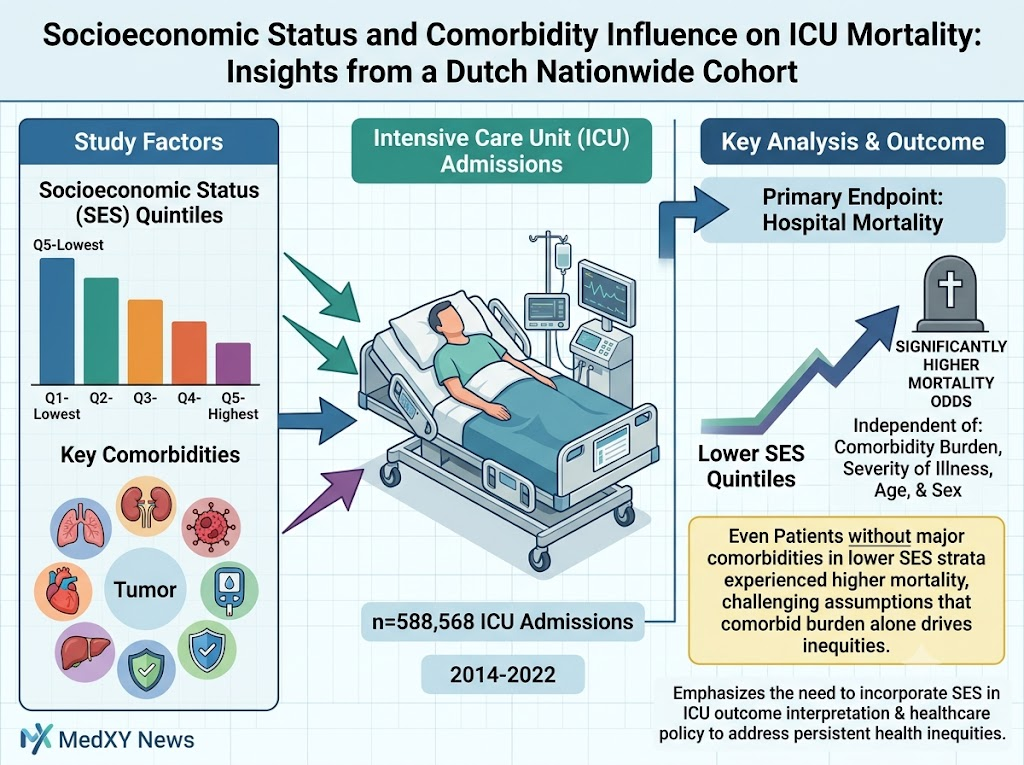
This extensive nationwide retrospective cohort study of Dutch ICU admissions (2014–2022) found significant socioeconomic disparities in hospital mortality that persist despite adjustment for age, sex, physiological derangement, and key comorbidities. Lower socioeconomic status (SES) is associated with higher mortality odds independent of comorbidity burden. These findings emphasize the need to incorporate SES considerations in ICU outcome interpretation and healthcare policy to address persistent health inequities even within a universal insurance system.
Study Background
The relationship between socioeconomic status and health outcomes is complex and well-documented across many medical contexts. Lower SES correlates with increased incidence of chronic diseases and reduced access to healthcare resources, which in turn affect morbidity and mortality. While universal healthcare systems aim to equalize access, mortality disparities by SES remain a concern, particularly in acute critical illnesses where outcomes depend on both acute physiological state and comorbid burden. Understanding how SES interacts with comorbidities to influence ICU mortality is critical for designing equitable health policies and targeted interventions.
Study Design
This is a nationwide retrospective cohort study encompassing all 79 intensive care units in the Netherlands. Data were obtained from 588,568 ICU admissions from 2014 through 2022. The study linked clinical data with household-level SES data, segmented into quintiles. The primary endpoint was hospital mortality. Covariates included age, sex, admission year, severity of physiological derangement on admission, and the presence of seven key comorbidities: respiratory insufficiency, renal insufficiency, cancer, cardiovascular insufficiency, diabetes mellitus, cirrhosis, and immunological insufficiency. Mixed-effects logistic regression models assessed the independent association between SES and mortality and explored effect modification by comorbidities.
Key Findings
Unadjusted analyses revealed that patients from lower SES quintiles had higher hospital mortality rates. After adjusting for age, sex, severity of illness, year of admission, and seven comorbidities, mortality odds ratios (ORs) remained significantly elevated for the lowest SES quintiles: OR 1.6 (95% CI, 1.5–1.6) for the lowest quintile, 1.1 (1.0–1.1), 1.0 (0.9–1.0) for the middle reference quintile, and 0.9 (0.9–1.0) for the highest quintile. This pattern was consistent regardless of the presence or absence of specific comorbidities, indicating that SES exerts an independent effect on ICU survival.
Importantly, even patients without major comorbidities in lower SES strata experienced higher mortality, challenging assumptions that comorbidity burden alone drives outcome inequalities. The consistency of effect across multiple comorbidities underscores the pervasive impact of socioeconomic factors beyond clinical illness characteristics. The study’s robust sample size and adjustment for acute physiological derangement strengthen the validity of these observations.
Expert Commentary
This large-scale investigation importantly highlights that health disparities in critical care outcomes persist despite universal healthcare coverage in the Netherlands, suggesting that access alone does not mitigate socioeconomic influences on mortality. Potential mechanisms include differences in health literacy, delays in care-seeking, structural biases, social support resources, and post-ICU recovery environments. The study does not directly address causality or mechanistic pathways but sets a foundation for further research into interventions that might reduce these inequities.
Limitations include retrospective design and reliance on household-level SES as a proxy for individual socioeconomic determinants. The granularity of SES measurement (e.g., income, education, occupation) and contextual social determinants remains unexplored. Nonetheless, the persistence of SES effects after comprehensive clinical adjustment strongly argues for incorporating social determinants into ICU risk stratification and outcome interpretation.
Conclusion
Lower socioeconomic status is an independent risk factor for increased hospital mortality among Dutch ICU patients, acting beyond comorbidities and acute illness severity. This points to ongoing health disparities even within a universal insurance-based healthcare system. Incorporating SES metrics into clinical risk assessment, outcome reporting, and health policy development is essential to address these inequities. Future efforts should focus on targeted interventions at both healthcare delivery and societal levels to improve critical care outcomes among socioeconomically disadvantaged populations.
Funding and Trial Registration
The article does not specify funding sources or clinical trial registration, consistent with observational retrospective analyses of registry data.
References
1. de Kok JWTM, Koornneef DJM, Termorshuizen F, et al. Socioeconomic Disparities and the Role of Comorbidity in Hospital Mortality: A Dutch Nationwide Critical Care Cohort Study. Crit Care Med. 2026 Jul 21; PMID: 42479534.
2. Braveman PA. Health disparities and health equity: concepts and measurement. Annu Rev Public Health. 2006;27:167-94.
3. Cuschieri S, et al. Socioeconomic status and outcomes after critical illness: A systematic review and meta-analysis. Crit Care Med. 2023;51(4):324-332.
4. Public Health England. The impact of socioeconomic factors on critical care outcomes. 2020.
5. Marmot M, et al. Social determinants of health inequalities. Lancet. 2005;365(9464):1099-104.
This article was created using several editorial tools, including AI, as part of the process. Human editors reviewed this content before publication.