Pooled Analysis of SELECT, FLOW, and SOUL Links Semaglutide to Reduced Kidney Outcomes
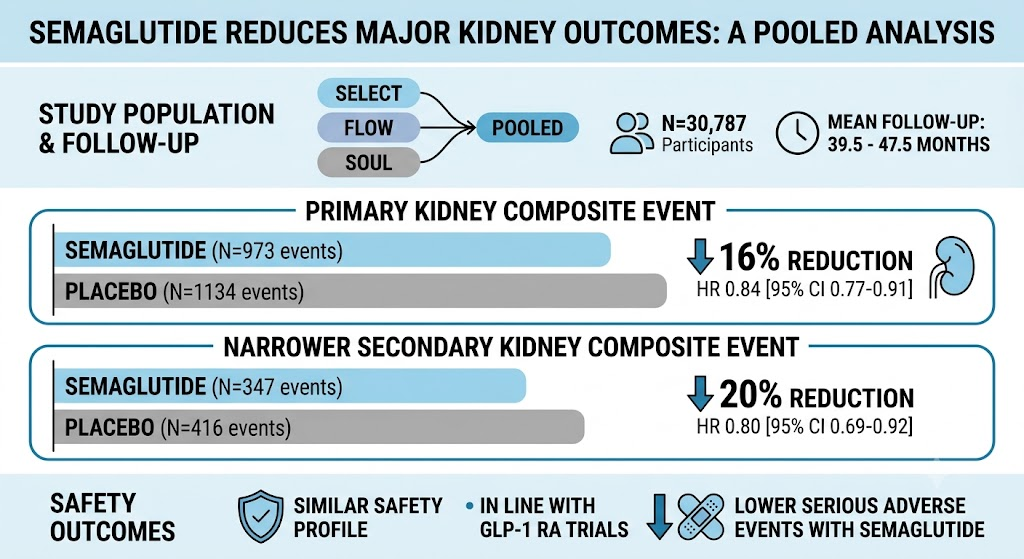
In a prespecified participant-level pooled analysis of the SELECT, FLOW, and SOUL trials, semaglutide reduced the primary kidney composite by 16% versus placebo (HR 0.84; 95% CI 0.77-0.91).
The narrower kidney composite, which excluded cardiovascular death, was reduced by 20% (HR 0.80; 95% CI 0.69-0.92).
Safety was consistent with the established GLP-1 receptor agonist profile, and serious adverse events were numerically less frequent with semaglutide than placebo.
Background
Chronic kidney disease, type 2 diabetes, and atherosclerotic cardiovascular disease frequently overlap, and their shared biology is increasingly described under the umbrella of cardio-kidney-metabolic disease. The glucagon-like peptide-1 (GLP-1) receptor agonist semaglutide has already been shown to reduce clinically important kidney outcomes in people with type 2 diabetes and chronic kidney disease. Less certain, however, is whether the same kidney benefit is seen across a broader spectrum of cardio-kidney-metabolic disease, including people without diabetes and those whose primary diagnosis is atherosclerotic cardiovascular disease.
To address this question, investigators conducted a prespecified participant-level pooled analysis of three large randomized placebo-controlled phase 3 trials: SELECT, FLOW, and SOUL. The pooled analysis was designed to provide a more precise estimate of semaglutide's effect on major kidney outcomes across these diverse but related populations. The results were published in The Lancet Diabetes & Endocrinology with a PubMed record dated 7 August 2026.
Study snapshot
Design
Prespecified participant-level pooled analysis of three randomized, placebo-controlled phase 3 trials.
Population
30,787 adults with chronic kidney disease (FLOW) or atherosclerotic cardiovascular disease (SELECT and SOUL), with and without diabetes.
Intervention
Semaglutide versus placebo added to standard of care; semaglutide was given as once-weekly subcutaneous 1.0 mg in FLOW, once-weekly subcutaneous 2.4 mg in SELECT, or once-daily oral 14 mg in SOUL.
Primary outcome
Time to first occurrence of a kidney composite: persistent eGFR decline of at least 50%, kidney failure (persistent eGFR <15 mL/min per 1.73 m2 or initiation of kidney replacement therapy), kidney-related death, or cardiovascular-related death.
Follow-up
Mean follow-up ranged from 39.5 to 47.5 months across trials.
Main result
Primary kidney composite events occurred in 973 participants assigned to semaglutide versus 1134 assigned to placebo (HR 0.84; 95% CI 0.77-0.91).
Secondary kidney result
A narrower kidney composite excluding cardiovascular death occurred in 347 versus 416 participants (HR 0.80; 95% CI 0.69-0.92).
Safety
Overall safety was similar between groups and consistent with the GLP-1 receptor agonist class; serious adverse events were numerically lower with semaglutide.
Funding
Novo Nordisk.
Why These Trials Were Pooled
SELECT, FLOW, and SOUL were designed as separate trials, but each tested semaglutide in a population with elevated cardiorenal risk. FLOW focused on people with chronic kidney disease. SELECT and SOUL enrolled people with atherosclerotic cardiovascular disease. The three trials also used semaglutide in different ways: FLOW used once-weekly subcutaneous 1.0 mg, SELECT used once-weekly subcutaneous 2.4 mg, and SOUL used once-daily oral 14 mg.
Trial | Population focus | Semaglutide regimen |
|---|---|---|
FLOW | Chronic kidney disease | 1.0 mg once weekly subcutaneous |
SELECT | Atherosclerotic cardiovascular disease | 2.4 mg once weekly subcutaneous |
SOUL | Atherosclerotic cardiovascular disease | 14 mg once daily oral |
By combining individual participant data rather than summary estimates, the authors were able to examine a common kidney composite across the three protocols. The pooled population includes people with and without diabetes, which broadens the clinical relevance beyond traditional type 2 diabetes kidney outcome trials.
What the Composite Captures
The primary outcome was a time-to-first-event composite defined as onset of a persistent 50% or greater reduction in estimated glomerular filtration rate (eGFR), kidney failure, kidney-related death, or cardiovascular-related death. Kidney failure was defined as persistent eGFR below 15 mL/min per 1.73 m2 or initiation of kidney replacement therapy.
Because the composite includes cardiovascular-related death, the primary result is not purely kidney-specific. The authors also reported a narrower secondary kidney composite that excluded cardiovascular-related death, providing a more direct look at kidney-related events.
Key Findings
Primary kidney composite
Among the 30,787 pooled participants, first events of the primary kidney composite occurred in 973 participants assigned to semaglutide and 1134 participants assigned to placebo. This corresponds to a hazard ratio of 0.84 (95% CI 0.77-0.91), a 16% relative reduction in the rate of the primary composite over the study period.
A hazard ratio of 0.84 means that, on a relative scale, semaglutide was associated with a 16% lower rate of first primary composite events during follow-up. The absolute benefit is not directly visible from the relative estimate and would depend on each patient's underlying event risk, which is not reported in the abstract-level source.
Narrower kidney composite
When cardiovascular-related death was removed from the endpoint, the kidney-specific signal remained. First events of the narrower kidney composite occurred in 347 semaglutide-treated participants versus 416 placebo-treated participants, yielding a hazard ratio of 0.80 (95% CI 0.69-0.92). This 20% relative reduction supports the interpretation that the benefit is not driven solely by cardiovascular death.
Safety
Safety outcomes were overall similar between the semaglutide and placebo groups, and the profile was described as consistent with other GLP-1 receptor agonist trials. Serious adverse events were numerically lower with semaglutide than with placebo, although the abstract does not provide formal statistical testing for this comparison.
Expert Commentary
This pooled analysis adds weight to the idea that GLP-1 receptor agonists have kidney-protective effects beyond their established glucose-lowering and weight-related actions. The authors state that the benefit of semaglutide “might not be explained only by its glycaemic effects, weight-management effects, or both.” That interpretation is biologically plausible, but the pooled analysis was not designed to establish mechanism.
Clinicians should read the primary result as a relative risk reduction in a broad composite endpoint. The inclusion of cardiovascular death in the primary outcome means that part of the observed benefit may reflect cardiovascular protection. The narrower kidney composite, which excluded cardiovascular death, is therefore an important secondary result and appeared consistent with a kidney-specific benefit.
The pooled design has clear strengths. Combining participant-level data from three large randomized trials improves statistical power and allows a single harmonized outcome definition. The main limitations are the differences among the trials, including baseline cardiovascular and kidney risk, diabetes status, semaglutide dose, route of administration, and background standard-of-care therapies.
Limitations
Pooling does not create a single randomized comparison across all participants; each person remained within the original trial and its protocol.
The three trials differed in inclusion criteria, semaglutide dose, route of administration, and follow-up duration.
The primary composite included cardiovascular death, so the result is not a pure kidney-specific effect.
The abstract-level source does not provide separate event counts by trial, eGFR slope data, albuminuria data, or absolute event rates.
The analysis was funded by the manufacturer of semaglutide.
Unanswered questions
The pooled analysis does not directly answer whether semaglutide's kidney benefit is independent of glucose lowering, weight loss, blood pressure changes, or other metabolic effects. Future analyses could examine treatment effects across CKD stages, albuminuria categories, diabetes status, and semaglutide formulation. The relative contribution of the kidney-specific components versus cardiovascular death also warrants further reporting.
Clinical Implications
For clinicians managing cardio-kidney-metabolic disease, this analysis supports the view that semaglutide may reduce major kidney outcomes across a broader population than has traditionally been considered for kidney-protective GLP-1 receptor agonist therapy. The benefit was observed in addition to standard of care and across populations with CKD or atherosclerotic cardiovascular disease, with and without diabetes.
Decisions about starting semaglutide should still be guided by licensed indications, tolerability, access, cost, and patient preferences. The pooled analysis contributes evidence of benefit but does not by itself define every patient who should receive semaglutide for kidney protection. Clinicians should also continue to follow established standards for CKD care, including blood pressure control, glycemic management, renin-angiotensin system inhibition where indicated, and other evidence-based therapies.
Conclusion
This prespecified participant-level pooled analysis of SELECT, FLOW, and SOUL provides evidence that semaglutide reduces major kidney outcomes in a broad cardio-kidney-metabolic population. The primary composite was reduced by 16%, the narrower kidney composite was reduced by 20%, and the safety profile was generally consistent with the GLP-1 receptor agonist class. The next important steps will be to clarify mechanism, report absolute benefits across risk groups, and understand how these kidney effects integrate with other organ-protective strategies.
References
Mann JFE, Badve SV, Baeres FMM, et al. Effect of semaglutide on kidney outcomes in the SELECT, FLOW, and SOUL trials: a prespecified pooled analysis. The Lancet Diabetes & Endocrinology. 2026 Aug 7. PMID: 42567173. https://pubmed.ncbi.nlm.nih.gov/42567173/
This article was created using several editorial tools, including AI, as part of the process. Human editors reviewed this content before publication.