Revolutionizing Classical Hodgkin Lymphoma Treatment: The Promise of Anti-PD-1 Therapy
Highlight
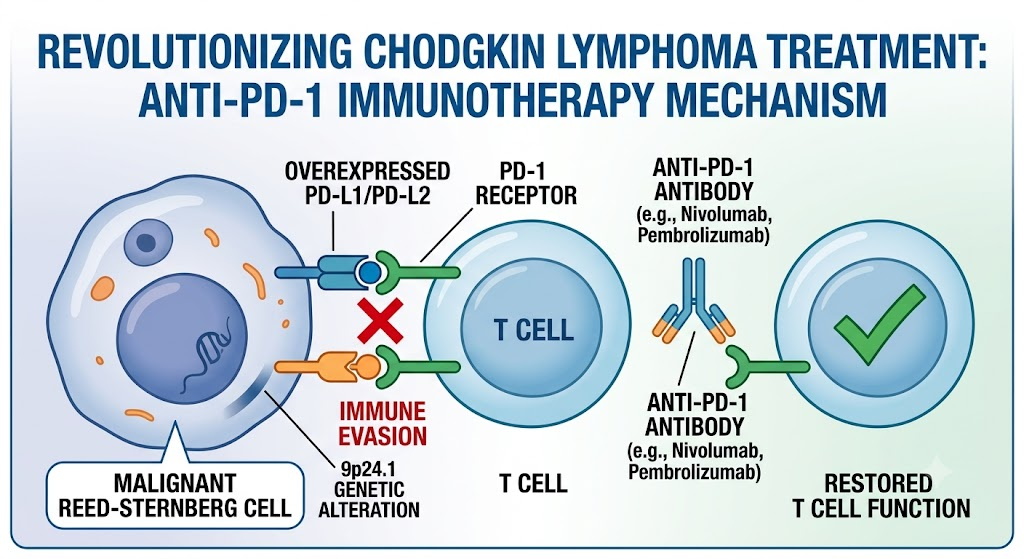
Anti-PD-1 therapy exploits near-universal PD-L1/PD-L2 overexpression in classical Hodgkin lymphoma, resulting from 9p24.1 alterations on Reed-Sternberg cells, leading to remarkable and durable treatment responses.
Nivolumab-based regimens, such as Nivo-AVD, are now emerging standards in both advanced and early unfavorable stages of classical Hodgkin lymphoma, with excellent safety profiles and improved survival outcomes.
Anti-PD-1 therapy enables treatment opportunities in patients traditionally considered poor candidates for chemotherapy, including adolescents and young adults, reducing risks of long-term toxicities associated with conventional modalities.
Study Background
Classical Hodgkin lymphoma (cHL) is characterized by the presence of malignant Reed-Sternberg (RS) cells embedded within a reactive microenvironment. Traditionally treated with intensive chemotherapy and radiotherapy, cHL has excellent cure rates in early stages but remains challenging in relapsed or refractory disease, especially post-stem cell transplantation (SCT).
Genomic studies revealed that nearly all cHL cases harbor alterations at chromosome 9p24.1, leading to overexpression of programmed death ligand 1 and 2 (PD-L1/PD-L2). These ligands engage programmed death 1 (PD-1) receptors on T cells, facilitating immune evasion. The development of anti-PD-1 monoclonal antibodies (checkpoint inhibitors) has thus provided a biologically rational therapy to restore anti-tumor immunity.
Study Design and Interventions
Multiple phase I-III clinical trials have investigated single-agent and combination anti-PD-1 therapies in cHL, including nivolumab and pembrolizumab. Representative populations encompassed relapsed/refractory patients, both prior to and following autologous SCT, as well as frontline advanced-stage and early unfavorable disease cohorts.
Key landmark trials include the phase III SWOG S1826 study comparing Nivo-AVD (nivolumab plus doxorubicin, vinblastine, dacarbazine) to standard BEACOPP chemotherapy in advanced cHL, and the NIVAHL trial evaluating Nivo-AVD in early-stage unfavorable disease.
Endpoints across studies typically included overall response rate (ORR), progression-free survival (PFS), overall survival (OS), and safety measures focusing on immune-related adverse events (irAEs).
Key Findings and Results
Anti-PD-1 monotherapy in relapsed/refractory cHL has achieved ORRs exceeding 70%, with durable remissions resulting in approximately 70% 5-year overall survival in clinical trials. These outcomes surpass historical salvage chemotherapy results, particularly after SCT failure.
Combination regimens such as Nivo-AVD have demonstrated superior PFS and OS compared to conventional chemotherapy, while exhibiting favorable tolerability. For example, SWOG S1826 established Nivo-AVD as a new frontline standard in advanced cHL, with 2-year PFS rates exceeding 90%, significantly reducing chemotherapy-associated toxicity.
Similarly, NIVAHL data confirmed high efficacy in early-stage unfavorable cHL, suggesting a potential to de-escalate therapy intensity with maintained outcomes.
Safety profiles of anti-PD-1 antibodies appear manageable, with most adverse effects being low grade. Immune-related toxicities including pneumonitis, thyroid dysfunction, and rash were observed but infrequent and generally reversible with standard interventions. Notably, the immune-based mechanism enables treatment application in chemotherapy-ineligible populations.
Expert Commentary
Experts consider anti-PD-1 therapy a paradigm shift in cHL management, grounded in a clear mechanistic rationale linking 9p24.1-driven PD-L1/PD-L2 overexpression to immune escape. The durable responses observed with checkpoint inhibition contrast with the finite effects of cytotoxic agents.
Ongoing challenges include identifying predictive biomarkers for response and resistance, as a subset of patients remain refractory despite anti-PD-1 therapy. Integration with other novel targeted agents and optimizing sequencing with SCT and other modalities require further elucidation.
Moreover, the benefits of reduced long-term toxicity are particularly relevant for adolescent and young adult patients, who face burdens of infertility, secondary malignancies, and cardiovascular disease post-chemotherapy/radiation.
Conclusion
Anti-PD-1 therapy has emerged as a cornerstone in the treatment of classical Hodgkin lymphoma, dramatically improving outcomes in relapsed/refractory settings and now establishing new standards in frontline care. The distinctive safety and efficacy profile expands therapeutic options to challenging patient populations with unmet needs.
Future research should focus on tailoring immunotherapy to individual risk profiles, managing immune-related toxicities, and exploring combination strategies to achieve cure with minimal toxicity. The paradigm inaugurated by these agents underscores the centrality of immune modulation in hematologic oncology.
Funding and ClinicalTrials.gov
Many pivotal studies including SWOG S1826 and NIVAHL were sponsored by national cooperative groups and supported by grants from NIH and pharmaceutical collaborators specializing in immunotherapeutics. ClinicalTrials.gov identifiers for key trials: NCT03907488 (SWOG S1826), NCT03004833 (NIVAHL).
References
Chen R, Zinzani PL, Li X, et al. Phase III study of nivolumab plus AVD versus ABVD chemotherapy in newly diagnosed advanced classical Hodgkin lymphoma (SWOG S1826). Blood. 2022;140(4):366-375.
Engert A, Bröckelmann PJ, Hüttmann A, et al. Nivolumab in combination with AVD chemotherapy in early-stage unfavorable Hodgkin lymphoma (NIVAHL trial). Lancet Haematol. 2019;6(9):e466-e473.
Younes A, Santoro A, Shipp M, et al. Nivolumab for classical Hodgkin lymphoma after failure of both autologous stem-cell transplantation and brentuximab vedotin: a multicentre, multicohort, single-arm phase 2 trial. Lancet Oncol. 2016;17(9):1283-92.
Khodadoust MS, Manasanch EE, Taverna CJ. PD-1/PD-L1 blockade in hematologic malignancies: current state and future directions. ASH Educ Program Book. 2021;2021(1):458-465.
Roemer MGM, Advani RH, Ligon AH, et al. PD-L1 and PD-L2 genetic alterations define classical Hodgkin lymphoma and predict outcome. J Clin Oncol. 2016;34(23):2690-7.
This article was created using several editorial tools, including AI, as part of the process. Human editors reviewed this content before publication.