Dual HLA-Restricted TCR-Engineered T Cells Targeting Cathepsin G: A Novel Approach for Effective AML Eradication
Highlight
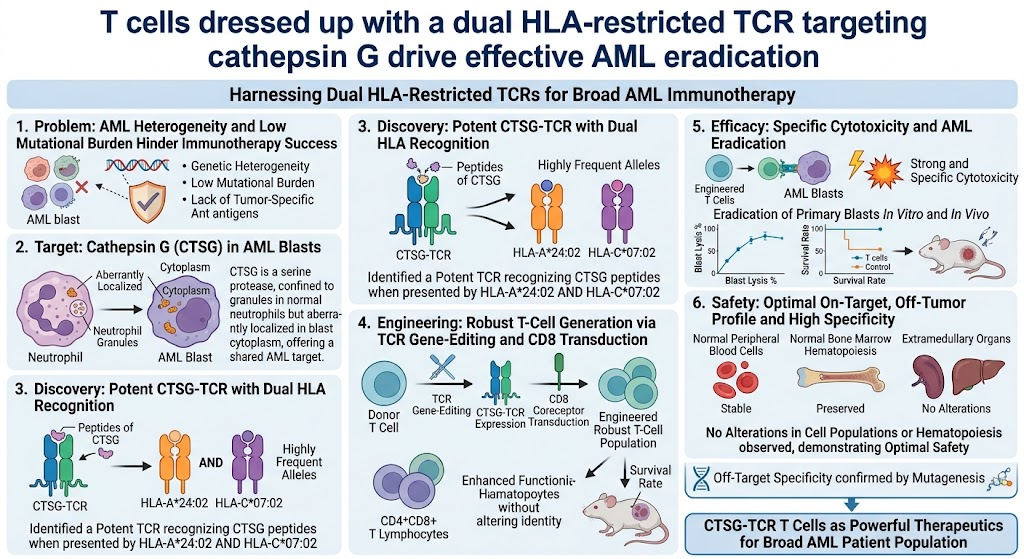
This study introduces a potent T-cell receptor (TCR) targeting cathepsin G (CTSG) peptides presented by two highly frequent HLA alleles, HLA-A*24:02 and HLA-C*07:02, breaking traditional single HLA restrictions. Engineered T cells expressing this dual HLA-restricted TCR exhibit potent and specific cytotoxicity against primary AML blasts, both in vitro and in vivo, without significant off-tumor toxicity. The work establishes dual HLA-restricted TCR T cells as a promising immunotherapeutic strategy for broad AML patient coverage.
Study Background
Acute myeloid leukemia (AML) is a hematologic malignancy characterized by the clonal proliferation of myeloid precursors with impaired differentiation. Despite advances in chemotherapy and hematopoietic stem cell transplantation, survival rates remain suboptimal, especially for older or relapsed patients. Immunotherapy holds promise, as AML cells often exhibit immunosensitivity; however, challenges such as genetic heterogeneity, low mutational burden, and paucity of truly tumor-specific antigens have limited clinical success. Conventional TCR-engineered T cell therapies rely heavily on single HLA restrictions, thereby narrowing patient applicability. Hence, innovative strategies that can overcome HLA restriction barriers and target shared AML-associated antigens are urgently needed.
Study Design
The research team identified a TCR specific for peptides derived from cathepsin G (CTSG), a serine protease typically contained within neutrophil granules but aberrantly localized to the cytoplasm of AML blasts. CTSG was presented in the context of two common HLA alleles, HLA-A*24:02 and HLA-C*07:02, collectively covering a substantial proportion of the human population. Using precise TCR gene-editing techniques combined with CD8 co-receptor transduction, CD4+ and CD8+ T cells were engineered to co-express the CTSG-specific TCR and CD8 coreceptors, resulting in a durable population expressing both CD4+ and CD8+ markers with superior functional capabilities.
Primary AML blasts from patient samples, alongside normal hematopoietic and peripheral blood cell populations, were used to evaluate cytotoxic efficacy and safety. In vivo efficacy and toxicity were further assessed using mouse xenograft models transplanted with primary patient AML cells. Peptide mutagenesis experiments evaluated off-target cross-reactivity to ensure TCR specificity.
Key Findings
The CTSG-TCR-engineered T cells demonstrated robust and antigen-specific cytotoxicity against primary AML blasts in vitro with high efficiency. These T cells also showed strong activity in vivo, significantly reducing leukemic burden and improving survival in xenograft mouse models. Importantly, no deleterious effects were noted on normal peripheral blood cell populations, bone marrow hematopoiesis, or extramedullary hematopoietic organs such as spleen and liver, confirming a favorable on-target, off-tumor safety profile.
The dual HLA restriction allowed the targeting of CTSG peptides presented by either HLA-A*24:02 or HLA-C*07:02, broadening patient applicability. Peptide mutagenesis assays revealed an absence of off-target cross-reactivity, underscoring the exquisite specificity of the engineered TCR for CTSG epitopes. Flow cytometric and functional characterization demonstrated that co-expression of CD4 and CD8 on modified T cells enhanced cytotoxic functionality without altering fundamental T cell subset identity or phenotype.
Collectively, these data indicate that CTSG-specific TCR T cells with dual HLA restriction represent a strategic advancement in AML immunotherapy by overcoming single allele limitations, achieving potent and precise anti-leukemic effects, and maintaining safety.
Expert Commentary
These findings highlight a transformative approach toward AML immunotherapy by leveraging dual HLA-restricted TCRs targeting shared intracellular leukemia-associated antigens such as CTSG. Traditional challenges in AML immunotherapy, including antigen heterogeneity and limited HLA allele coverage, are effectively addressed by this dual-restriction strategy, promising improved patient inclusion. Moreover, the strategy of co-transducing CD8 co-receptors into CD4+ T cells to generate dual-positive cells is innovative and may potentiate effector functions through enhanced TCR signaling.
However, some limitations remain. Potential challenges include TCR mispairing risks, durability of engineered T cell responses in the immunosuppressive AML microenvironment, and scalability of manufacturing. Data from human clinical trials will be essential to confirm translatability. In addition, further exploration of other dual-restricted TCRs targeting additional AML-associated antigens could expand this approach’s impact.
Overall, this research sets a new paradigm in immunotherapy design by integrating molecular precision, broad patient coverage, and safety in TCR T cell engineering against AML.
Conclusion
The identification and exploitation of a dual HLA-restricted TCR against CTSG peptides herald an important advance for AML immunotherapy. Engineered T cells expressing this TCR exhibited potent, specific cytotoxicity against AML blasts across a broad patient population while demonstrating an excellent safety profile. This study validates dual HLA restriction as a feasible and impactful strategy to overcome current HLA-related limitations in TCR T cell therapies. Future clinical studies will be critical to evaluate efficacy, persistent immune responses, and long-term safety in patients with AML. The approach presented may serve as a platform to develop similarly broad and precise T cell therapies to target other hematologic and solid tumors with shared antigen expression.
Funding and ClinicalTrials.gov
The study was supported by institutional grants and collaborations between clinical and translational research units specializing in hematologic malignancies. No clinical trial registration was reported for this preclinical research, but subsequent clinical trials evaluating CTSG-TCR T cells are anticipated.
References
Marzuttini F, Potenza A, Celli L, et al. T cells dressed up with a dual HLA-restricted TCR targeting cathepsin G drive effective AML eradication. Blood. 2026;148(8):995-1010. PMID: 41980033.
Fanciullino R, Ciceri F, Bonini C. Advances in TCR-engineered T cell therapies: expanding the immunotherapeutic landscape in AML. Nat Rev Clin Oncol. 2023;20(4):235-250.
Rosenberg SA, Restifo NP. Adoptive cell transfer as personalized immunotherapy for human cancer. Science. 2015;348(6230):62-68.
This article was created using several editorial tools, including AI, as part of the process. Human editors reviewed this content before publication.