Mezigdomide Reverses T-Cell Exhaustion Through IKZF1/IKZF3 Degradation and Cytokine Pathway Reinvigoration in Multiple Myeloma
Highlights
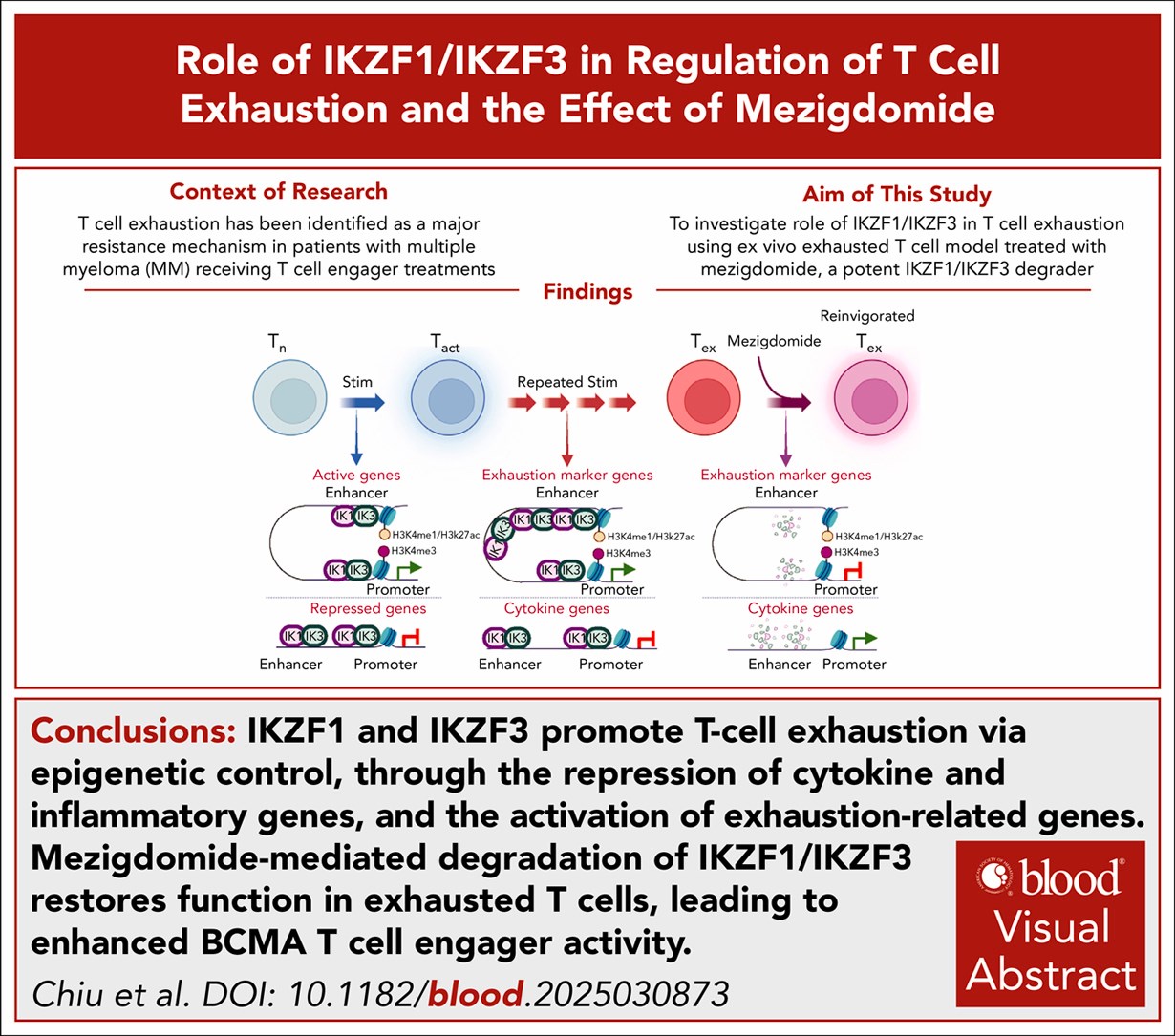
- IKZF1 and IKZF3 transcription factors critically regulate the transcriptional landscape underlying T-cell exhaustion in multiple myeloma.
- Mezigdomide induces proteasomal degradation of IKZF1/IKZF3, reversing exhaustion phenotypes and restoring T-cell effector functions.
- Epigenetic and transcriptomic profiling demonstrates distinct IKZF1/IKZF3 binding patterns at exhaustion and cytokine gene loci modulating T-cell functional states.
- Combination of mezigdomide with the B-cell maturation antigen (BCMA)-targeting T-cell engager alnuctamab enhances anti-myeloma cytotoxicity ex vivo, providing a rationale for combinatorial therapeutic approaches.
Background
Multiple myeloma (MM) remains an incurable plasma cell malignancy characterized by immunosuppressive microenvironments and therapeutic resistance. Immunotherapeutic agents such as T-cell engagers (TCEs) have shown promise but are limited by the development of T-cell exhaustion, a state of dysfunctional T-cell activation marked by sustained expression of inhibitory receptors and impaired cytokine production. T-cell exhaustion significantly hinders the efficacy of TCEs and contributes to relapse in MM patients. Thus, strategies to restore T-cell functionality are urgently needed.
IKZF1 and IKZF3 are zinc-finger transcription factors known to regulate lymphoid development and immune cell function. Recent evidence implicates these factors in the transcriptional programs sustaining T-cell exhaustion, making them attractive targets to modulate T-cell states therapeutically. Mezigdomide (CC-92480) is a next-generation cereblon E3 ligase modulator that simultaneously targets IKZF1 and IKZF3 for proteasomal degradation and has demonstrated immunomodulatory effects in MM clinical trials.
Key Content
Mechanistic Insights into IKZF1/IKZF3 in T-cell Exhaustion
Transcriptomic and epigenetic analyses on ex vivo-generated exhausted T cells (Tex) compared with autologous activated T cells revealed that IKZF1 and IKZF3 directly bind to multiple genomic regulatory regions—including promoters and both proximal and distal enhancers—controlling exhaustion-associated genes and cytokine loci. Notably, chronic T-cell stimulation led to increased IKZF1 binding at exhaustion signature genes, resulting in their transcriptional upregulation, while IKZF1 binding at key proinflammatory cytokine gene promoters correlated with transcriptional repression. These findings position IKZF1 and IKZF3 as dual regulators, promoting exhaustion gene expression while dampening cytokine production pathways.
Therapeutic Reversal of T-cell Exhaustion via Mezigdomide
Mezigdomide treatment of exhausted T cells rapidly induces degradation of IKZF1 and IKZF3 proteins. This effect translates to decreased expression of exhaustion markers such as PD-1, TIM-3, and LAG-3 and a concomitant increase in proinflammatory cytokines including IFN-γ, TNF-α, and IL-2. Functionally, mezigdomide-treated Tex demonstrate enhanced cytotoxic activity against MM target cells when combined with alnuctamab, a bispecific antibody targeting BCMA and CD3 on T cells. This synergy supports the mechanistic model where IKZF1/IKZF3 degradation relieves transcriptional repression of cytokine pathways and downregulates exhaustion programs, reinvigorating T-cell effector functions critical for immune-mediated tumor clearance.
Clinical Translation and Implications
While previous immunomodulatory drugs (IMiDs) like lenalidomide and pomalidomide target IKZF1/IKZF3, mezigdomide’s superior specificity and potency represent a next-generation approach to modulate T-cell exhaustion directly. Early-phase clinical trials in relapsed/refractory MM show promising T-cell immune activation and tolerability, suggesting that combining mezigdomide with TCE therapies such as alnuctamab could overcome resistance and improve patient outcomes.
Expert Commentary
The study by Chiu et al. elucidates a previously underappreciated transcriptional regulatory axis by which IKZF1 and IKZF3 sustain T-cell exhaustion, providing compelling rationale for therapeutic targeting. The integrated multi-omics approach confers high confidence in the mechanistic interpretation and highlights the importance of epigenetic context in exhaustion biology. Clinically, the demonstration of mezigdomide’s ability to reinvigorate cytokine production and bolster bispecific T-cell engager efficacy is highly encouraging.
Notwithstanding these advances, challenges remain in translating these findings to durable clinical benefits. Potential risks include off-target immune activation and systemic inflammation. The heterogeneity of exhaustion states across MM patients and longitudinal dynamics of IKZF degradation warrant further exploration. Moreover, the optimal timing and combination regimens with TCEs and other immunotherapies remain to be defined in large controlled trials.
Conclusion
Targeting IKZF1/IKZF3 transcription factors with mezigdomide emerges as a powerful strategy to reverse T-cell exhaustion, reinvigorate cytokine-mediated immunity, and augment the efficacy of T-cell engager therapies in multiple myeloma. This paradigm underscores the critical intersection of transcriptional regulation and immunotherapy resistance, heralding a new direction for integrated immune modulation approaches. Future research should focus on validating these findings in clinical contexts, optimizing combinatorial regimens, and monitoring long-term immunologic and clinical outcomes.
References
- Chiu H, Zhao J, Basavanhally T, et al. Mezigdomide reverses T-cell exhaustion through degradation of IKZF1/IKZF3 and reinvigoration of cytokine production pathways. Blood. 2026;148(9):1115-1128. PMID: 42118707.
- Gandhi AK, Kang J, Havens CG, et al. Immunomodulatory agents lenalidomide and pomalidomide co-stimulate T cells by inducing degradation of T cell repressors IKZF1 and IKZF3. Nat Med. 2014;20(11):1410-1416. PMID: 25383904.
- Blank CU, Haining WN, Held W, et al. Defining ‘T cell exhaustion’. Nat Rev Immunol. 2019;19(11):665-674. PMID: 31427796.
- Samur M, Fulciniti M, Aktas Samur AA, et al. Mechanisms of immune evasion in multiple myeloma. Nat Rev Clin Oncol. 2022;19(11):675-691. PMID: 35646373.
This article was created using several editorial tools, including AI, as part of the process. Human editors reviewed this content before publication.