Low-Normal Hemoglobin Concentrations and Clinical Outcomes in Heart Failure: Rethinking WHO Anemia Thresholds
Highlights
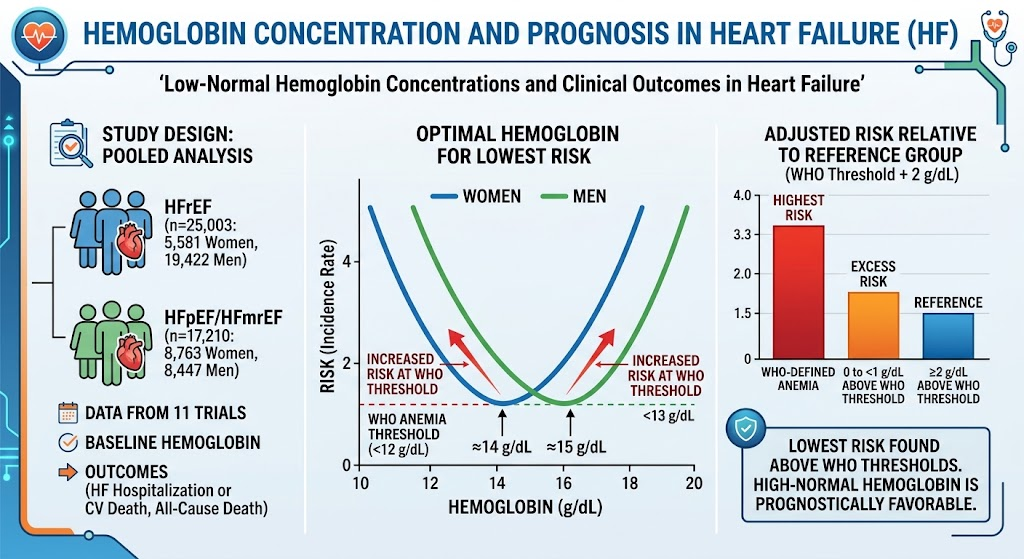
- Hemoglobin levels associated with the lowest risk in heart failure (HF) are approximately 14 g/dL in women and 15 g/dL in men, exceeding WHO anemia thresholds.
- WHO anemia definitions (<12 g/dL in women, <13 g/dL in men) may underestimate the risk associated with low-normal hemoglobin concentrations in HF patients.
- Iron deficiency, even at hemoglobin levels above anemia thresholds, remains a crucial modifiable risk factor influencing HF outcomes.
- Intravenous iron therapies demonstrate favorable effects on hospitalization and quality of life, underscoring the clinical importance of nuanced hemoglobin and iron management in HF.
Background
Heart failure (HF) remains a leading cause of morbidity and mortality worldwide, with complex multifactorial pathophysiology and diverse clinical phenotypes including heart failure with reduced ejection fraction (HFrEF), preserved ejection fraction (HFpEF), and mildly reduced ejection fraction (HFmrEF). Anemia—defined by the World Health Organization (WHO) as hemoglobin (Hb) <12 g/dL in women and <13 g/dL in men—is a common comorbidity in HF and associated with worsened prognosis. However, these anemia thresholds derive primarily from population-based distributions rather than outcome-driven analyses in diseased cohorts. The clinical relevance of low-normal Hb levels above these cutoffs and their relationship to adverse outcomes in HF remain unclear. Given anemia is often a surrogate marker for iron deficiency and other modifiable conditions, precisely characterizing the risk continuum of Hb concentrations is pivotal for optimal clinical management.
Key Content
Hemoglobin Concentrations and Clinical Outcomes in Heart Failure
A landmark individual patient-level meta-analysis conducted by Chimura et al. (J Am Coll Cardiol, 2026) pooled data from 6 HFrEF and 5 HFpEF/HFmrEF randomized controlled trials, encompassing 25,003 HFrEF and 17,210 HFpEF/HFmrEF patients. Using sophisticated Cox proportional hazards models and Poisson regression with restricted cubic splines, sex-specific Hb-risk relationships for primary outcomes (first HF hospitalization or cardiovascular death, components thereof, and all-cause mortality) were delineated.
Across HF phenotypes, the lowest event rates clustered around Hb concentrations ~14 g/dL in women and ~15 g/dL in men — notably above WHO anemia cutoffs. Patients with Hb levels defined as anemic by WHO thresholds had the highest risk, but importantly, excess risk was also evident at Hb levels just above the anemia definition (0 to <1 g/dL above thresholds), challenging the adequacy of current anemia classifications in HF.
This continuous risk association underscores that low-normal Hb values convey clinically relevant prognostic information and may warrant assessment for reversible underlying causes such as iron deficiency, chronic inflammation, or renal impairment.
Anemia, Iron Deficiency, and Prognosis in HF Phenotypes
Subsequent systematic reviews and meta-analyses (Cureus, 2026; BMC Cardiovasc Disord, 2026) corroborate that anemia and iron deficiency are prevalent in both HFrEF and HFpEF, with profound implications on morbidity and mortality. Anemia frequently coexists with comorbidities including chronic kidney disease and diabetes and reflects the severity and systemic burden of HF.
Evidence suggests that iron deficiency, independent of anemia, adversely affects functional capacity and hospitalization risk, likely through impaired myocardial energetics and systemic effects.
Therapeutic Interventions: Iron Supplementation and Transfusion Strategies
Meta-analyses of randomized controlled trials demonstrate that intravenous iron therapy, primarily ferric carboxymaltose, improves exercise capacity, health-related quality of life, and reduces HF hospitalizations (Clin Drug Investig, 2024; J Evid Based Med, 2025). These benefits are more pronounced in patients with iron deficiency and transferrin saturation <20%. However, effects on mortality remain inconclusive.
Comparative effectiveness analyses reveal intravenous iron is preferable to oral iron supplementation regarding functional improvement and reduction in HF hospitalizations (Cureus, 2025). Safety profiles are acceptable, with no increased serious adverse events.
Conversely, red blood cell transfusion strategies in anemia and cardiovascular disease contexts yield mixed results. Liberal transfusion thresholds may reduce myocardial infarction risk but increase complications such as acute lung injury; restrictive approaches are associated with increased mortality in some meta-analyses (Front Cardiovasc Med, 2025; NEJM Evid, 2025). These findings emphasize cautious individualized consideration, balancing benefits and risks.
Risk Stratification and Prognostic Modeling in HF
Multifactorial prognostic algorithms incorporating anemia, NT-proBNP, comorbidities, and infections have been developed (J Clin Med Res, 2026). Anemia remains an independent predictor of adverse events alongside other clinical parameters. Hemoglobin values, therefore, play a vital role within composite risk assessments guiding therapy.
Expert Commentary
The emerging paradigm challenges the conventional WHO anemia thresholds’ sufficiency in predicting adverse clinical outcomes in HF patients. Hemoglobin concentrations above classical anemia cutoffs, particularly in the low-normal range, carry meaningful prognostic information and may indicate unmet clinical needs such as iron deficiency or occult comorbidity burdens.
From a pathophysiological standpoint, hemoglobin is a critical determinant of oxygen delivery; thus, even modest decreases within the normal range can exacerbate myocardial and systemic hypoxia, fueling HF progression. Furthermore, iron deficiency impairs mitochondrial function and energetic metabolism regardless of anemia presence.
Current HF guidelines endorse screening and management of iron deficiency, particularly with intravenous iron for symptomatic HFrEF patients. Emerging evidence suggests that a more nuanced hemoglobin evaluation, integrating sex-specific thresholds and clinical context, may optimize identification of patients benefiting from iron repletion or other interventions.
Nevertheless, key uncertainties persist including optimal Hb targets, timing and modality of iron therapy, and the role of transfusions. Evidence gaps in HFpEF populations remain. Larger, pragmatic trials with long-term follow-up are imperative.
The integration of detailed hemoglobin monitoring into risk models and personalized HF management approaches aligns with precision medicine objectives. Clinicians should interpret hemoglobin values not only as binary anemia definitions but within a continuum considering sex, HF phenotype, and comorbid conditions.
Conclusion
Recent high-quality evidence definitively reveals that in heart failure, the hemoglobin concentrations associated with the lowest risk of adverse outcomes are higher than current WHO anemia thresholds, approximately 14 g/dL for women and 15 g/dL for men. Low-normal hemoglobin levels are prognostically significant and should prompt clinical evaluation for iron deficiency and other reversible causes.
Intravenous iron therapy has validated benefits in improving functional status and reducing HF hospitalization, though mortality benefits remain uncertain. Careful, individualized assessment of hemoglobin and iron status should be incorporated into comprehensive HF care across phenotypes.
Future research directions include refining sex- and phenotype-specific hemoglobin targets, exploring iron repletion timing, and expanding evidence in HFpEF. Bridging mechanistic insights with clinical investigations will enhance translational and therapeutic advances.
References
- Chimura M et al. Low-Normal Hemoglobin Concentrations and Clinical Outcomes in Heart Failure. J Am Coll Cardiol. 2026 Aug 28;PMID: 42663359.
- Pellicori P et al. Anemia and Prognosis in Heart Failure With Preserved Ejection Fraction: A Systematic Review and Meta-Analysis. Cureus. 2026 May 6;PMID: 42255840.
- Tanaka S et al. Intravenous iron therapy for patients with heart failure: a meta-analysis stratified by chronic kidney disease status. BMC Cardiovasc Disord. 2026 Mar 27;PMID: 41896739.
- Clarissa C et al. Comparative Effectiveness and Safety of Intravenous Versus Oral Iron Therapy With Iron-Deficient Heart Failure: A Network Meta-Analysis. Cureus. 2025 Sep 11;PMID: 41080322.
- Navarrete M et al. Intravenous Iron in Heart Failure Patients With Iron Deficiency: A Meta-Analysis of Randomized Controlled Trials. J Evid Based Med. 2025 Sep;PMID: 40810693.
- Canadian Drug Agency. Reimbursement Recommendation for Ferric Carboxymaltose (Ferinject) in Heart Failure Patients. 2024. PMID: 40674517.
- Zhao Y et al. Liberal versus restrictive red blood cell transfusion strategy in acute coronary syndrome and anemia: A systematic review. Front Cardiovasc Med. 2025 Apr;PMID: 40342977.
This article was created using several editorial tools, including AI, as part of the process. Human editors reviewed this content before publication.