We use cookies

Our website uses essential cookies and, with your consent, additional cookies to measure performance and improve our services. Cookie Policy.

You can change your choice at any time.

MMedXYNews
HomeVideos
MedXY AI/MedXY News/Section: Diabetes & Endocrinology

Reevaluating the Link Between Helicobacter pylori Infection and Insulin Resistance: Insights from Frequentist and Bayesian Analyses in a European Cohort
MedXY Editorial Team•Aug 25, 2026•Diabetes & Endocrinology
metabolic syndromeHelicobacter pyloriphân tích Bayesianinsulin resistance

Highlight

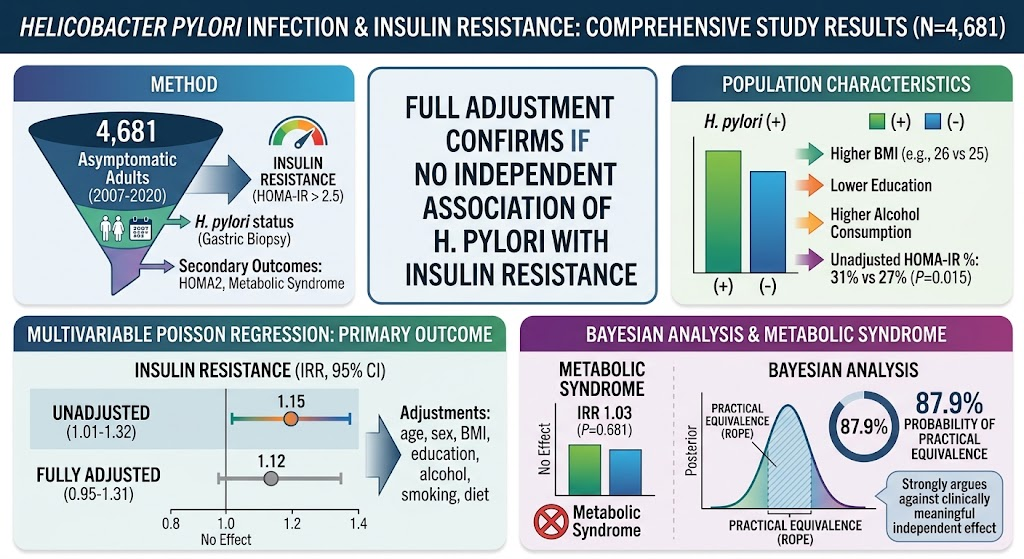
This large-scale European screening study investigates the relationship between Helicobacter pylori infection and insulin resistance, employing both traditional frequentist methods and Bayesian analyses.

Initial crude associations suggesting increased insulin resistance among H. pylori-positive individuals were fully explained by adjusting for socioeconomic and lifestyle confounders such as education, BMI, alcohol use, smoking, and diet.

MedXY registered readers

Sign in free to continue reading

Create or use your MedXY account to unlock the complete article.

This article was created using several editorial tools, including AI, as part of the process. Human editors reviewed this content before publication.

Related articles

Open language-specific specialty feeds and department pages.

Long-Term Cardiometabolic Risks of Gestational Diabetes Mellitus Subtypes: Insights from a 10-14 Year Prospective StudyThis study reveals that distinct gestational diabetes mellitus (GDM) subtypes confer increased risks of prediabetes, diabetes, metabolic syndrome, and cardiovascular disease 10-14 years postpartum, underscoring the need for tailored long-teAug 18, 2026Metabolic Dysfunction Following Initiation of Androgen Receptor Pathway Inhibitors in Prostate Cancer: Clinical Implications and RisksThis study reveals a significant early onset of metabolic syndrome in men with prostate cancer treated with combined ADT and ARPI therapies, highlighting the necessity for multidisciplinary metabolic monitoring and interventions.Aug 15, 2026Unveiling Heart Failure Risks in Newly Diagnosed Diabetes: The Critical Role of Insulin Resistance and Renal FunctionThis study reveals a high heart failure risk within 5 years of diabetes diagnosis, highlighting insulin resistance and reduced kidney function as independent predictors beyond conventional risk factors.Aug 13, 2026
Loading comments...
MedXY briefing

Get the free newsletter

Evidence-led clinical news, trends, and analysis—delivered to your inbox.

Ask MedXY AI

Most popular

Intimate Health
Five Benefits for Women Continuing Sexual Activity After Menopause
Intimate Health
Why Some Women Have a Strong Sex Drive—And Why Men Shouldn't Worry About It
Nursing & care
How often should a couple have sex?
Intimate Health
Classic Intimacy Recommendations: How to Help Women Reach Orgasm and Enjoy Mutual Pleasure
Intimate Health
What Makes a Woman "Physiologically Addicted" Is Never Money, But These Two Relationship Qualities
© 2026 MedXY
Contact usAbout usPrivacy PolicyMedXY story
Elevated Endogenous Insulin and Insulin Resistance in Progressive Diastolic Dysfunction and Cardiovascular Risk: A Comprehensive Clinical Review
Elevated endogenous insulin and insulin resistance independently predict progression of diastolic dysfunction and increased cardiovascular mortality, highlighting early metabolic dysregulation as a target to prevent heart failure with prese
Aug 11, 2026
Helicobacter pylori Infection and Colorectal Cancer: Genetic Risk Links and Treatment Outcomes from Two Long-Term Randomized TrialsTwo large randomized trials reveal that Helicobacter pylori infection elevates colorectal cancer risk, particularly in individuals with specific bacterial virulence factors or high genetic susceptibility, and that eradication treatment may Jul 1, 2026
Adolescent MASLD Plus PCOS Signals a Higher-Risk Cardiometabolic Trajectory Into AdulthoodIn the Raine Study, adolescents with both MASLD and PCOS had a substantially worse cardiometabolic profile by age 27 than peers with either condition alone, highlighting a high-risk subgroup that may warrant earlier metabolic surveillance.May 28, 2026