Reevaluating Age as a Prognostic Marker in Molecularly Defined Lower-Grade Gliomas
Highlight
- Older age (≥40 years) is associated with poorer progression-free survival in IDH-wildtype lower-grade gliomas but not in IDH-mutant cases.
- IDH-wildtype gliomas in older patients exhibit more aggressive molecular features such as TERT promoter mutations and EGFR amplification.
- Age alone should not dictate the use of adjuvant chemoradiotherapy in lower-grade gliomas in the absence of other molecular or clinical risk factors.
- Current clinical guidelines require revision to incorporate molecular markers alongside age for therapy decision-making.
Study Background
Lower-grade gliomas (LGGs), comprising grade 2 and 3 oligodendrogliomas and astrocytomas, exhibit heterogeneous behaviors with variable prognosis. Historically, age ≥ 40 years has been recognized as a high-risk clinical feature guiding therapeutic strategy, especially the addition of adjuvant chemoradiotherapy. However, the growing understanding of glioma molecular biology—particularly the presence or absence of isocitrate dehydrogenase mutations (IDH1/2)—has redefined prognostic subgroups. This paradigm shift warrants re-evaluation of the relevance of age as a prognostic factor in the molecular era, to optimize treatment personalization and avoid overtreatment or undertreatment.
Study Design
The study leveraged the Prospective Gliomas Research (PROGRES) database, encompassing individual patient-level data from 11 prospective clinical trials and observational registries of histologically defined WHO grade 2 and 3 lower-grade gliomas. Patients were stratified by age groups (18–39 years versus ≥40 years) and by IDH1/2 mutation status to examine the impact of age on progression-free survival (PFS). Analytical methods included log-rank tests and Cox regression models to evaluate associations. The findings were validated using the Retrospective Glioma Research (REGRES) database, a multi-institutional retrospective cohort.
Key Findings
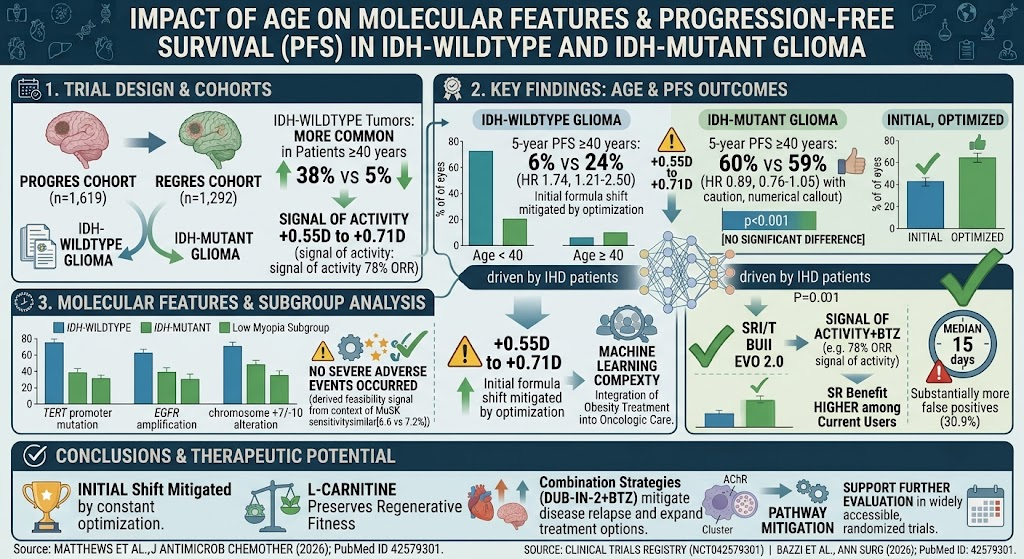
A total of 1,619 patients in PROGRES and 1,292 in REGRES were analyzed. IDH-wildtype tumors were significantly more prevalent among patients aged ≥40 years (38%) compared to younger patients (5%), with an odds ratio of 11.3 (95% CI, 6.5 to 19.7), highlighting a marked molecular distinction in older populations.
In patients with IDH-wildtype LGGs, those ≥40 years exhibited significantly worse progression-free survival at 5 years compared to those aged 18–39 years (6% vs. 24%; hazard ratio [HR] 1.74, 95% CI 1.21 to 2.50). In contrast, IDH-mutant patients displayed no significant age-related difference in PFS (60% vs. 59%; HR 0.89, 95% CI 0.76 to 1.05). The interaction effect between age and IDH status was statistically significant (P interaction < .001), underscoring molecular subtype as a key modifier of age’s prognostic impact.
Molecular profiling revealed that older patients with IDH-wildtype tumors harbored more aggressive molecular alterations, including TERT promoter mutations (65% vs. 28%), EGFR amplification (41% vs. 15%), and chromosome +7/-10 alterations (57% vs. 25%). These features correlate with known poor prognosis and more aggressive tumor biology.
Analysis of pooled data from four clinical trials demonstrated that age was not predictive of differential benefit from adding chemotherapy to radiotherapy in IDH-mutant gliomas, suggesting that age alone should not drive adjuvant treatment choices in this subgroup.
Expert Commentary
This study challenges conventionally held assumptions in glioma management that use age ≥40 years as an automatic high-risk clinical indicator warranting adjuvant chemoradiotherapy. The integration of molecular diagnostics into routine practice has transformed prognostic stratification, particularly the distinction between IDH-mutant and IDH-wildtype lower-grade gliomas.
The findings align with broader research emphasizing the prognostic supremacy of molecular markers over traditional clinical variables. Importantly, older age is tightly linked to IDH-wildtype status and unfavorable molecular signatures, which likely explains its historic association with poor outcomes. This nuance was previously unappreciated when molecular data was lacking.
Limitations include retrospective validation and incomplete data on other emerging biomarkers, which may further refine risk assessment. Additional studies are needed to validate how integrating molecular and clinical factors can tailor treatment intensities and improve patient quality of life.
Conclusion
The prognostic significance of age in lower-grade gliomas is critically dependent on IDH mutation status. Older age confers poor prognosis only in the context of IDH-wildtype tumors that harbor aggressive molecular alterations. In IDH-mutant gliomas, age does not independently predict progression risk nor chemosensitivity.
Therefore, clinical guidelines should be updated to incorporate molecular classification as central to risk stratification. Age alone should not be used to guide adjuvant therapy decisions without considering molecular and other clinical risk factors. This more nuanced approach promises to optimize therapeutic outcomes while minimizing unnecessary treatment exposure in lower-grade glioma patients.
Funding and ClinicalTrials.gov
Funding details were not specified in the abstract. Readers are encouraged to consult the original publication for disclosures.
References
1. Kinslow CJ, Minniti G, Brown PD, et al. Prognostic and Predictive Effect of Age in Molecularly Defined Lower-Grade Gliomas. J Clin Oncol. 2026; doi:10.1200/JCO-25-01846. PMID:42585601.
2. Louis DN, Perry A, Wesseling P, et al. The 2021 WHO Classification of Tumors of the Central Nervous System: a summary. Neuro Oncol. 2021;23(8):1231-1251.
3. Weller M, van den Bent M, Preusser M, et al. EANO guidelines on the diagnosis and treatment of diffuse gliomas of adulthood. Nat Rev Clin Oncol. 2021;18(3):170-186.
This article was created using several editorial tools, including AI, as part of the process. Human editors reviewed this content before publication.