Reassessing Diagnostic Tools for Peripheral Arterial Disease in Diabetes: Insights from the DMPAD Study
Highlight
Peripheral arterial disease (PAD) diagnosis in diabetic patients using traditional bedside tests shows considerably low sensitivity.
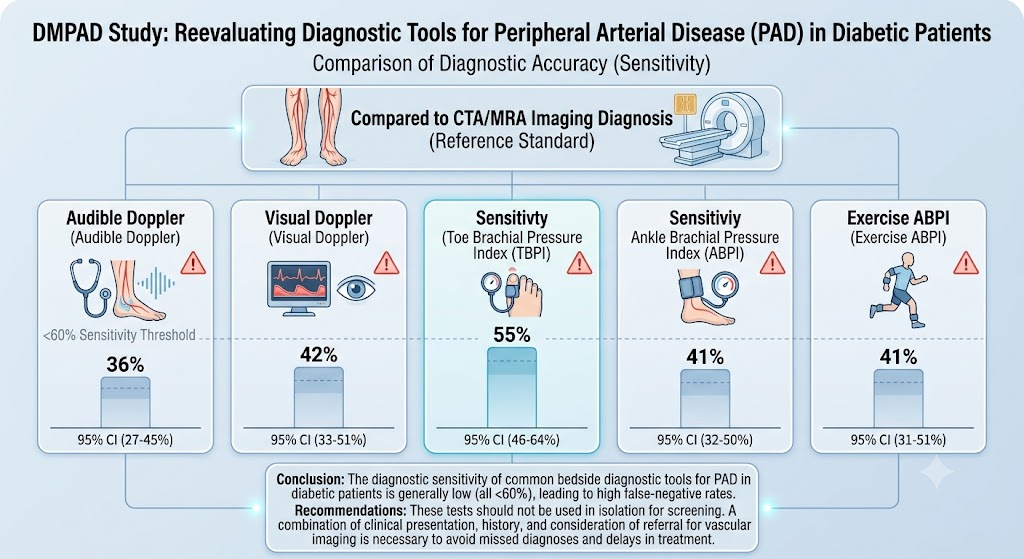
Five commonly used diagnostic tools—ABPI, exercise ABPI, TBPI, visual Doppler, and audible Doppler—demonstrate inadequate accuracy compared to CTA or MRA imaging.
Findings underscore the need for improved diagnostic strategies for PAD in diabetic populations to guide timely interventions.
Study Background
Peripheral arterial disease (PAD) constitutes a significant vascular complication in individuals with diabetes, often resulting in increased risk of limb ischemia, non-healing ulcers, and amputation. Early and accurate diagnosis of PAD is paramount to guiding effective clinical management and reducing adverse outcomes. However, the pervasive presence of medial arterial calcification and neuropathy in diabetes complicates clinical assessment and challenges the reliability of standard non-invasive diagnostic tools such as the ankle brachial pressure index (ABPI). Despite their widespread use, the diagnostic accuracy of these bedside tests in the diabetic population remains under scrutiny, necessitating robust evaluation against advanced imaging modalities like computed tomography angiography (CTA) and magnetic resonance angiography (MRA). The Diagnostic Tools to Establish the Presence of Peripheral Arterial Disease in People With Diabetes (DMPAD) study was designed to address this critical knowledge gap through a rigorous multicenter comparative diagnostic accuracy study in the UK.
Study Design
This prospective multicenter study enrolled 604 adult participants (age ≥18 years) with a documented diagnosis of diabetes, recruited from primary and secondary care across 16 UK sites between April 2022 and November 2023. Both symptomatic and asymptomatic individuals were included to reflect real-world clinical settings. Exclusion criteria encompassed contraindications to CTA or MRA, internationally recognized standards for non-invasive vascular imaging. The reference standard for PAD diagnosis was defined as ≥50% stenosis on CTA or MRA using the ANGIO scoring system, interpreted independently by blinded radiologists.
Index tests assessed were five bedside diagnostic tools widely employed in clinical practice:
Ankle Brachial Pressure Index (ABPI)
Exercise ABPI
Toe Brachial Pressure Index (TBPI)
Visual Doppler waveform assessment
Audible Doppler signals evaluation
The primary outcome was the sensitivity of each index test for detecting PAD, reflecting their ability to correctly identify patients with disease confirmed by imaging.
Key Findings
Among 536 participants completing the study with valid imaging results, PAD prevalence was 37%. Sensitivity analyses revealed suboptimal performance of all five bedside diagnostic tests:
Audible Doppler: 36% (95% CI, 27–45%)
Visual Doppler: 42% (95% CI, 33–51%)
Toe Brachial Pressure Index: 55% (95% CI, 46–64%)
Ankle Brachial Pressure Index: 41% (95% CI, 32–50%)
Exercise ABPI: 41% (95% CI, 31–51%)
These results highlight a pronounced deficiency in the diagnostic sensitivity of common bedside measures in diabetic populations at risk for PAD. Notably, none of the tests achieved sensitivity exceeding 60%, suggesting a high proportion of false-negative results when used in isolation.
The study did not report on specificity or other performance metrics such as positive predictive value or likelihood ratios in the abstract; however, the low sensitivity alone critically limits clinical utility for PAD screening or diagnosis.
Expert Commentary
The DMPAD study’s rigorous methodology and multicenter approach provide highly credible evidence underscoring a pervasive challenge in managing PAD in diabetes: reliable bedside diagnosis. Medial arterial calcification often leads to falsely elevated ABPI values, contributing to the poor sensitivity observed. TBPI, which measures toe pressures less influenced by calcification, demonstrated relatively higher sensitivity but still insufficient for dependable screening.
These findings align with prior smaller-scale studies and guideline observations cautioning the interpretation of ABPI in diabetic patients. Currently, clinical practice often relies on a combination of history, physical examination, and non-invasive tests to infer PAD presence, with definitive imaging reserved for advanced cases. The DMPAD study advocates a re-examination of this paradigm, suggesting that reliance on traditional bedside tests alone may delay diagnosis and treatment.
Limitations of the study include lack of detailed analysis of specificity and other diagnostic parameters, as well as potential variability in test execution across centers. Nonetheless, the standardized imaging reference and blinded radiologist assessment robustly support the validity of findings.
Conclusion
The DMPAD study decisively demonstrates that common bedside diagnostic tools, including ABPI, exercise ABPI, TBPI, and Doppler assessments, have poor sensitivity for detecting PAD in people with diabetes. This underlines a critical gap in current diagnostic strategies and calls for the integration of advanced vascular imaging or development of novel point-of-care techniques with enhanced accuracy. Clinicians should exercise caution interpreting bedside PAD tests in diabetic patients, recognizing their limitations to avoid underdiagnosis and consequent delayed treatment. Future research should explore alternative biomarkers, imaging modalities, or composite diagnostic algorithms tailored to this high-risk group to improve care outcomes.
Funding and Clinical Trials Registration
The study was supported by multiple institutional grants, as detailed in the original publication. Trial registration and funding specifics are available in the full article (PMID: 42525838).
References
1. Normahani P, Burgess L, Graham C, et al. Diagnostic Tools to Establish the Presence of Peripheral Arterial Disease in People With Diabetes (DMPAD): A Multicenter Comparative Diagnostic Accuracy Study. Diabetes Care. 2026 Jul 29. PMID: 42525838.
2. American Diabetes Association. Peripheral Arterial Disease in People With Diabetes. Diabetes Care. 2020;43(Suppl 1):S115-S124.
3. Aboyans V, et al. Measurement and Interpretation of the Ankle-Brachial Index: A Scientific Statement From the American Heart Association. Circulation. 2012;126(24):2890-2909.
This article was created using several editorial tools, including AI, as part of the process. Human editors reviewed this content before publication.