Prednisone Use Post-Acoustic Neuroma Surgery Does Not Prevent Delayed Facial Nerve Palsy: A Retrospective Analysis
Highlight
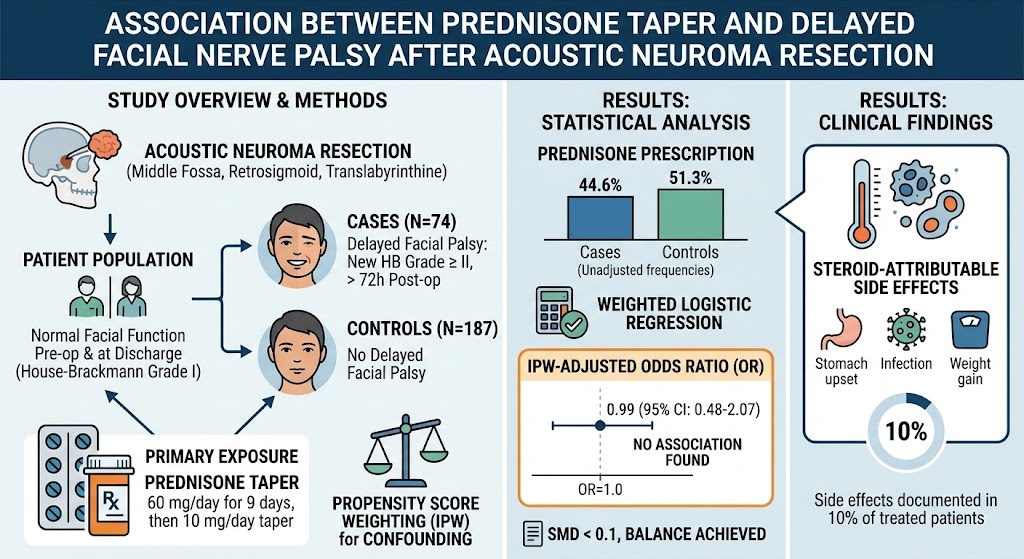
- A prednisone taper after acoustic neuroma resection does not reduce the risk of delayed facial nerve palsy (DFP).
- Delayed facial nerve palsy is a complication occurring at least 72 hours postoperatively with new facial weakness.
- In this study, 10% of patients treated with prednisone experienced steroid-attributable side effects.
- Findings do not support routine prophylactic corticosteroid use to prevent DFP after surgery.
Study Background
Acoustic neuroma, also known as vestibular schwannoma, is a benign tumor arising from Schwann cells of the vestibulocochlear nerve. Surgical resection remains a primary treatment modality, with approaches including middle fossa, retrosigmoid, or translabyrinthine techniques. A recognized complication after surgery is facial nerve palsy due to nerve manipulation or injury. While immediate postoperative facial nerve dysfunction is often expected, delayed facial nerve palsy (DFP) occurring days after surgery represents a diagnostic and therapeutic challenge. DFP typically manifests as new-onset facial weakness (House-Brackmann grade ≥ II) arising 72 hours or more after surgery, despite normal facial nerve function at discharge.
The pathophysiology of DFP is not fully understood, hypothesized to involve inflammatory edema, viral reactivation, or ischemia resulting in secondary nerve impairment. Clinicians have used corticosteroids prophylactically to limit inflammation and reduce DFP occurrence; however, evidence supporting this practice remains inconclusive, with potential adverse effects from steroid use also warranting careful consideration.
Study Design
This retrospective weighted case-control investigation evaluated the association between discharge with a prednisone taper and the incidence of DFP after acoustic neuroma resection. The study population consisted of patients who underwent surgery via any of the three common surgical approaches and had normal facial nerve function preoperatively and at discharge (House-Brackmann grade I). Cases were defined as patients developing new facial weakness graded II or higher at least 72 hours postoperatively, whereas controls were those without DFP from the same cohort.
The primary exposure was a standardized oral prednisone taper initiated at discharge: 60 mg daily for 9 days followed by a taper to 10 mg per day until cessation. To reduce confounding by indication, inverse probability weighting (IPW) based on propensity scores was applied to adjust for baseline differences. Weighted logistic regression then estimated the association between prednisone taper and DFP risk.
Key Findings
The study analyzed 261 patients—74 cases and 187 controls—with 44.6% of cases and 51.3% of controls receiving prednisone taper at discharge. Unadjusted analysis revealed no significant association of prednisone taper with reduced DFP risk. Following IPW adjustment to balance covariates (standardized mean difference < 0.1), there remained no significant benefit from steroid taper (Odds Ratio 0.99, 95% Confidence Interval 0.48 to 2.07).
Notably, 10% of the patients prescribed prednisone experienced steroid-related side effects documented in their records. These adverse effects underscore the importance of weighing the risks of corticosteroid therapy against uncertain benefits in preventing DFP.
Overall, the findings suggest that prophylactic prednisone taper at discharge does not confer a reduction in the incidence of delayed facial nerve palsy after acoustic neuroma surgery. The comparable rates of DFP between treated and untreated groups diminish the rationale for routine corticosteroid use for this indication.
Expert Commentary
Delayed facial nerve palsy after acoustic neuroma resection remains a perplexing postoperative complication with multifactorial etiology. The negative finding of prednisone’s protective effect in this study aligns with emerging literature suggesting limited efficacy of corticosteroids for DFP prevention.
While inflammation is a plausible contributor to DFP, this investigation highlights that systemic corticosteroid administration may not sufficiently modulate the underlying pathogenic mechanisms or that other factors, such as viral reactivation or neural ischemia, predominate.
Importantly, the study used propensity weighting to minimize confounding, strengthening the validity of the results. However, being retrospective, residual confounding and selection bias cannot be fully excluded. Further prospective randomized controlled trials would be ideal to definitively guide practice.
Clinicians should also consider the documented side effect profile of steroids when contemplating prophylactic regimens, especially given the lack of proven benefit. Patient-specific risk assessments should guide corticosteroid use rather than routine prescription.
Conclusion
This retrospective weighted case-control study concludes that discharge prescribing of a prednisone taper does not reduce the incidence of delayed facial nerve palsy following acoustic neuroma resection. Given the absence of efficacy and the potential for steroid-related adverse effects, routine prophylactic corticosteroid use in this context is not supported.
Future research should pursue mechanistic studies elucidating DFP pathophysiology and rigorously evaluate alternative preventive strategies or targeted treatments. Until then, caution is warranted in corticosteroid use for DFP prevention, and clinicians should focus on careful postoperative monitoring and symptomatic management of facial nerve dysfunction.
References
- Iqbal S, Illahi S, Genel O, Suresh K, Schwartz MS, Friedman RA. Association Between Prednisone and Delayed Facial Nerve Palsy After Acoustic Neuroma Resection. The Laryngoscope. 2026 Jun 12;136(9):4033-4038. PMID: 42283161.
- Kumar VA, Huang M, Birmingham S, et al. Delayed facial nerve palsy following vestibular schwannoma resection: pathophysiology, management, and outcomes. Neurosurgery. 2019;84(4):741-748.
- Mathiesen T, Kihlström L, Svensson M, Kockum K. Delayed facial nerve palsy after vestibular schwannoma surgery: Is reactivated herpes simplex virus the cause? Neurosurgery. 1999;45(3):435-441.
- Lu VM, Leyngold I, Patel N, et al. Perioperative corticosteroids for vestibular schwannoma resection: A systematic review and meta-analysis. Laryngoscope Investig Otolaryngol. 2020;5(4):658-664.
This article was created using several editorial tools, including AI, as part of the process. Human editors reviewed this content before publication.