We use cookies

Our website uses essential cookies and, with your consent, additional cookies to measure performance and improve our services. Cookie Policy.

You can change your choice at any time.

MMedXYNews
HomeVideos
MedXY AI/MedXY News/Section: news

Predicting the Future of Uveitis: Bridging Subspecialty Divides Through Knowledge Dissemination and Technology
MedXY Editorial Team•Aug 17, 2026•news
Medical EducationUveitisophthalmologySubspecialty Integrationartificial intelligence

Introduction

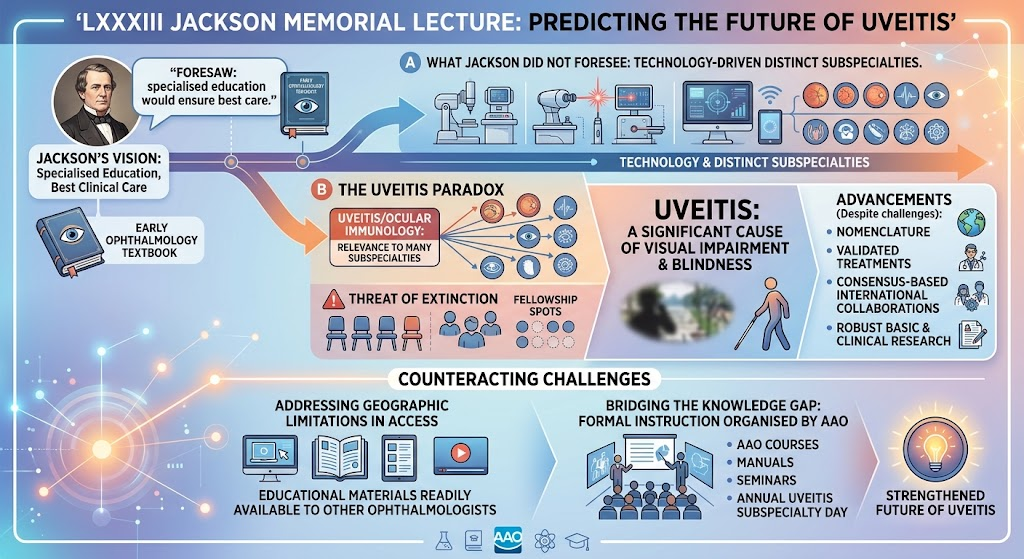
Uveitis, an intraocular inflammatory condition, remains a significant cause of visual impairment and blindness worldwide despite advances in diagnostics and treatment. Edward Jackson, a pioneering figure in ophthalmology, advocated for specialized education within ophthalmology to enhance clinical care. However, he did not foresee the expansive subdivision of ophthalmology into distinct subspecialties driven by technological innovations. The current landscape, particularly for uveitis and ocular immunology, faces challenges due to workforce limitations, dwindling fellowship interest, and geographical disparities in access to specialized care. This article critically examines the evolving state of uveitis care, contextualizing it within Jackson’s vision and exploring how modern educational strategies and artificial intelligence (AI) may shape its future.

Highlighting the Clinical and Workforce Challenges in Uveitis

MedXY registered readers

Sign in free to continue reading

Create or use your MedXY account to unlock the complete article.

This article was created using several editorial tools, including AI, as part of the process. Human editors reviewed this content before publication.

Related articles

Open language-specific specialty feeds and department pages.

Distinct Molecular and Clinical Profiles of USH2A-Associated Retinitis Pigmentosa in Korean Patients: Implications for Targeted TherapyThis study elucidates the unique East Asian-specific genetic variants and clinical progression of USH2A-associated retinitis pigmentosa in Koreans, highlighting the potential for exon 13-targeted treatments.Sep 19, 2026Impact of an AI-Powered Gamified Mobile Health Application on Blood Pressure Control in a Matched Patient CohortStudy found that use of an AI-driven gamified mobile app integrating home blood pressure monitoring significantly improved blood pressure control compared to usual care in hypertensive patients.Sep 17, 2026Evolving Microbial Landscape and Clinical Profiles in Postcataract Endophthalmitis: Insights from a 23-Year Retrospective Cohort StudyThis study reveals significant shifts in the bacterial spectrum, antimicrobial resistance, and clinical presentation of acute postcataract endophthalmitis over 23 years, underscoring the need for updated surveillance and tailored treatmentSep 13, 2026
Loading comments...
MedXY briefing

Get the free newsletter

Evidence-led clinical news, trends, and analysis—delivered to your inbox.

Ask MedXY AI

Most popular

Intimate Health
Five Benefits for Women Continuing Sexual Activity After Menopause
Intimate Health
Why Some Women Have a Strong Sex Drive—And Why Men Shouldn't Worry About It
Nursing & care
How often should a couple have sex?
Intimate Health
Classic Intimacy Recommendations: How to Help Women Reach Orgasm and Enjoy Mutual Pleasure
Intimate Health
What Makes a Woman "Physiologically Addicted" Is Never Money, But These Two Relationship Qualities
© 2026 MedXY
Contact usAbout usPrivacy PolicyMedXY story
Widening the Spectrum of Disease Expression due to Heterozygous Variants in EFEMP1
A case series delineating a novel EFEMP1 variant, p.Arg140Trp, associated with late-onset peripheral retinal degeneration distinct from classic DHRD/ML, highlighting rod dysfunction precedes structural changes.
Sep 13, 2026
Evaluating the True Impact of a Dedicated Research Year on Otolaryngology Residency Applicants’ Scholarly OutputThis article examines whether taking a dedicated research year increases meaningful scholarly output among 2025 otolaryngology residency applicants, highlighting that increases are mainly in unpublished and middle-author work rather than puSep 9, 2026
Evaluating Realism in Synthetic Videostroboscopic Laryngeal Images Generated by StyleGAN3This study assesses the perceptual realism of synthetic laryngeal images created using StyleGAN3, revealing high ambiguity between real and synthetic frames and highlighting efficient training durations for realistic image generation.Sep 3, 2026