Introduction
Ulcerative colitis (UC) is a chronic inflammatory bowel disease characterized by inflammation of the colon’s inner lining, leading to symptoms such as diarrhea, abdominal pain, and rectal bleeding. Effective management of UC is crucial to improve patients’ quality of life and prevent complications. Current targeted therapies often involve monoclonal antibodies against the interleukin-23 (IL-23) pathway, which have shown efficacy in controlling disease activity. However, these biologic agents require administration by intravenous infusion or subcutaneous injection, which may pose challenges related to convenience, patient adherence, and healthcare resource use.
Icotrokinra is a novel oral peptide agent that selectively blocks the IL-23 receptor, aiming to offer a convenient yet effective treatment alternative for patients with moderate to severe active UC.
Methods
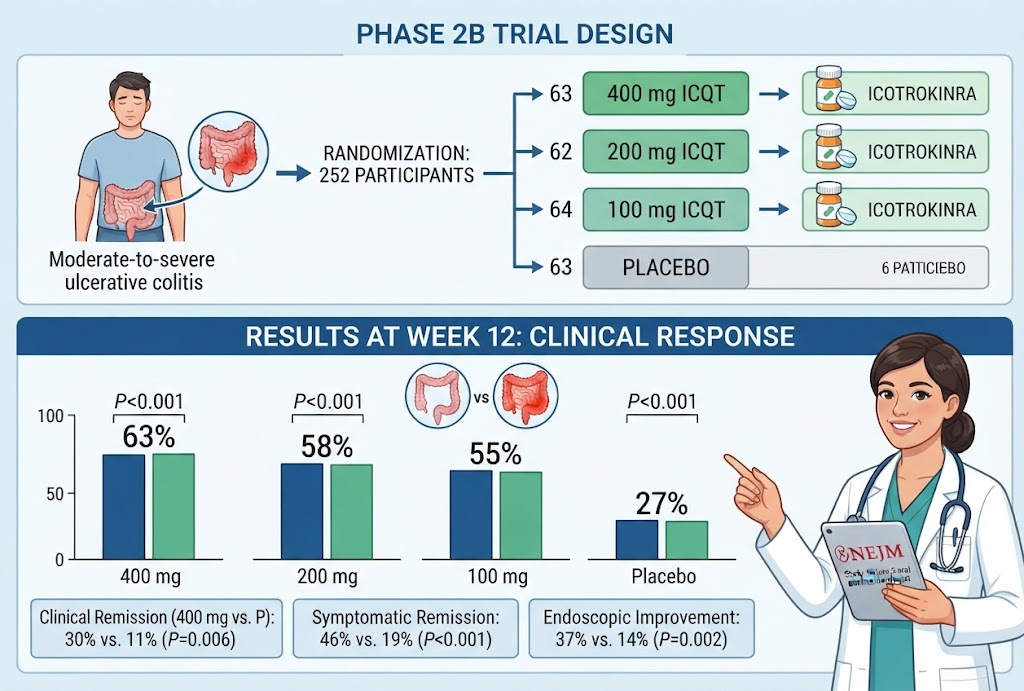
A multicenter, phase 2b, randomized, double-blind, placebo-controlled clinical trial was conducted to evaluate the efficacy and safety of oral icotrokinra in adults diagnosed with moderately to severely active ulcerative colitis. Participants were assigned in a 1:1:1:1 ratio to receive once-daily doses of icotrokinra at 400 mg, 200 mg, or 100 mg, or placebo, over a 12-week induction period.
The primary endpoint was the achievement of clinical response at week 12, defined by a validated composite measure of symptom improvement and endoscopic findings. Secondary endpoints included rates of clinical remission, symptomatic remission, and endoscopic improvement at the same time point.
Results
A total of 252 participants were enrolled and randomized: 63 patients in the 400 mg group, 62 in the 200 mg group, 64 in the 100 mg group, and 63 in the placebo group. Baseline demographics and disease characteristics were balanced across groups.
At 12 weeks, clinical response rates were significantly higher in all icotrokinra groups compared to placebo: 63% in the 400 mg group, 58% in the 200 mg group, and 55% in the 100 mg group versus 27% with placebo (P<0.001 for all comparisons). Clinical remission was also significantly more frequent in the 400 mg group versus placebo (30% vs. 11%, P = 0.006). Symptomatic remission rates were 46% in the 400 mg group compared to 19% in the placebo group (P<0.001), and endoscopic improvement was observed in 37% versus 14% respectively (P = 0.002).
In the 200 mg group, clinical remission at week 12 occurred in 24% of patients; this did not reach statistical significance compared to placebo (P = 0.054) when accounting for multiple comparisons, and further formal testing of secondary endpoints in this group was not performed.
Safety profiles were comparable across all groups through week 28. Adverse events were reported in 60%, 66%, 66%, and 62% of participants in the 400 mg, 200 mg, 100 mg, and placebo groups respectively. Serious adverse events occurred in 2%, 5%, 0%, and 10% of participants respectively, indicating a favorable safety profile for icotrokinra, particularly at the highest dose.
Discussion
This study demonstrates that icotrokinra, an oral IL-23 receptor antagonist, provides a significant clinical benefit in the treatment of moderate to severe ulcerative colitis. The oral administration route addresses an unmet need for more convenient therapies, potentially improving patient compliance and quality of life.
Compared to existing monoclonal antibodies requiring injections or infusions, icotrokinra’s peptide structure and oral availability may offer advantages in outpatient treatment settings. The higher dose (400 mg) showed the most robust efficacy with an acceptable safety profile, although further studies are needed to explore long-term outcomes and maintenance therapy potential.
Limitations include the short induction period, and the need for larger phase 3 trials to confirm these findings and better understand the pharmacodynamics and immunological effects of the drug. Future research should also examine the impact of icotrokinra in diverse patient populations and compare directly with established biologics.
Conclusion
In adults with moderately to severely active ulcerative colitis, oral icotrokinra administered once daily at doses of 400 mg, 200 mg, and 100 mg significantly improved clinical response rates at 12 weeks compared to placebo. The 400 mg dose additionally demonstrated superior rates of clinical remission, symptomatic remission, and endoscopic improvement. The safety profile was favorable, supporting further clinical development of icotrokinra as a novel oral treatment option for UC.
Clinical Implications
The introduction of icotrokinra may represent a meaningful advance in UC management by providing effective, convenient oral therapy targeting a key inflammatory pathway. This could reduce the burden of administration associated with injectable biologics and improve adherence, potentially leading to better disease control and patient outcomes.
Healthcare providers should consider the evolving therapeutic landscape as new oral agents like icotrokinra become clinically available.
Funding and Trial Registration
This study was funded by Johnson & Johnson. The trial is registered at ClinicalTrials.gov under the identifier NCT06049017.
References
Abreu MT, Siegmund B, Surace L, Erondu N, Chen M, Chachu K, Louis E, Matsuoka K, Limdi J, Arthur E, Houck N, Marano C, Vetter ML, Zou B, Zhan J, Frustaci ME, Kannan AK, Rydzewska G, Loftus EV, Jairath V, ANTHEM-UC Study Group. Phase 2 Trial of Icotrokinra for Patients with Ulcerative Colitis. N Engl J Med. 2026 Oct 15;395(15):1495-1504. PMID: 42874103.