Personalized Risk Modeling of Interatrial Shunt Therapy in Heart Failure: Insights from the RELIEVE-HF Trial
Highlight
- The RELIEVE-HF trial demonstrated improved 2-year outcomes with interatrial shunt implantation in HFrEF but worsened outcomes in HFpEF on a group level.
- Distinct baseline clinical, echocardiographic, and hemodynamic predictors influence outcomes after shunt placement in HFrEF versus HFpEF.
- Risk modeling suggests approximately two-thirds of HFrEF patients benefit from shunt implantation, whereas benefit is limited to about one-fifth of HFpEF patients.
- Personalized assessment of patient-specific risk factors may optimize selection for interatrial shunt therapy in heart failure populations.
Study Background
Heart failure (HF) remains a leading cause of morbidity and mortality worldwide, with two major phenotypes: heart failure with reduced ejection fraction (HFrEF) and heart failure with preserved ejection fraction (HFpEF). Despite advances in medical therapy, many patients experience persistent symptoms related to elevated left atrial and pulmonary pressures, contributing to dyspnea and recurrent hospitalizations. Interatrial shunting—creating a controlled left-to-right atrial septal communication—has emerged as a novel interventional approach aimed at decompressing the left atrium to alleviate pulmonary congestion and improve symptoms.
The RELIEVE-HF trial (NCT03499236) is a multicenter, randomized, placebo-controlled study evaluating the effect of interatrial shunt implantation on clinical outcomes in advanced heart failure. Prior analyses revealed a paradoxical divergence in 2-year outcomes: patients with HFrEF showed clinical improvement, while those with HFpEF experienced worsened outcomes. Understanding which patients benefit most from this intervention and identifying independent predictors of response could substantially improve patient selection.
Study Design
The RELIEVE-HF trial enrolled 508 patients stratified by HF phenotype: 206 with HFrEF and 302 with HFpEF. Participants were randomized to undergo transcatheter interatrial shunt implantation or a sham placebo procedure. Baseline assessments included 37 variables spanning clinical history, laboratory biomarkers (e.g., troponin), echocardiographic parameters, and invasive hemodynamics.
The primary composite endpoint encompassed all-cause mortality, cardiac transplantation or left ventricular assist device implantation, heart failure hospitalizations, and outpatient worsening HF events over a 2-year follow-up. The Lin-Wei-Yang-Ying statistical method modeled recurrent event risk, facilitating evaluation of independent baseline predictors for outcome in both control and shunt-treated groups within HFrEF and HFpEF strata.
Key Findings
Baseline Predictors in HFrEF
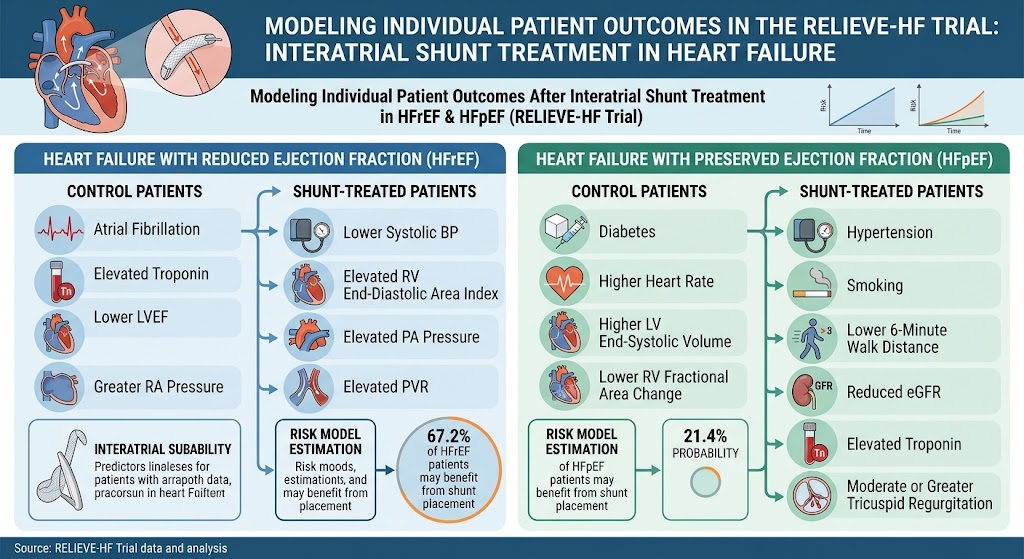
Among control patients with HFrEF, worse outcomes correlated independently with the presence of atrial fibrillation, elevated troponin levels indicating myocardial injury, lower left ventricular ejection fraction (LVEF), and elevated right atrial pressure, reflecting right-sided congestion. These variables underscore the importance of both ventricular function and atrial pressures in prognosis.
In shunt-treated HFrEF patients, however, independent predictors shifted. Lower systolic blood pressure—a marker of advanced disease severity—and elevated right ventricular end-diastolic area index, heightened pulmonary artery pressure, and increased pulmonary vascular resistance (PVR) were associated with poorer outcomes. This suggests that right ventricular and pulmonary vascular pathology influences post-shunt prognosis, potentially by limiting the capacity to accommodate increased right-sided flow.
Baseline Predictors in HFpEF
For HFpEF control patients, adverse outcomes were independently predicted by diabetes mellitus, elevated baseline heart rate, larger left ventricular end-systolic volume, and reduced right ventricular fractional area change—a surrogate for RV systolic dysfunction.
In contrast, HFpEF patients undergoing shunt implantation exhibited different risk profiles: hypertension, smoking status, lower 6-minute walk distance (reflecting exercise intolerance), reduced estimated glomerular filtration rate (EGFR, indicating renal impairment), elevated troponin, and moderate or greater tricuspid regurgitation were linked to worse outcomes. These findings illustrate the complex interplay of comorbidities, functional capacity, and valvular pathology in modulating shunt response in HFpEF.
Risk Modeling and Clinical Implications
Using the identified independent predictors, the investigators generated individualized risk models estimating the proportion of patients likely to benefit from the shunt. Approximately 67.2% of HFrEF patients were predicted to derive clinical advantage, consistent with the overall trial result favoring shunt use in this subgroup. Conversely, only 21.4% of HFpEF patients were estimated to benefit, paralleling the group-level trend of worsened outcomes in this phenotype.
These nuanced insights highlight the heterogeneity of HF populations and the necessity of personalized risk stratification beyond simple ejection fraction classification. Notably, some HFpEF patients with favorable risk profiles may still benefit, underscoring potential for tailored therapeutic decisions.
Expert Commentary
The RELIEVE-HF trial adds critical knowledge regarding patient-level factors influencing response to interatrial shunt therapy. While prior small studies had suggested symptomatic benefit of atrial shunting in both HFrEF and HFpEF, these randomized trial data illuminate divergent effects and underlying mechanisms. The observation that right-sided cardiac and pulmonary vascular parameters strongly influence outcomes post-shunt in HFrEF emphasizes the importance of comprehensive hemodynamic evaluation pre-intervention.
The distinct predictors for HFpEF patients indicate that comorbid burden, renal function, and pulmonary valve integrity may modulate shunt efficacy or harm, aligning with the multifactorial pathophysiology of HFpEF. Clinicians should be cautious in applying interatrial shunting widely to HFpEF patients without careful individual assessment. Further mechanistic studies might clarify whether modulation of right-sided pressures and vascular resistance could potentiate shunt benefit.
Limitations include the post hoc nature of predictor modeling and potential confounders inherent in complex HF populations. Larger prospective validation incorporating biomarker and imaging phenotyping could refine risk stratification tools.
Conclusion
The RELIEVE-HF trial demonstrates that interatrial shunt therapy yields heterogeneous effects in heart failure patients, with significant benefit in many but not all individuals with HFrEF and more limited benefit in HFpEF. Distinct baseline clinical and hemodynamic factors independently predict outcomes before and after shunt implantation in these groups. Personalized risk modeling may enhance patient selection, maximizing therapeutic efficacy while minimizing harm. Future research should focus on integrating detailed phenotyping and longitudinal monitoring to optimize interatrial shunt use within precision heart failure care.
Reference
Stone GW, Lindenfeld J, Zile MR, Anker SD, Rodés-Cabau J, Snyder C, Kar S, Pfeiffer MP, Bayes-Genis A, Bax JJ, Bank AJ, Núñez J, Lee EC, Laufer-Perl M, Moravsky G, Litwin SE, Holcomb R, Eigler NL, Abraham WT; RELIEVE-HF Investigators. Modeling Individual Patient Outcomes After Interatrial Shunt Treatment in Heart Failure With Reduced and Preserved Ejection Fraction: The RELIEVE-HF Trial. Circ Heart Fail. 2026 Aug 4:e014100. doi: 10.1161/CIRCHEARTFAILURE.125.014100. Epub ahead of print. PMID: 42550570.
This article was created using several editorial tools, including AI, as part of the process. Human editors reviewed this content before publication.