Optimizing Heart Failure with Reduced Ejection Fraction Management: Insights from Swedish Registry on Quadruple Therapy Adherence and Persistence
Highlight
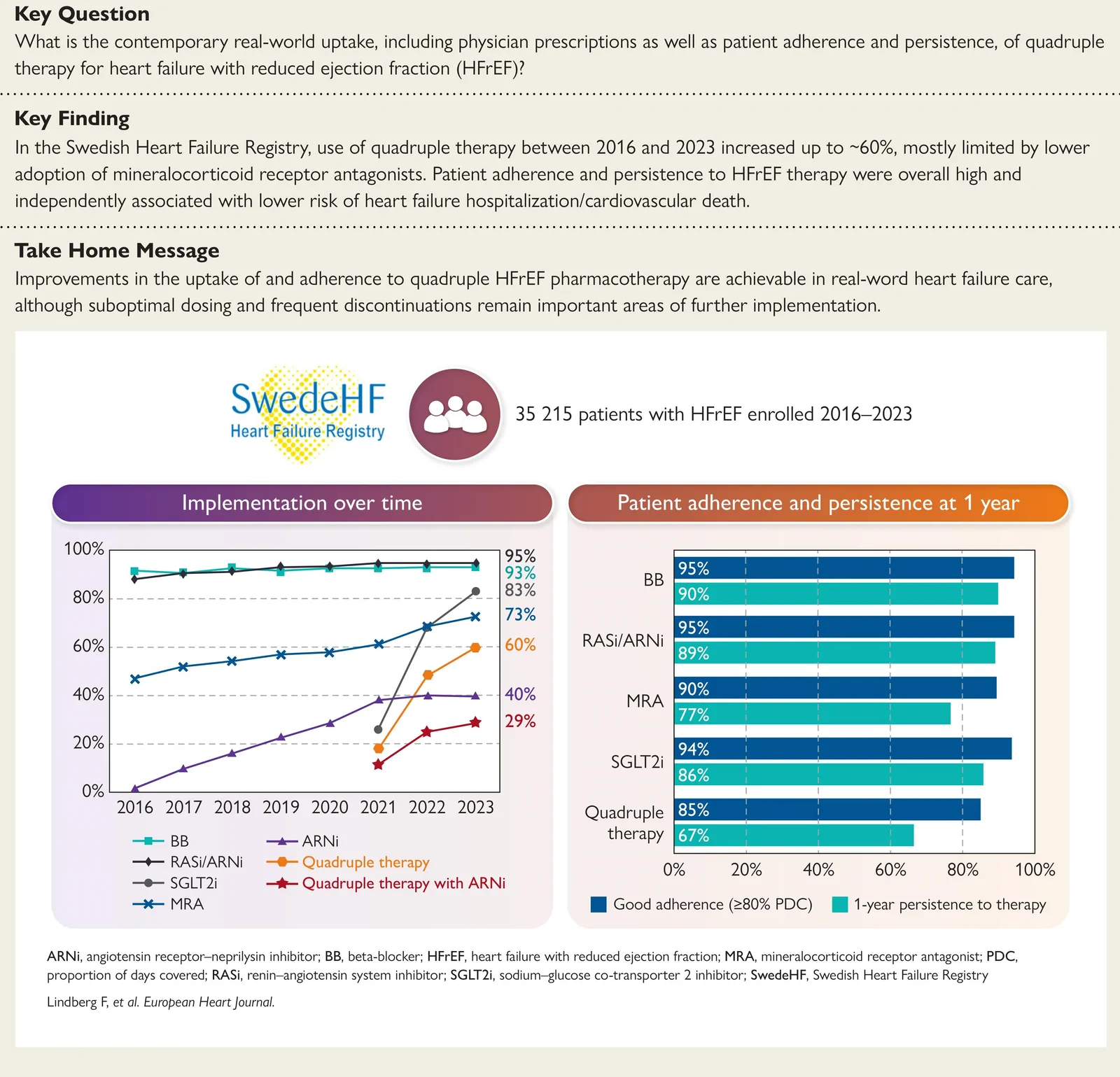
– Quadruple therapy use in heart failure with reduced ejection fraction (HFrEF) in Sweden increased substantially from 2016 to 2023, reaching about 60% in 2023.
– Patient adherence rates to foundational HFrEF medications were high (>85%), with persistence somewhat lower, especially for mineralocorticoid receptor antagonists (MRA).
– Good adherence and persistence to beta-blockers, renin-angiotensin system inhibitors/angiotensin receptor-neprilysin inhibitors, and MRAs, as well as adherence to sodium-glucose co-transporter 2 inhibitors (SGLT2i), were associated with reduced heart failure hospitalizations and cardiovascular mortality.
– Remaining challenges include suboptimal MRA uptake, frequent medication discontinuations, and dosing issues in real-world clinical practice.
Study Background
Heart failure with reduced ejection fraction (HFrEF) represents a significant clinical burden, characterized by impaired systolic function and elevated morbidity and mortality globally. Guideline-directed medical therapy (GDMT) consisting of four drug classes—beta-blockers (BB), renin-angiotensin system inhibitors (RASi) or angiotensin receptor-neprilysin inhibitors (ARNi), mineralocorticoid receptor antagonists (MRA), and sodium-glucose co-transporter 2 inhibitors (SGLT2i)—has transformed prognosis by improving survival and reducing hospitalizations. Despite robust clinical trial evidence, real-world implementation hinges critically on both prescription by clinicians and patient adherence and persistence with therapy. Suboptimal adherence contributes to poorer outcomes and higher healthcare utilization. This study from the Swedish Heart Failure Registry examines contemporary patterns of quadruple therapy use, adherence, and persistence over an eight-year period and their associations with clinical outcomes, providing valuable insights into real-world application of HFrEF pharmacotherapy.
Study Design
This observational study included 35,215 patients with diagnosed HFrEF enrolled in the Swedish Heart Failure Registry between January 2016 and December 2023. The registry integrates detailed clinical, prescription, and outcome data representative of routine care throughout Sweden. Adherence was assessed from pharmacy refill data by calculating the proportion of days covered (PDC) over 12 months post-index date, defining adherence as PDC ≥80%. Persistence was defined as ongoing medication dispensation within a 12 ± 2 month window. The study analyzed use, adherence, and persistence rates for each drug class individually and for the quadruple therapy combination. Associations between medication adherence/persistence and clinical endpoints—heart failure hospitalization and cardiovascular death—were evaluated using multivariable models adjusting for confounders.
Key Findings
Between 2016 and 2023, uptake of guideline-recommended HFrEF therapies increased markedly. By 2023, 93% of patients used beta-blockers, 95% used RASi/ARNi, 73% used MRAs, and 83% used SGLT2is, with approximately 60% receiving all four foundational therapies concurrently. Although MRA use increased, its uptake remained the lowest among the four drug classes, limiting full quadruple therapy adoption.
Adherence rates over the study period were impressively high: 95% for BB and RASi/ARNi, 90% for MRA, and 94% for SGLT2i. Persistence rates were slightly lower, with 90% for BB, 89% for RASi/ARNi, 77% for MRA, and 86% for SGLT2i. Persistence to complete quadruple therapy (all four agents) was 67%, and adherence was 85%.
Importantly, both good adherence and persistence to BB, RASi/ARNi, and MRA were independently associated with significant reductions in combined endpoints of heart failure hospitalization and cardiovascular death. For SGLT2i, only adherence but not persistence showed an independent prognostic benefit, suggesting consistent medication use confers survival and morbidity advantage.
The study also highlighted challenges, including lower MRA initiation and persistence, attributed potentially to tolerability concerns or comorbidities, and frequent discontinuations impacting continuous therapy delivery. Additionally, although adherence was high, suboptimal dosing—common in clinical practice—may reduce treatment effectiveness.
Expert Commentary
The findings underscore the remarkable progress Sweden has made in implementing quadruple therapy for HFrEF, aligning closely with contemporary European Society of Cardiology guidelines advocating comprehensive multidrug regimens to improve survival and reduce hospitalizations. High pharmacy-based adherence and persistence rates indicate that, with robust healthcare infrastructure and registry support, patients can maintain complex HFrEF regimens effectively.
However, the gap in MRA uptake, lower persistence, and dosing challenges remain critical barriers to fully realizing therapeutic benefits. Factors leading to these limitations—such as adverse effects, monitoring requirements, and clinical inertia—warrant focused interventions including patient education, dose titration protocols, and clinician support tools.
This real-world evidence complements clinical trial data, emphasizing the necessity of adherence support as a pillar of optimized heart failure care. It also reflects the importance of national registries and prescription monitoring in identifying gaps and facilitating quality improvement efforts.
Conclusion
The Swedish Heart Failure Registry data demonstrate substantial advances in the uptake and patient adherence to quadruple therapy in HFrEF across Sweden, with significant implications for improved clinical outcomes. High adherence and persistence correlate with better survival and reduced hospitalizations, validating real-world benefit of these therapies beyond trial settings. Nonetheless, suboptimal MRA use and discontinuations highlight persistent challenges to address. Future efforts should emphasize strategies to enhance adherence, persistence, and individualized dosing to close treatment gaps further and maximize the life-saving potential of quadruple therapy in patients with HFrEF.
Funding and Clinical Trials
Details of funding were not specified in the source publication. The study was based on registry data from the Swedish Heart Failure Registry, reflecting observational real-world practice rather than a clinical trial.
References
1. Lindberg F, Uijl A, Benson L, Valente V, Coats AJS, Böhm M, Metra M, Masi S, Lund LH, Rosano GMC, Savarese G. Heart failure with reduced ejection fraction in Sweden: patient adherence and persistence to quadruple pharmacotherapy prescription. European Heart Journal. 2026 Aug 24;47(32):4442-4458. PMID: 41920862.
2. McMurray JJ, et al. ESC Guidelines for the diagnosis and treatment of acute and chronic heart failure 2021. European Heart Journal. 2021.
3. Yancy CW, et al. 2022 AHA/ACC/HFSA Guideline for the Management of Heart Failure. Circulation. 2022.
This article was created using several editorial tools, including AI, as part of the process. Human editors reviewed this content before publication.