We use cookies

Our website uses essential cookies and, with your consent, additional cookies to measure performance and improve our services. Cookie Policy.

You can change your choice at any time.

MMedXYNews
HomeVideos
MedXY AI/MedXY News/Section: Cardiology

Optimizing Donor Heart Preservation: Superior Outcomes with 10°C Versus 4-8°C in Adult Heart Transplantation
MedXY Editorial Team•Aug 5, 2026•Cardiology
Heart Transplantationgraft functionstatic cold storagedonor heart preservation

Highlight

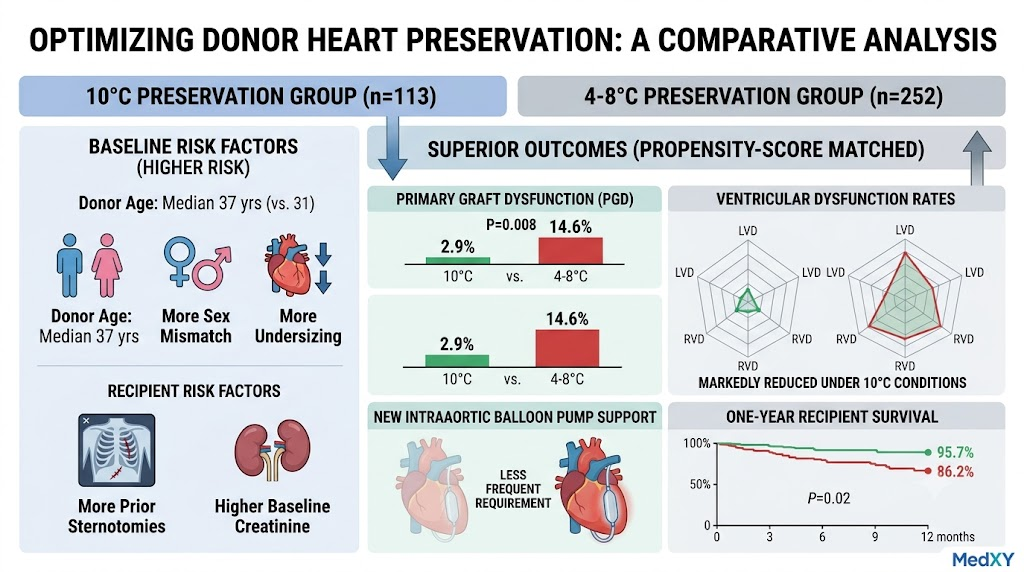
This multicenter study comparing 10°C versus 4-8°C static cold storage for donor hearts demonstrated superior early graft function, reduced primary graft dysfunction, and improved one-year survival with 10°C preservation despite higher risk donor and recipient profiles.

Additional benefits included less ventricular dysfunction and reduced need for intraaortic balloon pumps, suggesting 10°C as an optimal temperature for cardiac allograft preservation.

MedXY registered readers

Sign in free to continue reading

Create or use your MedXY account to unlock the complete article.

This article was created using several editorial tools, including AI, as part of the process. Human editors reviewed this content before publication.

Related articles

Open language-specific specialty feeds and department pages.

Machine-learning model incorporating perioperative hemodynamics predicts moderate-to-severe AKI after heart transplantationA machine-learning model using perioperative hemodynamic indices accurately predicted stage 2-3 acute kidney injury after orthotopic heart transplantation in 114 patients, with light gradient boosting machine achieving AUC 0.898.Jul 29, 2026Evaluating the Impact of the OPTN Status Escalation Policy for Adult Heart Transplant Candidates on Durable LVAD SupportThe OPTN’s new status escalation policy for stable adult heart transplant candidates with durable LVADs may benefit only a small fraction of patients, as most experience complications or transplant within six years.Jun 24, 2026Donor-Derived Cell-Free DNA as a Prognostic Biomarker in Severe Cardiac Allograft Rejection: From Detection to Risk StratificationRecent heart-transplant studies show donor-derived cell-free DNA not only detects rejection but also predicts mortality and persistent graft dysfunction, especially when elevated at diagnosis. Evidence supports a shift from binary surveillaJun 17, 2026
Loading comments...
MedXY briefing

Get the free newsletter

Evidence-led clinical news, trends, and analysis—delivered to your inbox.

Ask MedXY AI

Most popular

Intimate Health
Five Benefits for Women Continuing Sexual Activity After Menopause
Intimate Health
Why Some Women Have a Strong Sex Drive—And Why Men Shouldn't Worry About It
Nursing & care
How often should a couple have sex?
Intimate Health
Classic Intimacy Recommendations: How to Help Women Reach Orgasm and Enjoy Mutual Pleasure
Intimate Health
What Makes a Woman "Physiologically Addicted" Is Never Money, But These Two Relationship Qualities
© 2026 MedXY
Contact usAbout usPrivacy PolicyMedXY story
A Mobility-Enabled Active Driver for Berlin Heart EXCOR Showed Zero Major Device Malfunctions in High-Risk Pediatric VAD Support
In a prospective multicenter study, the EXCOR Active Driver demonstrated excellent reliability and high short-term survival in children requiring ventricular assist support, while supporting a registry-enabled pathway for class III pediatri
Jun 10, 2026
Circulating MicroRNA Scores May Distinguish Cellular and Antibody-Mediated Heart Transplant Rejection With High AccuracyA prospective multicenter study found circulating microRNA rejection scores identified ACR and AMR with strong diagnostic performance and prognostic value, supporting their development as noninvasive tools to reduce reliance on surveillanceMay 25, 2026
Misaligned Urgency: Why Status Exceptions May Be Paradoxically Lowering Priority for the Sickest Children in Heart TransplantationA large-scale analysis of 6,026 pediatric heart transplant candidates reveals that status exceptions often prioritize patients with lower mortality risk than those meeting standard criteria, highlighting a significant misalignment in the U.Mar 10, 2026