We use cookies

Our website uses essential cookies and, with your consent, additional cookies to measure performance and improve our services. Cookie Policy.

You can change your choice at any time.

MMedXYNews
HomeVideos
MedXY AI/MedXY News/Section: Cardiology

Optimizing Antithrombotic Therapy After PCI in Atrial Fibrillation Patients: Insights from a Network Meta-Analysis
MedXY Editorial Team•Sep 1, 2026•Cardiology
Liệu pháp chống huyết khốiDirect Oral AnticoagulantsPercutaneous Coronary Interventionatrial fibrillation

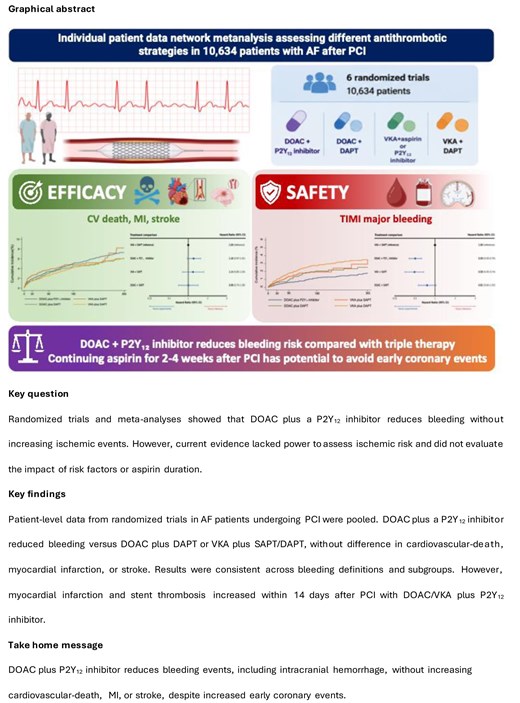
Graphical abstract

Introduction

Every year, millions of patients worldwide face the complex challenge of managing atrial fibrillation (AF) alongside coronary artery disease requiring percutaneous coronary intervention (PCI). AF, the most common sustained cardiac arrhythmia, significantly increases stroke risk, necessitating anticoagulant therapy. Concurrently, PCI — a procedure to open obstructed coronary arteries — requires antiplatelet therapy to prevent stent thrombosis. However, combining these therapies significantly raises the bleeding risk, complicating clinical decisions. Recent advances have introduced newer direct oral anticoagulants (DOACs) as alternatives to vitamin K antagonists (VKAs), sparking a need to clarify the optimal antithrombotic regimen balancing efficacy and safety for AF patients undergoing PCI.

Understanding which combination of antithrombotic treatments minimizes cardiovascular events without excess bleeding is vital for personalized patient care. To address this, an individual patient data network meta-analysis pooled data from six major randomized trials involving over 10,000 patients. This article summarizes key findings, clinical implications, and practical recommendations derived from this landmark analysis.

MedXY registered readers

Sign in free to continue reading

Create or use your MedXY account to unlock the complete article.

This article was created using several editorial tools, including AI, as part of the process. Human editors reviewed this content before publication.

Related articles

Open language-specific specialty feeds and department pages.

Intracoronary Imaging-Guided PCI: Updated Meta-Analysis Validates Cardiovascular Outcome BenefitsThis updated meta-analysis of 28 RCTs reveals significant reductions in cardiovascular events and mortality with intracoronary imaging-guided PCI versus angiography-guided PCI, highlighting the importance of lesion and geographic factors inSep 19, 2026Geographic Variability in Outcomes of IVUS-Guided Versus Angiography-Guided PCI: Insights from a Meta-Analysis of Randomized TrialsThis meta-analysis reveals significant geographic differences in the benefits of intravascular ultrasound (IVUS)-guided percutaneous coronary intervention (PCI), with East Asian populations showing marked reductions in cardiac death and advSep 15, 2026Genotype-Dependent Risk and Impact of Atrial Fibrillation in Dilated Cardiomyopathy: Insights from the SHaRe RegistryThis study reveals genotype-specific differences in atrial fibrillation (AF) risk among dilated cardiomyopathy (DCM) patients, highlighting LMNA mutations as a major predictor of incident AF and its association with worse clinical outcomes,Sep 15, 2026
Loading comments...
MedXY briefing

Get the free newsletter

Evidence-led clinical news, trends, and analysis—delivered to your inbox.

Ask MedXY AI

Most popular

Intimate Health
Five Benefits for Women Continuing Sexual Activity After Menopause
Intimate Health
Why Some Women Have a Strong Sex Drive—And Why Men Shouldn't Worry About It
Nursing & care
How often should a couple have sex?
Intimate Health
Classic Intimacy Recommendations: How to Help Women Reach Orgasm and Enjoy Mutual Pleasure
Intimate Health
What Makes a Woman "Physiologically Addicted" Is Never Money, But These Two Relationship Qualities
© 2026 MedXY
Contact usAbout usPrivacy PolicyMedXY story
Physiological Left Atrial Staging as a Predictor of New-Onset Atrial Fibrillation in Hypertrophic Cardiomyopathy
A novel left atrial (LA) staging system, integrating hemodynamic load and contractile function, predicts new-onset atrial fibrillation risk in hypertrophic cardiomyopathy and may guide tailored AF surveillance.
Sep 15, 2026
Global Trends in the Burden of Ischemic Stroke Attributable to Diabetes Versus Atrial FibrillationThis study analyzes global trends comparing ischemic stroke burdens linked to diabetes and atrial fibrillation, revealing a rising impact of diabetes-related stroke and highlighting the need for targeted interventions.Sep 12, 2026
Long-Term Benefits of Quantitative Flow Ratio-Guided PCI: Insights from the 5-Year FAVOR III China TrialThe FAVOR III China trial demonstrates that QFR-guided percutaneous coronary intervention significantly reduces major adverse cardiac events over 5 years, mainly by decreasing myocardial infarction and ischemia-driven revascularization compSep 11, 2026