We use cookies

Our website uses essential cookies and, with your consent, additional cookies to measure performance and improve our services. Cookie Policy.

You can change your choice at any time.

MMedXYNews
HomeVideos
MedXY AI/MedXY News/Section: Cardiology

Myocardial Fibrosis and Reverse Remodeling After Valve Replacement in Chronic Aortic Regurgitation: Advances and Clinical Implications
MedXY Editorial Team•Aug 28, 2026•Cardiology
Cardiac Magnetic Resonancereverse remodelingvalve replacement心筋線維症主动脉反流

Highlights

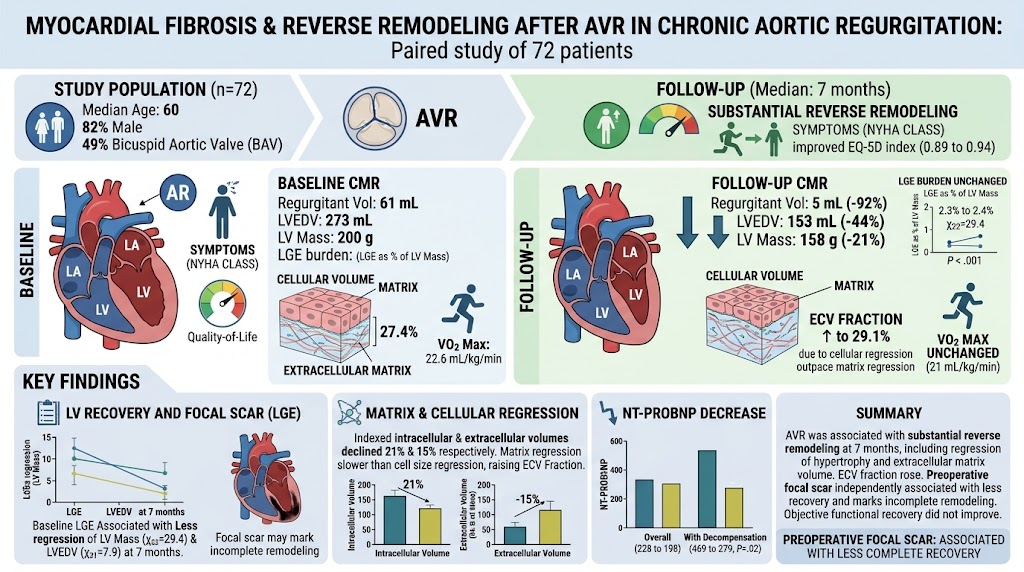
  • Advanced cardiac magnetic resonance (CMR) techniques identify both focal and diffuse myocardial fibrosis in chronic aortic regurgitation (AR) and predict post-AVR remodeling outcomes.
  • AVR leads to significant left ventricular reverse remodeling characterized by reductions in LV end-diastolic volume (LVEDV), LV mass, and indexed extracellular volume, with cellular regression outpacing matrix regression.
  • Focal myocardial scars quantified by late gadolinium enhancement (LGE) remain stable post-AVR and are independently associated with incomplete reverse remodeling.
  • Despite structural improvements, objective functional capacity measured by maximal oxygen consumption may not substantially improve at early follow-up after AVR.

Background

MedXY registered readers

Sign in free to continue reading

Create or use your MedXY account to unlock the complete article.

This article was created using several editorial tools, including AI, as part of the process. Human editors reviewed this content before publication.

Related articles

Open language-specific specialty feeds and department pages.

Refining Right Ventricular Assessment in Pulmonary Hypertension: Impact of Postprocessing Techniques on Cardiac MRI MetricsThis study examines how cardiac MRI postprocessing methods, including trabeculation exclusion and pulmonary artery flow measurement sites, significantly influence right ventricular volume and function assessment in pulmonary hypertension paSep 17, 2026RUNX1-Driven Endothelial-to-Mesenchymal Transition: A Novel Mechanistic Link and Therapeutic Target in LMNA CardiomyopathyThis study identifies RUNX1-mediated endothelial-to-mesenchymal transition as a key driver of myocardial fibrosis and remodeling in LMNA cardiomyopathy, highlighting potential therapeutic avenues targeting endothelial RUNX1 signaling.Aug 21, 2026Subvalvular Aortic Stenosis in Adults: Clinical Course and Long-Term OutcomesThis review synthesizes recent evidence on adult subvalvular aortic stenosis, highlighting long-term clinical outcomes, disease progression, and implications for management and follow-up strategy.Aug 11, 2026
Loading comments...
MedXY briefing

Get the free newsletter

Evidence-led clinical news, trends, and analysis—delivered to your inbox.

Ask MedXY AI

Most popular

Intimate Health
Five Benefits for Women Continuing Sexual Activity After Menopause
Intimate Health
Why Some Women Have a Strong Sex Drive—And Why Men Shouldn't Worry About It
Nursing & care
How often should a couple have sex?
Intimate Health
Classic Intimacy Recommendations: How to Help Women Reach Orgasm and Enjoy Mutual Pleasure
Intimate Health
What Makes a Woman "Physiologically Addicted" Is Never Money, But These Two Relationship Qualities
© 2026 MedXY
Contact usAbout usPrivacy PolicyMedXY story
Reevaluating the Ross Procedure in Adults: Insights from a Large Contemporary Cohort
The Ross procedure in adults demonstrates excellent long-term survival, valve durability, and low reintervention rates, supporting its broader use in selected patients at experienced centers.
Jun 24, 2026
Myocardial Fibrosis Predicts Outcomes in Asymptomatic Severe Aortic Stenosis, But Early Valve Replacement May Not Offer Universal BenefitThe EVOLVED trial reveals that higher myocardial fibrosis burden associates with adverse events in asymptomatic severe aortic stenosis patients, yet early intervention benefits appear nuanced—showing promise for reducing hospitalizations inApr 17, 2026
Persistent Fibroblast Activation Predicts Heart Failure Progression: [68Ga]FAPI-46 PET/MRI Reveals Distinct Patterns in Ischemic and Nonischemic CardiomyopathyA prospective case-control study demonstrates that myocardial fibroblast activation persists in heart failure patients and follows distinct spatial patterns depending on etiology. Using [68Ga]FAPI-46 PET/MRI, researchers found that higher bApr 15, 2026