Metabolic Implications of Hepatic, Pancreatic, and Abdominal Fat Depots in Asian Indians Across Normoglycaemia, Prediabetes, and Type 2 Diabetes
Introduction
Type 2 diabetes mellitus (T2DM) and its precursor state, prediabetes, are rapidly increasing metabolic disorders worldwide, particularly in South Asian populations such as Asian Indians. Despite often having a body mass index (BMI) considered only modestly elevated (~25 kg/m²), these individuals tend to develop diabetes and cardiovascular complications earlier and at lower BMIs compared to Western populations. This paradox suggests that body fat distribution and ectopic fat accumulation—the deposition of fat in organs not specialized for fat storage—might play a critical role in the pathogenesis of T2DM among Asian Indians.
This study aimed to assess and compare hepatic (liver), pancreatic, and abdominal fat depots in Asian Indians across glycaemic categories—normoglycaemia, prediabetes, and newly diagnosed T2DM—while controlling for BMI. The goal was also to identify predictors of dysglycaemia, which encompasses abnormal blood glucose regulation.
Methods
In this cross-sectional analysis, 45 adult Asian Indian participants were selected and equally divided into three groups based on glycaemic status: normoglycaemia, prediabetes, and newly diagnosed type 2 diabetes. All groups were matched for BMI to isolate fat distribution effects independent of overall obesity.
Advanced imaging techniques were employed to accurately quantify fat depots:
Liver and pancreas fat content: Proton density fat fraction (PDFF) was measured using multi-echo chemical-shift-encoded magnetic resonance imaging (CSE-MRI), a non-invasive gold standard to detect and quantify ectopic fat.
Abdominal fat compartments: MRI quantified subcutaneous adipose tissue (SCAT) subdivided into anterior, posterior, superficial, and deep layers, as well as intra-abdominal adipose tissue (IAAT), intraperitoneal and retroperitoneal adipose compartments.
Whole body fat: Total body fat percentage and fat mass in grams were measured by dual-energy X-ray absorptiometry (DEXA).
Insulin sensitivity and beta-cell function—key markers of glucose metabolism—were estimated using Homeostatic Model Assessment (HOMA) indices derived from blood samples.
Results
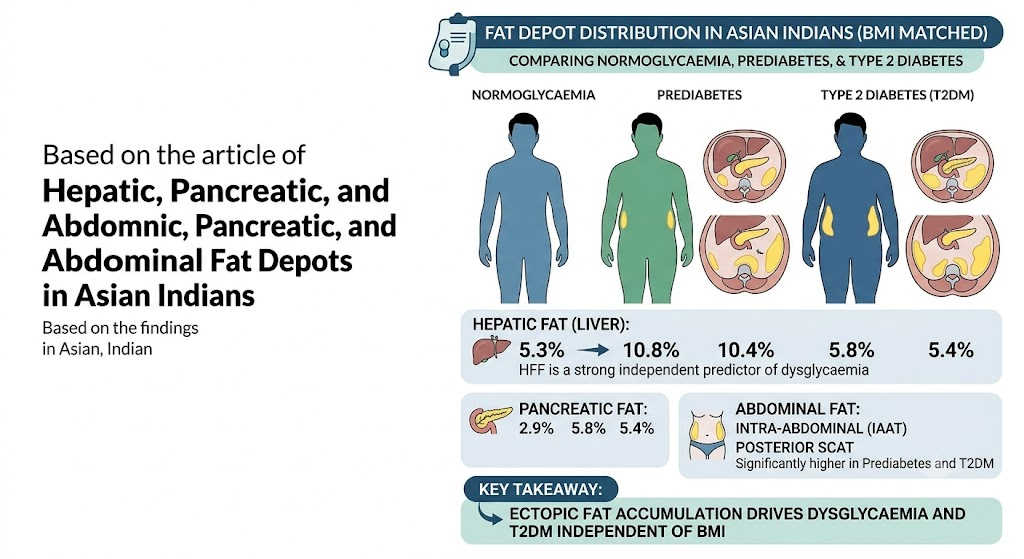
Hepatic fat: The liver fat fraction (HFF) was approximately twice as high in individuals with prediabetes (10.78% ± 6.50) and newly diagnosed T2DM (10.35% ± 9.95) compared to normoglycaemic participants (5.34% ± 4.69), with statistical significance (p=0.009 and p=0.026 respectively). This indicates a substantial accumulation of liver fat well before and during diabetes onset.
Pancreatic fat: Fat content in the pancreas was similarly elevated in prediabetes (5.83% ± 4.73) and T2DM groups (5.35% ± 4.75) versus normoglycaemia (2.97% ± 3.56), signifying ectopic fat infiltration that may impair insulin secretion.
Abdominal fat compartments: Specific abdominal fat depots, including intra-abdominal adipose tissue (IAAT), superficial and posterior subcutaneous adipose tissue, and retroperitoneal fat, were significantly higher in people with prediabetes and T2DM when compared to normoglycaemic individuals (p < 0.05). Interestingly, superficial and posterior SCAT were higher in prediabetes than in T2DM, suggesting dynamic fat remodeling.
Predictors of dysglycaemia: After adjusting for age and BMI, only the fat fraction in the liver remained an independent predictor of dysglycaemia, with each 1% increase raising the odds by 11% (p=0.023). Specifically, every 1% increase in hepatic fat raised prediabetes risk by 16% and overall dysglycaemia risk by 11%.
Beta-cell function: HOMA-β indices, indicating insulin secretion capacity, were preserved or elevated during prediabetes but declined in T2DM, reflecting progressive pancreatic beta-cell dysfunction as diabetes develops.
Discussion
This study underlines the critical role of ectopic fat, particularly hepatic fat, in the development of glycaemic abnormalities in Asian Indians. Despite matched BMIs, individuals with prediabetes and type 2 diabetes exhibited markedly higher fat deposits in the liver, pancreas, and specific abdominal compartments compared to their normoglycaemic counterparts.
The disproportionate accumulation of liver fat emerges as a strong and independent metabolic risk factor. This is clinically significant because hepatic fat accumulation contributes to insulin resistance and hepatic inflammation, which are early steps in diabetes pathogenesis.
Pancreatic fat infiltration can disrupt insulin-producing beta cells, explaining the observed decline in beta-cell function transitioning from prediabetes to overt diabetes. The finding that beta-cell function is preserved or even slightly increased in prediabetes suggests a compensatory beta-cell response to insulin resistance, which eventually fails as diabetes progresses.
The distinct pattern of abdominal fat distribution, including increased intra-abdominal and retroperitoneal fat, supports the idea that central obesity and visceral fat, rather than total fat mass alone, drive metabolic risk in South Asians. This highlights the need for imaging-based evaluation of fat depots beyond BMI and waist circumference.
Clinical Implications and Recommendations
Given these insights, early and targeted intervention strategies are critical for Asian Indians at risk of diabetes, even at modest BMI levels. These may include:
Lifestyle modifications: Tailored diets emphasizing reduced saturated fats, increased fiber, and physical activity to reduce ectopic fat deposition.
Pharmacologic interventions: Early use of insulin sensitizers (e.g., metformin) in prediabetes might help reduce hepatic fat and preserve beta-cell function.
Screening and monitoring: Incorporation of advanced imaging or surrogate markers for hepatic fat and abdominal adiposity into risk assessment models for South Asians.
Such proactive measures could potentially delay or prevent the progression from normoglycaemia and prediabetes to type 2 diabetes, reducing the burden of diabetic complications prevalent in this population.
Limitations and Future Directions
The study’s cross-sectional design limits causal inferences; longitudinal studies are needed to track fat depot changes over time and their direct effects on metabolic deterioration. Larger samples would also enhance the statistical power to explore additional predictors and subgroup differences such as gender or age variations.
Exploration of therapeutic interventions targeting ectopic fat reduction and their impact on diabetes prevention in Asian Indians represents a promising area for future research.
Conclusion
Asian Indians with prediabetes or early type 2 diabetes exhibit significantly higher hepatic, pancreatic, and abdominal fat depots compared to normoglycaemic individuals, independent of BMI. Hepatic fat fraction is a particularly strong predictor of dysglycaemia, underscoring the importance of early detection and aggressive interventions at prediabetic stages to prevent beta-cell failure and diabetes progression.
Healthcare providers should recognize ectopic fat’s pivotal role and advocate for comprehensive metabolic assessments, personalized lifestyle counseling, and timely medical therapy tailored to this high-risk ethnic group.
Trial Registration
Clinical Trials Registry of India (CTRI/2023/06/054228).
This article was created using several editorial tools, including AI, as part of the process. Human editors reviewed this content before publication.