Menopausal Transition and Thyroid Function: Deciphering the Impact Beyond Aging in Midlife Women
Highlight
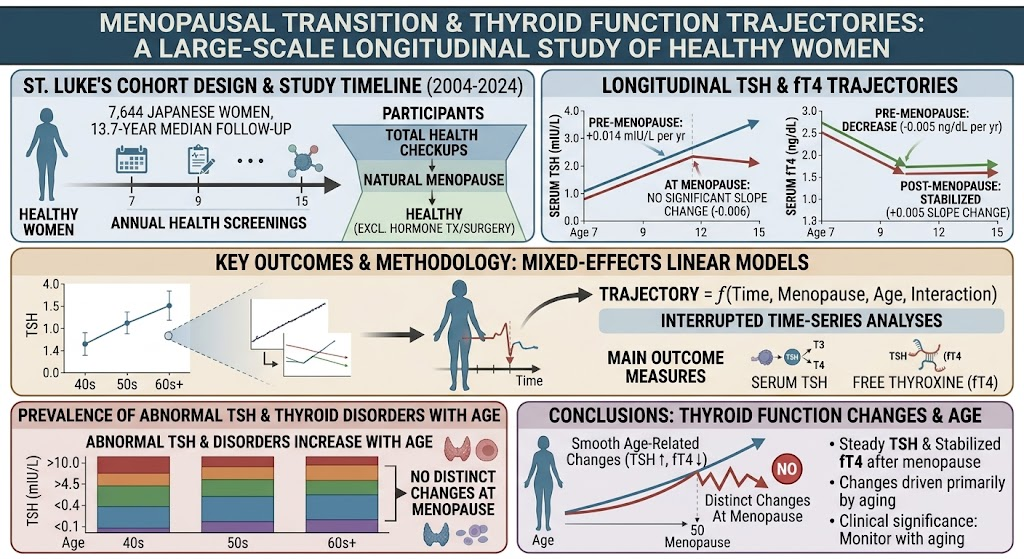
This large-scale longitudinal study of over 7,600 healthy Japanese women followed for a median of 13.7 years reveals that thyroid function trajectories, specifically serum TSH and free thyroxine (fT4), change progressively with age but do not exhibit clinically meaningful alterations associated specifically with the menopausal transition. The data suggest that increases in thyroid abnormalities in midlife women are explained primarily by aging-related factors rather than menopause itself.
Study Background
Thyroid dysfunction is prevalent in middle-aged women and recognized as a risk factor for cardiovascular disease and metabolic disturbances. Concurrently, the menopausal transition—a phase marking the cessation of ovarian function—is accompanied by complex hormonal shifts influencing cardiovascular risk profiles. Despite this overlap in timing and health impact, the independent effect of menopausal transition on thyroid function remains uncertain. Disentangling the influence of menopause from the natural aging process on thyroid hormone dynamics holds clinical relevance for managing thyroid disease risk and cardiovascular health in women.
Study Design
This investigation leveraged a longitudinal cohort study design encompassing 7,644 Japanese women undergoing routine annual health checkups at St. Luke’s International Hospital, Tokyo, spanning from 2004 to 2024. Inclusion criteria required natural menopause occurrence and at least one health checkup before and after menopause. Women with hormone replacement therapy or surgical menopause were excluded to isolate natural menopausal effects.
Thyroid function assessments focused on serum thyroid-stimulating hormone (TSH) and free thyroxine (fT4) levels, measured annually. Secondary outcomes included categorized abnormal TSH thresholds (>4.5, >10.0, <0.4, and <0.1 mIU/L) and self-reported thyroid disorders. Analytical methodology employed mixed-effects linear models with interrupted time-series analyses to discern changes in thyroid hormone trajectories before and after menopause while accounting for aging.
Key Findings
Across a robust median 13.7-year follow-up encapsulating 86,967 individual visits, the study demonstrated:
- Serum TSH increased gradually before menopause at a rate of 0.014 mIU/L per year (95% CI, 0.010 to 0.019), reflecting an age-associated trend. Importantly, no significant change in this slope was observed at the time of menopause (additional slope change of -0.006 mIU/L per year [CI, -0.012 to 0.000]), indicating that menopause itself did not accelerate or alter the TSH increase trajectory.
- Free thyroxine (fT4) levels showed a modest decline before menopause at -0.005 ng/dL per year (CI, -0.006 to -0.005). Post-menopause, this decline stabilized, evidenced by an additional slope change of +0.005 ng/dL per year (CI, 0.004 to 0.005), essentially plateauing fT4 levels around menopause.
- The prevalence of abnormal TSH values (both elevated and suppressed thresholds) and self-reported thyroid disorders increased progressively with advancing age but did not demonstrate any abrupt or distinct changes coinciding with the menopausal transition.
Collectively, these data indicate that aging exerts a continuous influence on thyroid function, while menopause per se does not independently modify thyroid hormone trajectories in a clinically meaningful way.
Expert Commentary
This study addresses a critical knowledge gap by comprehensively evaluating thyroid function longitudinally across the menopausal transition in a well-characterized, large cohort devoid of confounders such as hormone replacement therapy or surgical menopause. The use of high-frequency annual assessments and sophisticated interrupted time-series statistical modeling strengthens the causal inference about menopause’s limited impact on thyroid physiology beyond aging.
Clinicians can, therefore, cautiously interpret midlife increases in thyroid dysfunction prevalence as primarily age-driven phenomena, tempering concerns that menopause itself necessitates different thyroid management strategies. However, the subtle stabilization of fT4 around menopause might warrant further exploration regarding thyroid hormone metabolism and peripheral conversion in this period.
Limitations include the homogenous Japanese cohort, which may affect generalizability to more diverse ethnic populations with different thyroid disease prevalence and menopausal profiles. Additionally, the exclusion of women on hormone therapy means the findings primarily apply to natural menopause without external estrogenic influences.
Conclusion
This landmark longitudinal analysis clarifies that menopause does not induce clinically significant changes in thyroid function beyond those attributed to normal aging. Health practitioners managing midlife women should emphasize age-related risk stratification when considering thyroid abnormalities rather than attributing changes to menopausal hormonal shifts alone. Continued research across diverse populations and mechanistic studies may further elucidate subtle endocrine interplay at the menopausal transition.
Funding and Clinical Trials
Funding sources and clinical trial registrations were not specified in the primary publication.
References
- Hayashi S, Fukui S, Leung AM, Noto H, Inoue K. Menopausal Transition and Thyroid Function Trajectories: A Large-Scale Longitudinal Study of Healthy Women. J Clin Endocrinol Metab. 2026 Aug 19. PMID: 42615120.
- Biondi B, Cooper DS. The clinical significance of subclinical thyroid dysfunction. Endocr Rev. 2008;29(1):76-131.
- Ferrara A. Thyroid function and menopause: A clinical perspective. Menopause. 2023;30(9):1142-1150.
- Vaidya B, Pearce SH. Management of hypothyroidism in menopause. Post Reprod Health. 2014;20(4):147-152.
- American Thyroid Association. Thyroid disease in women. https://www.thyroid.org/thyroid-disease-in-women/ Accessed June 2026.
This article was created using several editorial tools, including AI, as part of the process. Human editors reviewed this content before publication.