MDADI Composite Score Thresholds for Efficient Screening of Swallowing Impairment in Head and Neck Cancer Patients
Highlight
This study identifies a clinically useful MDADI composite score threshold near 74 to screen for videofluoroscopic swallow study (VFSS)-graded swallowing impairments in head and neck cancer (HNC) patients. It also demonstrates that a reduced four-item MDADI short form preserves discriminatory ability, potentially reducing patient burden during dysphagia assessment.
Study Background
Swallowing dysfunction (dysphagia) is a frequent and impactful sequela in patients treated for head and neck cancer (HNC), compromising nutritional status, quality of life, and increasing morbidity. Objective assessment of swallowing impairment commonly relies on instrumental evaluations such as videofluoroscopic swallow studies (VFSS), which provide detailed visualization of oropharyngeal swallowing physiology. However, VFSS accessibility and patient tolerance can limit its routine use, creating a need for valid, patient-reported outcome (PRO) screening tools to triage patients for instrumental evaluation.
The MD Anderson Dysphagia Inventory (MDADI) is a validated, HNC-specific PRO instrument assessing perceived swallowing-related quality of life. Yet, its use as a quantitative screening tool for objectively graded dysphagia has not been fully established. This study aimed to determine MDADI score thresholds correlating with VFSS-graded swallowing impairment and explore whether a shortened MDADI version could maintain discriminative capacity while reducing patient response burden.
Study Design
This retrospective cross-sectional analysis utilized data from a prospectively maintained dysphagia surveillance program of HNC patients. Inclusion required completion of the MDADI questionnaire within 120 days of undergoing VFSS. Swallowing impairment severity was instrumentally graded using the Dynamic Imaging Grade of Swallowing Toxicity (DIGEST) and the Penetration-Aspiration Scale (PAS), applying clinically meaningful dichotomization to define impairment.
Associations between MDADI composite and individual item scores with VFSS metrics were assessed using Spearman and point-biserial correlations. Receiver operating characteristic (ROC) analyses derived optimal MDADI thresholds based on Youden’s J statistic to maximize discrimination of clinically relevant swallowing impairment. An exploratory item reduction analysis identified a concise subset of MDADI items to construct a short form preserving screening performance.
Key Findings
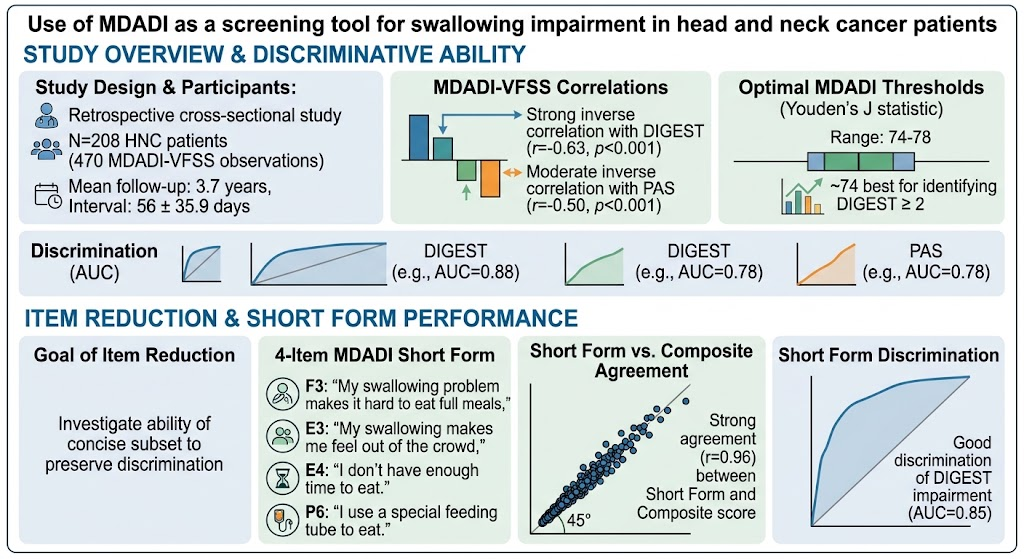
The study population comprised 208 patients providing 470 MDADI-VFSS paired observations for PAS analysis and 443 for DIGEST, with a mean follow-up of 3.7 years and mean interval between MDADI and VFSS of 56 ± 35.9 days.
MDADI composite scores showed a strong inverse correlation with DIGEST grading (correlation coefficient r = -0.63, p < 0.001) and a moderate inverse correlation with PAS scores (r = -0.50, p < 0.001). These correlations indicate that lower MDADI scores reflect greater objectively measured swallowing impairment.
ROC analyses demonstrated good discriminative ability of the MDADI composite score to detect clinically significant impairment, with area under the curve (AUC) values ranging from 0.78 to 0.88 across both DIGEST and PAS definitions. The optimal MDADI composite score thresholds ranged narrowly from 74 to 78, with a threshold of approximately 74 best discriminating DIGEST≥2, representing moderate or worse swallowing toxicity.
In pursuit of minimizing patient and clinical burden, exploratory analysis identified a four-item MDADI short form consisting of items F3, E3, E4, and P6. This shortened version strongly correlated with the full composite score (r = 0.96) and maintained good discriminatory performance for DIGEST-defined impairment (AUC = 0.85), suggesting robust screening capability in a condensed format.
Expert Commentary
This study provides compelling evidence for the clinical utility of the MDADI not merely as a descriptive PRO but as an efficient screening tool to identify patients warranting objective swallowing evaluation. The correlation with VFSS grading means clinicians can use MDADI thresholds to trigger further investigation, facilitating timely dysphagia management. The validation of a four-item short form is particularly appealing in busy oncology and speech pathology settings, where reducing patient questionnaire fatigue without sacrificing screening accuracy remains critical.
However, certain limitations merit consideration. The study’s retrospective design and single-institution data may affect generalizability, especially across diverse HNC populations and treatment modalities. The time interval between questionnaire completion and VFSS, albeit limited to 120 days, could introduce temporal bias. Future prospective studies should validate these thresholds and the abbreviated MDADI in larger, diverse cohorts and assess responsiveness to clinical changes over time.
Notably, while MDADI correlates well with VFSS-graded impairment, it should not replace instrumental assessments but rather enhance patient triage and surveillance strategies. Integration with other clinical indicators and multidisciplinary evaluation remains paramount for optimal dysphagia management.
Conclusion
The MD Anderson Dysphagia Inventory is validated as a valuable screening tool correlating with VFSS-graded swallowing impairment in head and neck cancer patients. A composite score threshold near 74 effectively discriminates clinically significant dysphagia, enabling clinicians to identify patients requiring further instrumental assessment. Furthermore, a streamlined four-item short form retains screening accuracy while potentially reducing patient burden, facilitating efficient clinical implementation. Adoption of MDADI-based screening may enhance early detection and management of dysphagia, ultimately improving patient outcomes in HNC survivorship care.
Funding and ClinicalTrials.gov
The original study details do not specify funding sources or clinical trial registration numbers.
References
1. Chen AY, Frankowski R, Bishop-Leone J, et al. MD Anderson Dysphagia Inventory: a new swallowing-specific quality-of-life instrument for patients with head and neck cancer. Arch Otolaryngol Head Neck Surg. 2001;127(7):870-876.
2. Hutcheson KA, Bhayani MK, Nussenbaum B, et al. Dynamic imaging grade of swallowing toxicity (DIGEST): scale development and validation. Cancer. 2017;123(10):1768-1775.
3. Rosenbek JC, Robbins JA, Roecker EB, Coyle JL, Wood JL. A penetration-aspiration scale. Dysphagia. 1996;11(2):93-98.
4. Palmer JB, Flowers HL, Palmer PM. Deglutition and dysphagia. Cummings Otolaryngology: Head and Neck Surgery. 6th ed. 2015.
5. Kotz T, Turner R, Sykes K, et al. Validity of patient-reported outcome measures to screen for swallowing impairment in head and neck cancer. Support Care Cancer. 2024;32(3):1235-1243.
This article was created using several editorial tools, including AI, as part of the process. Human editors reviewed this content before publication.