Enhanced Pathologic Responses with Neoadjuvant Chemoimmunotherapy in Resectable Head and Neck Squamous Cell Carcinoma
Highlight
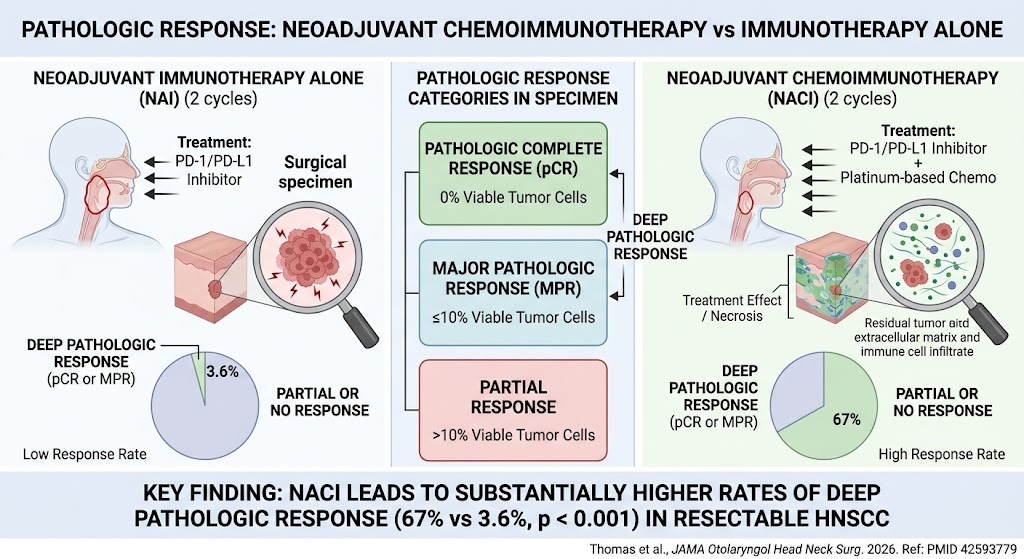
Neoadjuvant chemoimmunotherapy (NACI) in resectable head and neck squamous cell carcinoma (HNSCC) leads to significantly higher rates of pathologic complete response (pCR) and major pathologic response (MPR) compared with neoadjuvant immunotherapy (NAI) alone. The regimen is feasible and well tolerated, with few delays to surgery.
Study Background
Head and neck squamous cell carcinoma (HNSCC) is a common malignancy that often presents at a locally advanced stage, contributing to a substantial global disease burden. Despite multidisciplinary treatment approaches including surgery, radiation, and chemotherapy, survival outcomes remain unsatisfactory, with high rates of treatment failure and recurrence. Immunotherapy, particularly immune checkpoint inhibitors, has shown promise in recurrent or metastatic HNSCC, but its role in earlier-stage disease and in the neoadjuvant setting is still evolving. Single-agent neoadjuvant immunotherapy regimens have yielded modest pathologic response rates, leading investigators to explore combination strategies integrating chemotherapy and immunotherapy (chemoimmunotherapy) to potentiate anti-tumor effects and improve long-term outcomes.
Study Design
This was a retrospective cohort study conducted at a large, urban tertiary academic referral center, assessing adult patients with pathologically confirmed resectable squamous cell carcinoma of the head and neck aerodigestive tract. Patients treated from July 2024 to March 2026 who received at least one cycle of neoadjuvant immunotherapy alone (NAI) or neoadjuvant chemoimmunotherapy (NACI) prior to definitive surgical resection were included. The study cohort also incorporated patients with locoregional tumor recurrence treated with curative intent. Both NAI and NACI regimens were typically administered over two cycles before surgery. The primary outcome measure was pathologic response in the surgical specimen, classified as pathologic complete response (pCR), major pathologic response (MPR, defined as ≤10% viable tumor), or partial response. Deep pathologic response was operationalized as either pCR or MPR. Propensity score-adjusted analyses were carried out to mitigate confounding by baseline differences between groups.
Key Findings
The study enrolled 86 participants with a mean age of 63 years; 31% were female. Overall, 29% (25 patients) achieved pCR, while 17% (15 patients) exhibited MPR. Combining these, 46% demonstrated deep pathologic response. However, responses differed markedly between treatment modalities. Among 58 patients receiving NACI, 67% (39 patients) achieved either pCR or MPR. By contrast, only 3.6% (1 of 28) of patients treated with NAI alone reached this benchmark. Adjusted statistical modeling revealed NACI was associated with dramatically increased odds of achieving deep pathologic response (odds ratio 29.1, 95% CI 6.7 to 274.7). These findings suggest a synergistic effect of chemotherapy with immunotherapy in inducing tumor regression preoperatively.
Regarding safety, the combined chemoimmunotherapy regimen was generally well tolerated without significant adverse event–related delays to definitive surgery, supporting its feasibility in a real-world clinical context.
Expert Commentary
These data add to the growing evidence favoring neoadjuvant chemoimmunotherapy over immunotherapy alone in resectable HNSCC. The high rates of pathologic complete and major responses may translate into improved disease control and survival, though prospective randomized trials are needed for confirmation. Biologically, chemotherapy can induce immunogenic cell death, enhancing antigen presentation and immune activation, which likely synergizes with checkpoint blockade to amplify anti-tumor immunity. The study’s retrospective nature and single-center setting may limit broader generalizability, and unmeasured confounding cannot be excluded despite propensity score adjustment. Prospective clinical trials incorporating survival endpoints, biomarker analyses, and quality-of-life assessments will be critical to validate and extend these findings.
Conclusion
In summary, neoadjuvant chemoimmunotherapy achieves substantially higher pathologic response rates than immunotherapy alone in patients with resectable head and neck squamous cell carcinoma, with an acceptable safety profile. This combination strategy shows promise for enhancing tumor eradication before surgery and potentially improving long-term outcomes. Future prospective trials are warranted to assess survival benefits and optimize neoadjuvant regimens in this patient population.
Funding and Trial Registration
Details regarding specific funding sources or clinical trial registrations were not provided in the retrospective study report.
References
1. Gomez EA, Kraft DO, Elkersh Y, et al. Pathologic Response After Neoadjuvant Chemoimmunotherapy in Head and Neck Squamous Cell Carcinoma. JAMA Otolaryngol Head Neck Surg. 2026; PMID: 42593779. Available at: https://pubmed.ncbi.nlm.nih.gov/42593779/
2. Ferris RL, Blumenschein G Jr, Fayette J, et al. Nivolumab for Recurrent Squamous-Cell Carcinoma of the Head and Neck. N Engl J Med. 2016 Nov 10;375(19):1856-1867.
3. Uppaluri R, Campbell KM, Egloff AM, et al. Neoadjuvant nivolumab or nivolumab plus ipilimumab in untreated oral cavity squamous cell carcinoma: a phase 2 randomized clinical trial. Nat Med. 2020 May;26(5):747-755.
This article was created using several editorial tools, including AI, as part of the process. Human editors reviewed this content before publication.