Incidental Emphysema Detected on Routine Screening Chest CT and Its Association with Mortality in a Korean Population
Highlight
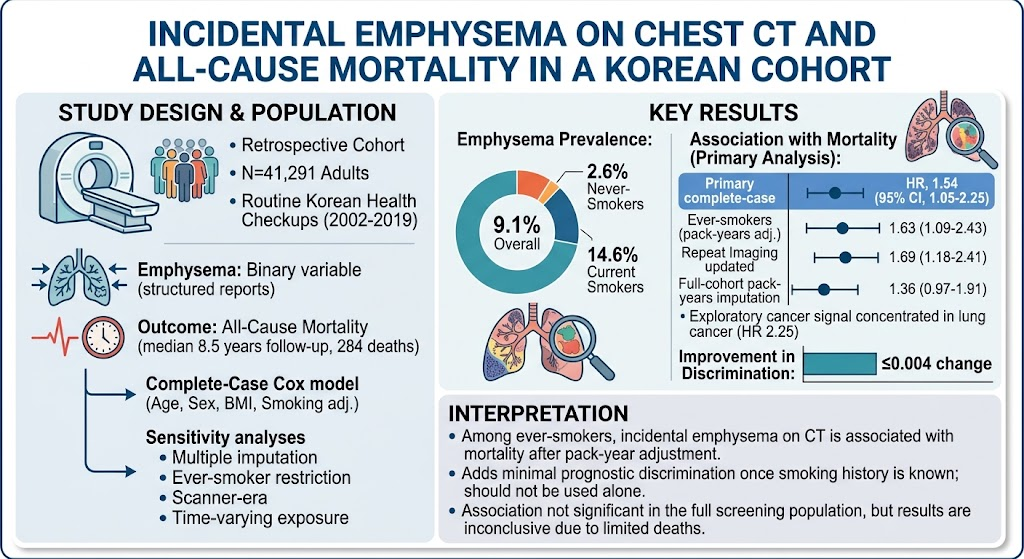
1. Incidental emphysema is detected in approximately 9% of asymptomatic adults undergoing screening chest CT in Korea, with prevalence increasing markedly among current smokers.
2. Among ever-smokers, incidental emphysema independently correlates with an increased risk of all-cause mortality, even after adjusting for detailed smoking exposure.
3. The presence of incidental emphysema adds minimal prognostic discrimination beyond known smoking history and should not solely guide clinical risk stratification.
4. The study’s findings in the full cohort, including never-smokers, were inconclusive due to limited mortality events, emphasizing cautious interpretation.
Study Background
Emphysema, a chronic obstructive pulmonary disease (COPD) phenotype characterized by alveolar destruction and airspace enlargement, is well recognized as a major contributor to respiratory morbidity, particularly among smokers. With increasing use of low-dose chest computed tomography (CT) screening for lung cancer and health checkups, emphysema is often incidentally identified in asymptomatic individuals. However, the prognostic significance of incidentally detected emphysema on routine screening chest CT among asymptomatic populations remains inadequately characterized. Understanding the mortality risk associated with incidental emphysema could inform clinical follow-up and management strategies, particularly in lung cancer screening programs and routine health screenings.
Study Design and Methods
This retrospective cohort study analyzed 41,291 adults who underwent chest CT scans as part of routine health screenings in Korea from 2002 to 2019. Emphysema status was extracted as a binary variable from structured radiology reports. The primary outcome was all-cause mortality, ascertained through linkage with the national death registry. Participants’ demographic data including age, sex, body mass index (BMI), smoking status (never, former, current), and cumulative smoking exposure in pack-years were recorded.
The primary statistical approach employed a multivariate Cox proportional hazards model adjusted for age, sex, BMI, and smoking status, analyzing complete cases. Several sensitivity analyses were performed to address confounding and robustness of findings: multiple imputation for missing pack-years, restriction to ever-smokers with adjustment for smoking intensity, adjustment for scanner-era to account for technical variations, modeling emphysema as a time-varying exposure to incorporate repeat imaging data, and competing-risks models examining specific causes of death.
Key Findings
The prevalence of incidental emphysema in this cohort was 9.1% overall, varying substantially by smoking status: 2.6% in never-smokers, 9.1% in former smokers, and 14.6% in current smokers. Over a median follow-up of 8.5 years, there were 284 deaths recorded.
In the complete-case analysis adjusted for key confounders, emphysema was significantly associated with higher all-cause mortality (Hazard Ratio [HR] 1.54; 95% Confidence Interval [CI] 1.05–2.25). Among ever-smokers, after detailed adjustment for pack-years, this association remained robust (HR 1.63; 95% CI 1.09–2.43). When emphysema status was updated over time using repeat imaging data, the association slightly strengthened (HR 1.69; 95% CI 1.18–2.41).
However, in the full cohort where pack-year data were imputed for missing cases, the association attenuated to non-significance (HR 1.36; 95% CI 0.97–1.91), likely influenced by the inclusion of never-smokers, among whom no deaths occurred in emphysema-positive individuals. This dilution underscores the importance of smoking history in risk stratification.
An exploratory analysis focused on cause-specific mortality revealed a notable signal for cancer-related deaths, primarily lung cancer (13 lung cancer deaths associated with emphysema; HR 2.25). Despite this signal, adding incidental emphysema status to prognostic models already incorporating smoking history yielded minimal improvement in discriminatory power (increase of ≤0.004 in model discrimination metrics).
Expert Commentary
This large-scale, longitudinal cohort study provides compelling evidence that incidental emphysema detected on routine screening chest CT carries prognostic significance for mortality among ever-smokers, independent of quantified smoking exposure. Nonetheless, residual confounding by unmeasured aspects of smoking intensity or environmental exposures cannot be fully excluded, given the observational nature of the study.
Notably, while emphysema presence correlates with mortality risk, the incremental value of emphysema beyond smoking history is marginal, suggesting that clinical decisions should not rely on isolated emphysema findings without contextual smoking data. The authors prudently refrain from recommending emphysema as a stand-alone prognostic marker or sole indication for COPD evaluation in asymptomatic individuals.
Limitations include the retrospective design and reliance on radiology report text rather than quantitative emphysema metrics, which could reduce sensitivity and specificity. Also, the study population predominantly consists of Korean adults undergoing routine health screenings, which may limit generalizability to other ethnic groups or clinical settings.
The intriguing cancer mortality signal associated with emphysema warrants further investigation into underlying biological mechanisms linking lung parenchymal destruction and carcinogenesis. Future prospective studies integrating lung function testing, quantitative imaging, and biomarker assessments could enrich predictive models and guide targeted interventions.
Conclusion
Incidental emphysema detected during routine screening chest CT examinations in asymptomatic Korean adults is relatively common, particularly among smokers. Among ever-smokers, this finding independently predicts increased all-cause mortality after adjusting for smoking exposure. However, in the broader population including never-smokers, the association remains inconclusive due to limited mortality events.
Clinically, incidental emphysema should be interpreted in conjunction with detailed smoking history, as it contributes minimally to mortality risk discrimination beyond smoking data. While the results highlight the prognostic importance of emphysema, they do not justify the use of incidental emphysema alone to stratify prognosis or direct management strategies without further supporting clinical information.
Further research is needed to clarify whether incidental emphysema should trigger systematic evaluation for undiagnosed COPD and to explore its potential role as a biomarker for lung cancer risk in screening populations.
Funding and Clinical Trial Registration
This was an observational retrospective cohort study. No clinical trial registration applies. Funding details were not specified in the source article.
References
Nam Y, Cho HR, Kim E, Ko NG, Hong P, Cho HK. Incidental Emphysema on Health Screening Chest CT and All-Cause Mortality in a Korean Cohort. Chest. 2026 Aug 19. PMID: 42617836.
Global Initiative for Chronic Obstructive Lung Disease (GOLD). Global Strategy for the Diagnosis, Management, and Prevention of COPD. 2023 Report.
Lynch DA, Austin JHM, Hogg JC, et al. CT-Definable Subtypes of Chronic Obstructive Pulmonary Disease: A Statement of the Fleischner Society. Radiology. 2015;277(1):192-205.
Washko GR, Silverman EK. How Do Advances in Computed Tomography and MicroCT Imaging Can Aid the Understanding of COPD? Respiratory Medicine. 2009;103(3):345-353.
This article was created using several editorial tools, including AI, as part of the process. Human editors reviewed this content before publication.