Longitudinal Heart Stress Changes and Cardiovascular Risk in Older Adults: Insights from NT-proBNP Dynamics
Highlight
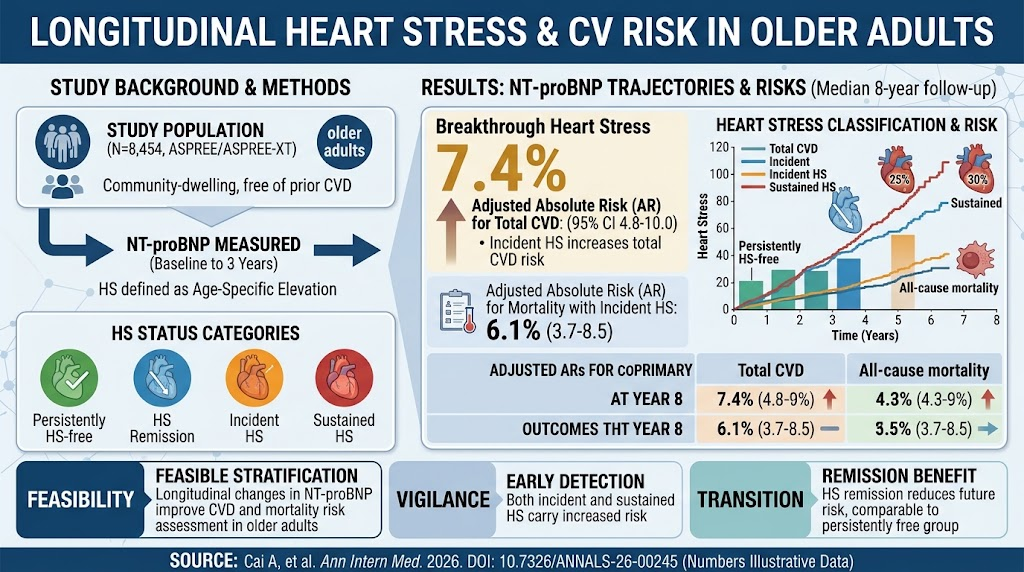
This observational study highlights that longitudinal changes in N-terminal pro-B-type natriuretic peptide (NT-proBNP) levels, reflecting heart stress (HS) status, provide improved risk stratification for cardiovascular disease (CVD) and all-cause mortality in community-dwelling older adults free of prior CVD. Notably, incident and sustained HS were associated with significantly higher absolute risks of CVD and death over eight years, whereas remission of HS corresponded to risks similar to those persistently HS-free.
Study Background
Cardiovascular disease remains a leading cause of morbidity and mortality in older adults worldwide. Early identification of those at increased future risk is critical for timely intervention to prevent adverse outcomes. NT-proBNP is a well-established biomarker released in response to myocardial wall stress, with elevated concentrations previously linked to incident CVD, heart failure, and mortality. However, single NT-proBNP measurements may fail to capture dynamic changes in cardiovascular risk over time, especially in older adults undergoing complex physiological changes. Understanding how changes in NT-proBNP over time—termed “heart stress” status—affect long-term cardiovascular and mortality outcomes could refine risk assessment and guide preventive strategies in this demographic.
Study Design
The study utilized data from the ASPREE trial and its observational extension, ASPREE-XT, involving 8454 community-dwelling older adults (mean age 78 years, 52.9% women) free of prior cardiovascular events. NT-proBNP levels were measured at baseline and at three years. Participants were categorized into four heart stress (HS) status groups based on NT-proBNP changes from enrollment to year 3: persistently HS-free (low NT-proBNP at both times), HS remission (elevated initially but normalized by year 3), incident HS (normal initially but became elevated by year 3), and sustained HS (elevated at both times).
The primary outcomes were total cardiovascular disease events, defined as nonfatal myocardial infarction, fatal or nonfatal stroke, coronary heart disease death, or hospitalization for heart failure, and all-cause mortality, assessed over a median follow-up of eight years beyond year 3.
Key Findings
Among 818 CVD events and 1584 deaths recorded during follow-up, the study found significant differences in risk according to HS status categories. Compared with the persistently HS-free group, participants with incident HS had an adjusted absolute risk (AR) increase of 7.4% (95% CI, 4.8% to 10.0%) for total CVD events at 8 years, while those with sustained HS had an AR increase of 6.7% (CI, 4.3% to 9.0%). Similarly, all-cause mortality AR was higher by 6.1% (CI, 3.7% to 8.5%) in incident HS and 7.5% (CI, 5.2% to 9.8%) in sustained HS compared with persistently HS-free participants.
Importantly, participants with HS remission exhibited adjusted risk profiles comparable to those continuously HS-free, suggesting that normalization of NT-proBNP confers a lower future risk.
The persistence or emergence of elevated NT-proBNP thus portends a substantially increased risk of cardiovascular events and death independent of traditional risk factors. These results underscore the value of repeated NT-proBNP measurement in enhancing prognostic accuracy in older populations.
Expert Commentary
This study contributes important longitudinal evidence supporting dynamic assessment of NT-proBNP as a biomarker of evolving heart stress and cardiovascular risk in older adults without prior CVD. The delineation of four distinct HS trajectories—persistently low, remission, incident, and sustained—provides a nuanced framework for interpreting biomarker changes beyond single baseline values.
While observational, the large sample size, well-characterized cohort, and robust adjudication of clinical endpoints strengthen the validity of findings. However, the predominantly White participant base limits generalizability to more diverse populations, where NT-proBNP distributions and cardiovascular risks may differ.
Clinicians may consider serial NT-proBNP measurements to identify older patients who would benefit from intensified preventive interventions. Further research should explore underlying mechanisms driving HS remission and whether targeted therapies can modify NT-proBNP trajectories and outcomes.
Conclusion
Longitudinal changes in NT-proBNP levels identify distinct heart stress trajectories in older adults, with incident and sustained elevation strongly predicting future cardiovascular disease and mortality risk. Incorporation of heart stress status assessment into cardiovascular risk stratification models could improve individualized preventive strategies in the elderly population.
Funding and ClinicalTrials.gov
No specific funding sources were declared for this study. The data originated from the ASPREE trial (ASPirin in Reducing Events in the Elderly) and its observational extension (ASPREE-XT), registered clinical trials investigating aspirin use and health outcomes in the elderly.
References
1. Cai A, Bayes-Genis A, Wolfe R, et al. Longitudinal Changes in Heart Stress and the Risk for Cardiovascular Disease and Mortality in Older Adults: An Observational Study. Ann Intern Med. 2026 Aug 18; PMID: 42607310.
2. Januzzi JL Jr, et al. N-terminal pro-B-type natriuretic peptide testing for diagnosis and prognosis in heart failure. J Am Coll Cardiol. 2018;71:2172-2187.
3. Wang TJ, Larson MG, Levy D, et al. Plasma natriuretic peptide levels and the risk of cardiovascular events and death. N Engl J Med. 2004;350(7):655-663.
4. Yancy CW, et al. 2017 ACC/AHA/HFSA Focused Update of the 2013 ACCF/AHA Guideline for the Management of Heart Failure. J Am Coll Cardiol. 2017;70(6):776-803.
This article was created using several editorial tools, including AI, as part of the process. Human editors reviewed this content before publication.