Highlight
This randomized controlled trial uniquely compares loop electrosurgical excision procedure (LEEP) performed with versus without intraoperative Lugol’s iodine staining (IOS). Contrary to expectations, the application of IOS was associated with a significantly higher rate of involved (positive) resection margins. Secondary outcomes indicated reduced postoperative bleeding intensity and duration in the iodine-staining group, but no differences in operative complications, pain, or procedure time. The findings argue against routine use of intraoperative iodine for margin delineation during LEEP.
Study Background
Cervical intraepithelial neoplasia (CIN), a precancerous condition often identified through screening, is commonly managed by loop electrosurgical excision procedure (LEEP), which removes affected cervical tissue. Precise excision margins are critical to minimize residual disease and recurrence risk. Lugol’s iodine staining (IOS) is applied intraoperatively in some centers with the aim of better defining the transformation zone and lesion margins by exploiting the differential iodine uptake of normal versus abnormal epithelium. However, there is a lack of randomized, head-to-head evidence evaluating whether IOS truly improves surgical outcomes such as margin status. This study addresses this important clinical question to guide best practice in cervical excision procedures.
Study Design
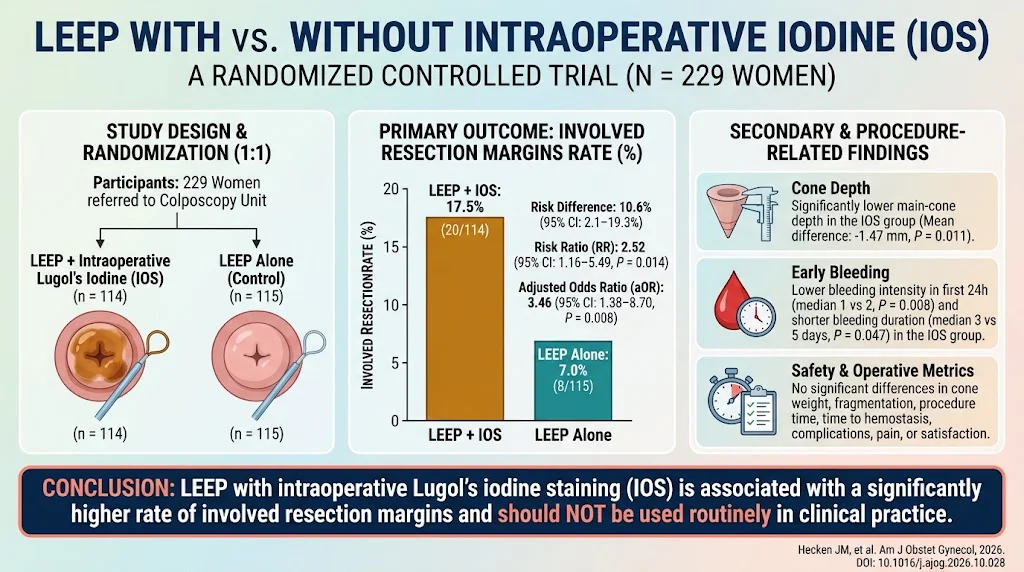
This prospective randomized controlled trial recruited 229 women referred to a university colposcopy unit for LEEP between January 2022 and September 2025. Participants were randomized 1:1 to undergo LEEP with intraoperative Lugol’s iodine application (IOS arm, n=114) or LEEP without IOS (control arm, n=115). The primary endpoint was the histopathological rate of involved (positive) resection margins. Secondary endpoints included patient satisfaction on the day of surgery and 14 days postoperatively, procedure-related metrics (pain, blood loss, cone weight, fragmentation, time to hemostasis), intraoperative complications, and surgeon preference. Statistical analyses included chi-square, t-tests, and multivariable logistic regression adjusting for age, BMI, smoking history, and transformation zone type.
Key Findings
The intention-to-treat analysis revealed a stark difference in involved margin rates: 17.5% in the IOS group versus 7.0% in the control group (risk difference 10.6 percentage points; 95% CI 2.1–19.3; P=0.014). Multivariable logistic regression confirmed that IOS increased the odds of positive margins (adjusted odds ratio 3.46, 95% CI 1.38–8.70; P=0.008), independent of other covariates.
Post hoc analysis of 215 women showed that the main cone depth was significantly lower in the IOS group by 1.47 mm after adjusting for transformation zone type (P=0.011). However, there were no significant differences in cone weight, cone fragmentation, procedure duration, or time to achieve hemostasis.
Intraoperative complications were similar across groups, and surgeons’ subjective ratings did not differ. Immediate postoperative pain intensity and satisfaction were also comparable. At 14-day follow-up, bleeding outcomes favored the IOS group: median bleeding intensity during the first 24 hours was lower (1 vs 2 on a 0–10 scale, P=0.008) and bleeding duration was shorter (3 vs 5 days, P=0.047). There were no noted differences in pain duration, analgesic use, or overall satisfaction at follow-up.
Expert Commentary
This trial provides robust evidence challenging the long-held assumption that intraoperative Lugol’s iodine facilitates better margin delineation during LEEP. The unexpected increase in involved margins with IOS suggests that iodine staining may alter the surgical field or operator interpretation in ways that reduce excision completeness. The somewhat shallower cone depth with IOS may indicate less extensive excision, potentially contributing to the higher positive margin rates.
While reduced postoperative bleeding with iodine staining may represent a clinical advantage, margin status remains critical to oncological safety. These findings warrant reconsideration of routine IOS use during LEEP and underscore the imperative for caution before adopting staining techniques without strong evidence.
The study’s strengths include its randomized design, adequate sample size, and comprehensive assessment of operative and patient-centered outcomes. Limitations involve single-center setting, potential operator bias despite randomization, and relatively short follow-up to assess longer-term recurrence rates.
Conclusion
In summary, intraoperative Lugol’s iodine staining during LEEP is associated with a significantly increased risk of involved resection margins despite some benefits in bleeding outcomes. Given the critical importance of clear margins in CIN treatment, routine use of IOS cannot be recommended based on current evidence. Further studies with longer follow-up are needed to assess whether these margin differences translate into altered clinical outcomes such as recurrence or need for repeat procedures.
Funding and Registration
The trial was undertaken at a university colposcopy unit with no specific funding disclosures provided. The clinical trial registration and further logistic details were not reported in the available abstract.
References
Hecken JM, Romich FA, Tempfer CB, Rezniczek GA. Loop electrosurgical excision procedure with or without intraoperative iodine: A randomized controlled trial. American Journal of Obstetrics and Gynecology. 2026 Oct 26. PMID: 42933750.
Gray RJ, Manchanda R. Treatment of cervical intraepithelial neoplasia: balancing risk and benefit in surgical excision techniques. Obstetrics and Gynecology Clinics. 2017;44(3):437–455.
Castle PE, Maza M. Prophylactic HPV vaccination: the population impact. Preventive Medicine. 2016;91:270-273.