Repeat Procedures After CIN Excision: LEEP Tied to More Repeat Excisions, CKC to Higher Cancer and Hysterectomy Rates
Among 117,235 patients with high-grade CIN treated with CKC or LEEP, the overall need for repeat procedures was substantial.
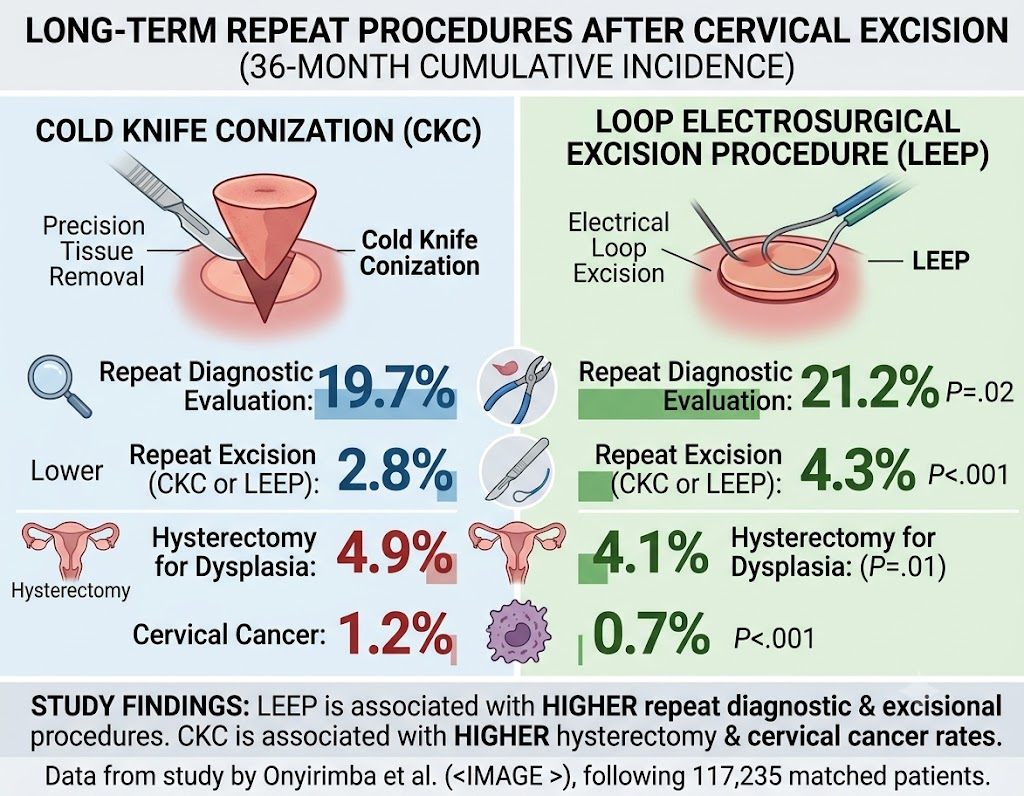
LEEP was associated with higher rates of repeat diagnostic evaluation (21.2% vs 19.7%) and repeat excision (4.3% vs 2.8%) over 36 months.
CKC was associated with higher rates of hysterectomy (4.9% vs 4.1%) and subsequent cervical cancer diagnosis (1.2% vs 0.7%).
These findings highlight trade-offs that may inform shared decision-making about excisional treatment choice.
Study Snapshot
Design: | Retrospective cohort using a large US commercial claims database (MarketScan, 2008–2021) |
Population: | 117,235 patients with high-grade cervical intraepithelial neoplasia (CIN) treated with cold knife conization (CKC; n=13,147) or loop electrosurgical excision procedure (LEEP; n=104,088); propensity-score matched groups compared |
Primary Outcomes: | Cumulative 36-month rates of repeat diagnostic evaluation (colposcopy, biopsy, endocervical curettage), repeat excision (CKC or LEEP), hysterectomy for dysplasia, and cervical cancer diagnosis |
Main Results: | Repeat diagnostic evaluation: 19.7% (CKC) vs 21.2% (LEEP), P=.02; Repeat excision: 2.8% vs 4.3%, P<.001; Hysterectomy: 4.9% vs 4.1%, P=.01; Cervical cancer: 1.2% vs 0.7%, P<.001 |
Limitations: | Administrative database lacks histology details, HPV status, smoking, parity; measured confounders only; possible coding errors; results may not generalize to uninsured populations |
Why This Study Matters
Cervical excisional procedures—cold knife conization (CKC) and loop electrosurgical excision procedure (LEEP)—are standard treatments for high-grade cervical intraepithelial neoplasia (CIN). Both effectively remove precancerous tissue, but their long-term outcomes regarding the need for repeat diagnostic and therapeutic interventions have not been well compared in large, contemporary cohorts. Understanding these patterns is essential for counseling patients and for surveillance planning.
How the Study Was Conducted
Researchers used the MarketScan commercial claims database to identify women aged 18–64 years who underwent CKC or LEEP for high-grade CIN between 2008 and 2021. Patients with adenocarcinoma in situ were excluded. To reduce selection bias, the investigators employed propensity score matching, balancing age, region, comorbidities, and other clinical and demographic characteristics. After matching, 13,147 CKC-treated and 104,088 LEEP-treated patients were analyzed for up to 36 months. The cumulative incidence of repeat diagnostic procedures (colposcopy, biopsy, endocervical curettage), repeat excisional procedures (CKC or LEEP), hysterectomy performed for dysplasia, and subsequent diagnosis of cervical cancer was compared using Gray's test, accounting for competing risks.
What the Researchers Found
Overall, the need for additional procedures after initial excision was substantial. Within 36 months, nearly one in five patients required repeat diagnostic evaluation. The cumulative incidence of repeat diagnostic procedures was 19.7% after CKC and 21.2% after LEEP (P=.02). Repeat excision was also more common after LEEP: 4.3% vs 2.8% for CKC (P<.001). In contrast, hysterectomy for dysplasia was performed more often after CKC (4.9% vs 4.1%, P=.01), and cervical cancer was diagnosed more frequently after CKC (1.2% vs 0.7%, P<.001). The absolute differences were modest but statistically significant.
What the Findings May Mean
The results point to distinct trade-offs between the two procedures. LEEP, which is less invasive and more commonly performed, was associated with a higher likelihood of requiring subsequent diagnostic evaluations and repeat excisions. This may reflect a higher rate of positive or indeterminate margins after LEEP, though the study did not have margin status data. Conversely, CKC, which often provides a deeper and more complete specimen, was associated with a higher risk of hysterectomy and cervical cancer diagnosis. The latter finding is unexpected and may indicate channeling bias—patients with more concerning clinical features or larger lesions may have been preferentially offered CKC, despite propensity score matching. Alternatively, CKC itself might alter the cervical architecture in ways that affect cancer surveillance.
Strengths and Limitations
The study's major strength is its large, real-world population and use of propensity score matching to address measured confounders. However, as a retrospective claims–based analysis, it is limited by the absence of histologic details such as margin status, lesion size, glandular involvement, and HPV genotyping. Important confounders like smoking, parity, and immunosuppression were not measured. Propensity score matching can only account for variables captured in the database, so residual confounding is likely. The findings apply primarily to patients with commercial insurance and may not reflect outcomes in uninsured or publicly insured populations.
Implications for Practice and Research
Clinicians should be aware that regardless of the excisional method used, a substantial proportion of patients with high-grade CIN will require further evaluation or treatment within three years. The choice between CKC and LEEP should weigh the risk of repeat diagnostic and excisional procedures (higher with LEEP) against the risk of hysterectomy and subsequent cancer diagnosis (higher with CKC). Prospective studies with detailed pathology and HPV data, as well as longer follow-up, are needed to clarify the underlying reasons for these differences and to refine surveillance strategies.
Funding, Disclosures, and Registration
Funding and disclosure information were not reported in the abstract. The study did not indicate registration.
References
Onyirimba B, Chen L, Ferris J, et al. Repeat diagnostic and therapeutic procedures after excisional procedures for high-grade cervical intraepithelial neoplasia. Obstet Gynecol. 2026 Jul 24. PMID: 42492079.
This article was created using several editorial tools, including AI, as part of the process. Human editors reviewed this content before publication.