Highlight
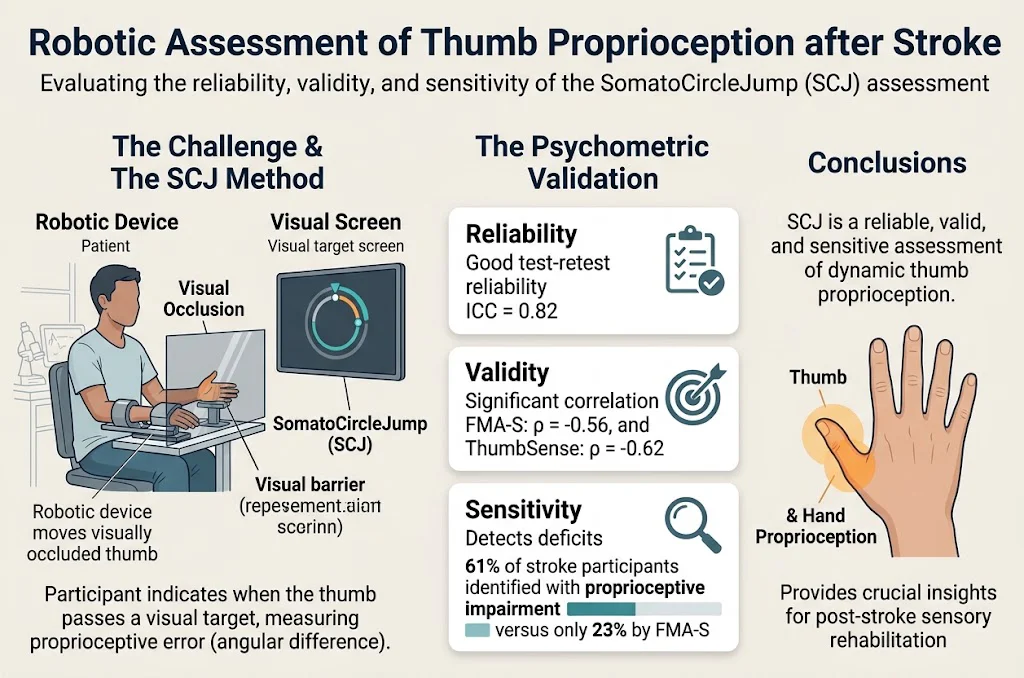
The SomatoCircleJump (SCJ), a novel robotic assessment tool, reliably and sensitively measures dynamic thumb proprioception in chronic stroke survivors. SCJ demonstrated strong test-retest reliability (ICC 0.82) and correlated significantly with established clinical and robotic proprioception measures. It identified thumb proprioceptive impairment in 61% of stroke patients, markedly higher than the 23% detected by traditional clinical scales, underscoring prevalent sensory deficits often overlooked in routine assessments.
Study Background
Proprioception, the sense of limb position and movement, is essential for fine motor control and dexterity. The thumb plays a pivotal role in hand function, contributing critically to tasks requiring precision grip. After stroke, sensory impairments including proprioceptive deficits contribute to persistent functional limitations. However, clinical assessment of thumb proprioception is often rudimentary and poorly sensitive, limiting the recognition of sensory deficits and consequently hampering targeted rehabilitation efforts. Addressing this gap, advanced robotic tools offer objective, precise quantification of proprioceptive function.
Study Design
This cross-sectional psychometric study utilized baseline data from a clinical trial involving 35 chronic stroke survivors with residual unilateral hand weakness and 24 healthy, age-matched controls. The primary intervention was the assessment itself using the SomatoCircleJump (SCJ) robotic system, in which a robot moved the visually occluded thumb through a range of motion. Participants indicated when their thumb passed a visually presented angular target, allowing calculation of proprioceptive error as the angular difference between actual thumb position and the participant’s reported position. Assessments were performed twice 5–10 days apart to evaluate test-retest reliability.
Comparator measures included the Fugl-Meyer Assessment Sensory Scale (FMA-S) thumb position item and two validated robotic proprioceptive tests: ThumbSense, targeting thumb position sense, and Crisscross, targeting finger proprioception. These tools enabled evaluation of SCJ’s validity and sensitivity in detecting proprioceptive deficits.
Key Findings
The SCJ demonstrated robust test-retest reliability with an Intraclass Correlation Coefficient (ICC) of 0.82 (95% CI 0.72–0.87), reflecting consistent measurements across sessions. Validity analyses showed significant correlations between SCJ error and the FMA-S thumb item (Spearman’s ρ = -0.56, p < 0.001), ThumbSense accuracy (ρ = -0.62, p < 0.001), and Crisscross error assessing finger proprioception (ρ = 0.61, p < 0.001). These correlations confirm that SCJ measures a construct closely related to established proprioceptive parameters.
Utilizing a conservative 2-standard-deviation cutoff relative to controls, SCJ detected thumb proprioceptive impairment in 61% of stroke survivors, compared to only 23% identified by the conventional FMA-S clinical scale. This significant sensitivity difference highlights the SCJ’s superiority in revealing subtle and dynamic proprioceptive deficits.
Furthermore, the association between thumb and finger proprioceptive impairments suggests shared or overlapping sensory pathway disruptions post-stroke, with potential implications for holistic sensory rehabilitation strategies.
Expert Commentary
The introduction of the SCJ robotic assessment represents a meaningful advance in the quantitative evaluation of upper extremity sensory function post-stroke. Traditional clinical scales such as the FMA-S often rely on subjective, categorical scoring systems that lack granularity and fail to detect mild deficits that nonetheless may impact functional recovery. By contrast, SCJ provides a dynamic, continuous measure of proprioception with high reliability and sensitivity.
Nevertheless, the study’s cross-sectional design and moderate sample size invite caution regarding generalizability. Future longitudinal studies assessing responsiveness to therapeutic interventions and expanded validation in diverse stroke populations would strengthen evidence for clinical integration. Additionally, clinical workflow considerations, such as assessment duration and equipment accessibility, will determine real-world implementation feasibility.
Mechanistically, the close relationship between thumb and finger proprioceptive deficits supports neuroanatomical data implicating shared dorsal column and cortical processing pathways. This convergence emphasizes the need for integrated sensory rehabilitation targeting the hand as a functional unit rather than isolated digits.
Conclusion
The SomatoCircleJump robotic system is a reliable, valid, and sensitive tool for assessing dynamic thumb proprioception in chronic stroke survivors, outperforming standard clinical sensory scales. It reveals that thumb proprioceptive deficits are common and often coincide with finger proprioceptive impairments, underscoring the importance of comprehensive sensory evaluation in stroke rehabilitation. This tool holds promise to facilitate objective monitoring of sensory recovery and guide personalized therapeutic interventions to improve hand function post-stroke.
Funding and Clinical Trials
The source study was conducted in a university-based rehabilitation research laboratory; specific funding sources and clinical trial registration details were not provided within the primary abstract.
References
Garcia-Fernandez L, Farrens AJ, Chan V, et al. Robotic Assessment of Thumb Proprioception after Stroke: Reliability, Validity, and Sensitivity. Arch Phys Med Rehabil. 2026 Oct 29; PMID: 42956919.
Carey LM, Matyas TA. Feedback and the assessment of proprioception after stroke. J Neurol Neurosurg Psychiatry. 2011;82(9):863–867.
Koch G, Buccino G, Caltagirone C. Role of sensory feedback in stroke motor recovery: insights from neurophysiological and neuroimaging studies. Curr Opin Neurol. 2012 Apr;25(2):296-301.
Sanes JN, Donoghue JP. Plasticity and primary motor cortex. Annu Rev Neurosci. 2000;23:393-415.