Highlight
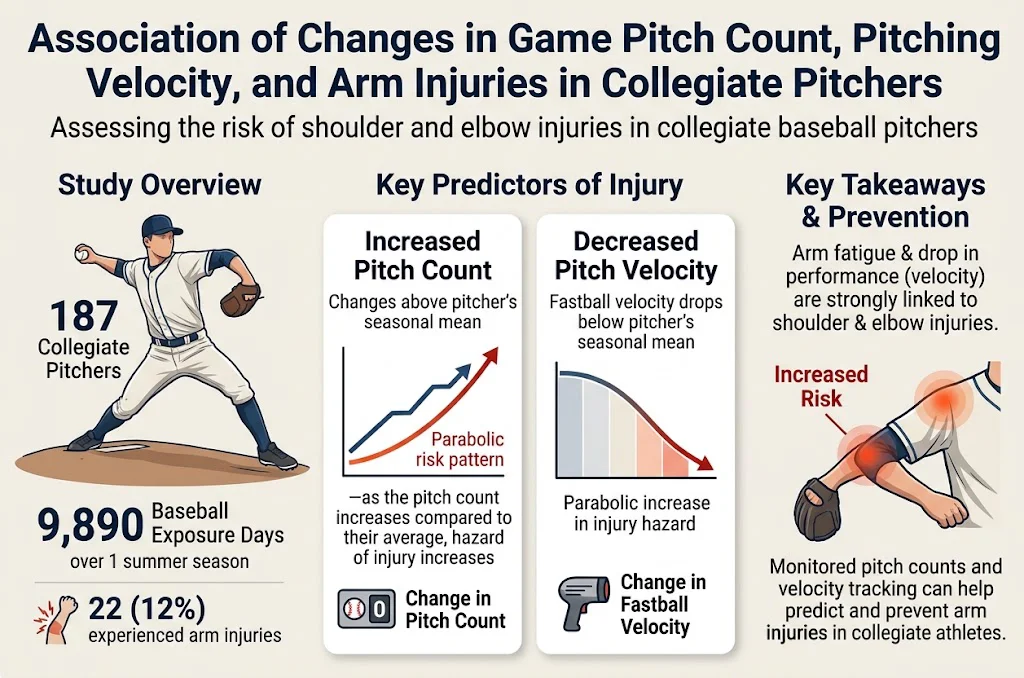
Increased game pitch counts above a pitcher’s personal average correlate with a higher risk of shoulder and elbow injuries.
Decreases in mean fastball velocity relative to individual baseline also associate with elevated injury risk.
Nonlinear, parabolic relationships suggest that both excessive increases and reductions in workload and velocity have injury implications.
Prospective cohort design with 187 collegiate pitchers offers robust data over nearly 10,000 exposure days.
Study Background
Shoulder and elbow injuries represent a significant burden for baseball pitchers, particularly at the collegiate level where training intensity and performance demands increase. Such injuries not only impair athletic performance but can also cause long-term morbidity affecting career trajectories. Previous research has identified pitch count and pitch velocity as critical factors influencing injury risk, yet their combined and dynamic effects remain insufficiently characterized. Understanding how fluctuations in these parameters within a pitcher’s seasonal workload relate to injury incidence is essential for optimizing training protocols and preventive strategies.
Study Design
This research employed a prospective cohort design involving 187 collegiate baseball pitchers monitored across a summer competitive season. Data collected included individual game pitch counts, in-game fastball velocity, and records of arm injuries, defined as shoulder or elbow damage requiring medical attention. The study also tracked other outcomes such as player release, voluntary retirement, and season innings limits to control for competing risks that could bias injury detection.
Analytically, Bayesian joint models combined time-to-event Cox regression and multilevel mixed-effects regression techniques to evaluate associations. These models adjusted for nonlinear relationships using natural spline functions to capture complex patterns beyond linear trends. Changes in pitch count and velocity were assessed relative to each pitcher’s seasonal mean, allowing individualized comparison of risk dynamics.
Key Findings
Over nearly 10,000 baseball exposure days, 22 pitchers (12%; 95% CI 7.5%-17.2%) sustained arm injuries, while 4 pitchers (2%; 95% CI 0.6%-5.4%) were released or retired or reached innings limits. The results demonstrated two key nonlinear associations:
Pitch Count Increase: When a pitcher’s game pitch count increased relative to their mean seasonal pitch count, the risk of experiencing shoulder or elbow injury followed a parabolic curve. This indicated an elevated injury hazard associated with substantial increases from baseline workloads, suggesting that overuse or abrupt workload escalation may precipitate injury.
Pitch Velocity Decrease: Contrary to expectations that higher velocity correlates with injury, the study found that decreases in fastball pitch velocity relative to the pitcher’s mean also followed a parabolic risk pattern. Declining velocity may represent fatigue, compensatory mechanics, or underlying injury progression, all of which precede overt clinical injury.
The nonlinear models highlight that both an excessive increase in pitch count and a significant drop in pitch velocity are critical warning signs for arm injuries, emphasizing the importance of individualized monitoring and nuanced workload management.
Expert Commentary
The study provides valuable longitudinal evidence underscoring the complexity of injury risk factors in baseball pitching. The use of Bayesian joint modeling to concurrently analyze pitch workload dynamics and injury time-to-event delivers advanced insights surpassing simple threshold-based recommendations. Importantly, the findings suggest that injury prevention should not solely focus on absolute pitch counts or velocities, but rather on relative changes within the athlete’s unique performance baseline.
Limitations include the focus on collegiate pitchers in a summer season, which may limit generalizability to younger athletes or professional levels. Additionally, the observational design precludes causation but offers compelling association data to guide further interventional studies. Prospective validation with biomechanical data and fatigue biomarkers could enhance mechanistic understanding.
Conclusion
This prospective cohort study identifies that increases in game pitch counts above a pitcher’s mean and decreases in fastball velocity relative to baseline are significantly associated with increased risk of shoulder and elbow injuries in collegiate baseball pitchers. These findings advocate for individualized monitoring strategies that consider dynamic changes rather than static workload limits. Such precision approaches may better protect pitchers from arm injuries and optimize performance longevity. Future research should integrate biomechanical and physiological metrics to refine injury prediction and prevention.
Funding and ClinicalTrials.gov
Details on funding sources and clinical trial registration were not provided in the abstract. Additional disclosures and trial registration information may be available in the full study publication.
References
Salahm P, Plisky P, Beiting J, et al. Association of Changes in Game Pitch Count, Pitching Velocity, and Arm Injuries in Collegiate Pitchers. Am J Sports Med. 2026 Oct 23. PMID: 42925023.
Fleisig GS, Andrews JR. Prevention of elbow injuries in youth baseball pitchers. Sports Health. 2012;4(5):419-424.
Olsen SJ, Fleisig GS, Dun S, et al. Risk factors for shoulder and elbow injuries in adolescent baseball pitchers. Am J Sports Med. 2006;34(6):905-912.