Highlight
A subcutaneous furosemide minipump allows early hospital discharge in heart failure patients requiring ongoing parenteral diuretics.
Early discharge strategy significantly increases days alive and out of hospital (DAOH) at 30 and 60 days post-randomization.
The intervention shortens index hospitalization by over 5 days without a substantial increase in serious adverse events.
Though heart failure readmissions were numerically higher in the early discharge group, overall clinical outcomes suggest safe feasibility.
Study Background
Heart failure remains a prevalent and costly cardiovascular condition worldwide, often necessitating hospitalizations for management of acute decompensations. Intravenous diuretic therapy, particularly with loop diuretics like furosemide, is a cornerstone for managing volume overload in acute heart failure. However, prolonged inpatient intravenous therapy contributes substantially to healthcare expenditure and exposes patients to hospitalization-associated risks, such as nosocomial infections and deconditioning. Current outpatient intravenous administration options are limited, and oral diuretics might be insufficient during acute phases.
This clinical need has propelled exploration of alternative diuretic delivery methods that support earlier hospital discharge. Subcutaneous (SC) administration of a pH-neutral formulation of furosemide via a wearable minipump offers a promising approach, potentially combining efficacy with greater convenience and safety in a home setting.
Study Design
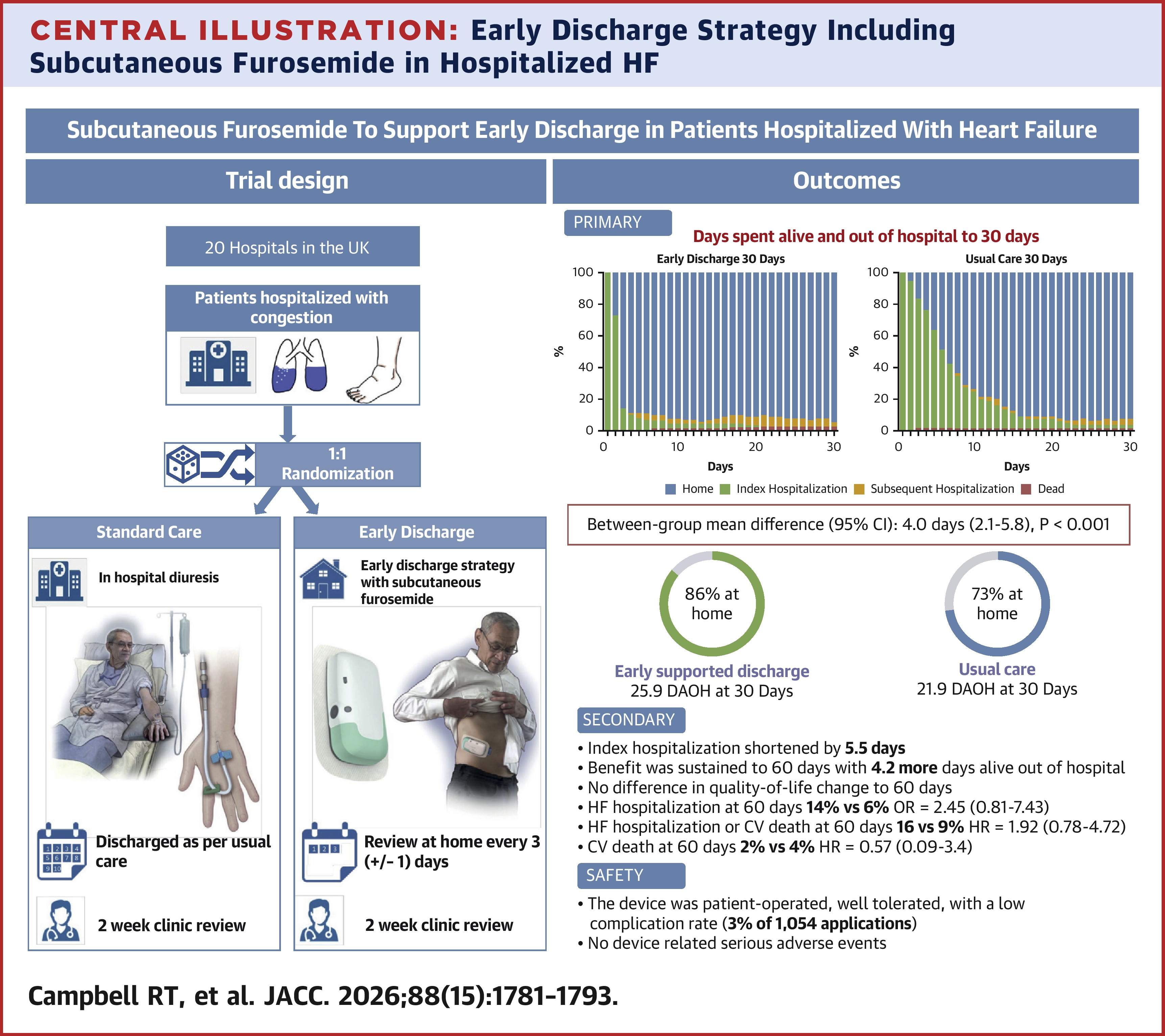
The SUBCUT-HF II trial was a multicenter, open-label, randomized, active-controlled clinical trial conducted across centers in the United Kingdom. It enrolled 172 hospitalized patients with heart failure who required ongoing parenteral diuretics after initial stabilization. Patients were randomized 1:1 to either an early discharge strategy or usual care.
The early discharge cohort received continuous subcutaneous furosemide through a patient-operated, wearable minipump featuring a pH-neutral preparation, facilitating ambulatory parenteral diuretic therapy. Post-discharge management included structured follow-up visits every three days until cessation of subcutaneous therapy.
The control group received standard inpatient care with intravenous diuretics until deemed suitable for discharge, followed by outpatient follow-up at two weeks post-randomization in both arms.
The primary endpoint was days alive and out of hospital (DAOH) within 30 days following randomization. Secondary endpoints included DAOH at 60 days, length of index hospitalization, readmission rates, and safety assessments.
Key Findings
Out of 172 randomized patients, 92 comprised the early discharge group, and 80 received usual care. Baseline demographic and clinical characteristics were well matched between groups.
The early discharge strategy demonstrated a significant increase in DAOH at 30 days, with an adjusted mean difference of 4.0 days (95% CI: 2.1 to 5.8; P < 0.001). This improvement indicates that patients randomized to the subcutaneous furosemide protocol spent substantially more time alive and outside of hospital within the first month after randomization.
Correspondingly, the index hospitalization duration was significantly reduced by an average of 5.5 days (95% CI: 3.6 to 7.4; P < 0.001) in the early discharge group, underscoring the potential for healthcare resource optimization.
The DAOH advantage persisted at 60 days, favoring early discharge by 4.2 days (95% CI: 0.9 to 7.6 days). However, there was a non-significant numerical increase in heart failure-related readmissions in the early discharge arm (14% vs 6%; OR 2.45, 95% CI: 0.81 to 7.43).
Safety outcomes were comparable, with serious adverse events occurring in 25% of early discharge versus 23% in usual care patients. Device-related complications were rare (3%), generally minor, and did not lead to serious adverse outcomes.
These findings suggest that subcutaneous furosemide is an effective and safe alternative to prolonged inpatient intravenous diuretic therapy, enabling earlier safe discharge.
Expert Commentary
This trial addresses a critical gap in outpatient management of heart failure requiring parenteral diuretics. Subcutaneous administration of furosemide via a patient-friendly minipump offers a novel solution to reduce hospital stay length, enhance patient autonomy, and potentially diminish healthcare system burdens associated with prolonged admissions.
While the increased readmission rate warrants cautious interpretation, the trend did not reach statistical significance, and no excess in overall serious adverse events was observed. The frequent follow-up every three days in the intervention arm likely contributed to early detection and management of clinical deterioration.
Limitations include the open-label design and the trial being conducted solely within UK healthcare settings, which might affect generalizability. Future studies could evaluate cost-effectiveness and long-term impact on mortality and health-related quality of life.
Biologically, sustained subcutaneous delivery ensures stable plasma diuretic levels, circumventing issues with oral absorption seen in gut edema during decompensation. Moreover, the pH-neutral formulation addresses local tolerability concerns traditionally associated with subcutaneous furosemide.
Conclusion
The SUBCUT-HF II trial demonstrates that an early discharge strategy incorporating subcutaneous furosemide delivered through a wearable minipump effectively increases days alive and out of hospital and reduces the length of index hospitalization without compromising safety. This approach represents a significant advancement in tailored ambulatory care for patients hospitalized with heart failure requiring ongoing parenteral diuretics.
Implementing such strategies could transform heart failure management paradigms by empowering patients, reducing hospital resource utilization, and enhancing clinical outcomes. Integration into clinical practice should consider local infrastructure for follow-up and device support. Further research is needed on broader implementation, patient selection, and long-term benefits.
Funding and ClinicalTrials.gov Registration
The study was funded by grants supporting novel heart failure interventions. Trial registration: SUBCUT-HF II (NCT05419115).
References
1. Campbell RT, Osmanska J, Docherty KF, et al. Early Discharge Strategy Including Subcutaneous Furosemide in Hospitalized Heart Failure. J Am Coll Cardiol. 2026;88(15):1781-1793. doi:10.1016/j.jacc.2026.08.034
2. McMurray JJV, et al. Heart failure: epidemiology, diagnosis, and management. Lancet. 2022;399(10320):395-415.
3. Felker GM, et al. Diuretic strategies in patients with acute decompensated heart failure. N Engl J Med. 2020;383(12):1237-1248.