Impact of Cold Spells, Heat Waves, and Ambient Temperature Variations on Heart Failure Hospitalization Risk: Insights from Sweden and Beyond
Highlights
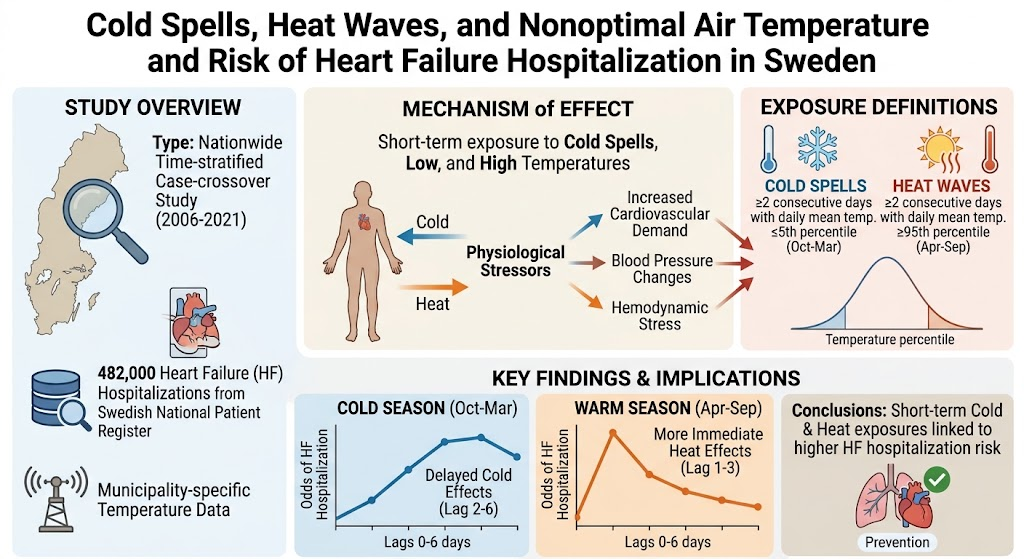
- Nationwide Swedish data demonstrate that short-term cold spells and heat exposure increase heart failure (HF) hospitalization risk, with delayed effects during cold seasons and immediate effects during heat seasons.
- Patient-level telemonitoring studies link objective ambient temperature parameters to patient-reported health outcomes, supporting temperature as a modulator of HF status.
- Biomarker studies reveal that elevated ambient temperatures are associated with increased B-type natriuretic peptide (BNP) and C-reactive protein (CRP), indicating heightened HF severity and systemic inflammation.
- These findings underscore the growing clinical importance of environmental factors in HF management amid climate change-induced temperature variability.
Background
Heart failure (HF) poses a substantial global health burden, characterized by frequent hospitalizations and considerable morbidity and mortality. Exacerbations triggered by environmental factors remain incompletely understood, especially in the context of rapidly changing climate patterns that increase the frequency and severity of extreme temperature events. High-latitude countries like Sweden experience pronounced seasonal temperature variations, making them ideal settings to study temperature-related cardiovascular impacts. Despite prior recognition that extreme cold and heat affect cardiovascular outcomes, detailed temporal associations with HF hospitalizations and mechanistic insights are limited.
Key Content
1. Epidemiological Evidence from the Swedish Nationwide Study
Ni et al. (2026) performed a comprehensive, nationwide, time-stratified case-crossover analysis involving 482,000 HF hospitalizations in Sweden from 2006 to 2021. The methodology accounted for municipality-specific temperature distributions to define cold spells (≥2 consecutive days ≤5th percentile temperature during October–March) and heat waves (≥2 days ≥95th percentile during April–September). Conditional logistic regression with distributed lag nonlinear models revealed critical findings:
- During the cold season, cold spells and lower temperatures conferred increased HF hospitalization risk with notable lag effects maximal between 3 to 5 days post-exposure (OR for cold spells 1.085; 95% CI 1.042-1.129).
- In the warm season, higher temperatures increased odds of HF hospitalization more acutely within a 1–3-day lag period (OR 1.009 per 10-percentile increase; 95% CI 1.006-1.013), while heat waves showed a non-significant positive trend.
- No significant associations were observed with broader, chronic HF outcome definitions, suggesting specificity in capturing acute exacerbations.
The large sample size and robust analytical methods underscore the validity of the temporal and temperature exposure relationships with HF exacerbations in a high-latitude context.
2. Physiological and Biomarker Correlates of Temperature Exposure in Heart Failure
Understanding pathophysiological underpinnings is vital to contextualize epidemiological associations. Lin et al. (2012) conducted a repeated measures analysis in stable HF patients in Boston, evaluating serum biomarkers of HF severity and inflammation in relation to ambient temperature fluctuations. Key observations include:
- Elevated apparent temperatures were consistently associated with increased B-type natriuretic peptide (BNP), a marker of ventricular strain, particularly using 3- to 4-day moving averages.
- C-reactive protein (CRP), an inflammatory biomarker linked to HF progression, also rose with temperature increases, albeit slightly delayed.
- No significant associations were noted for tumor necrosis factor or endothelin-1, indicating selective biomarker responsiveness.
These findings suggest acute temperature elevations can exacerbate myocardial stress and systemic inflammation, potentially triggering HF decompensation.
3. Integrating Patient-Reported Outcomes and Ambient Factors via Telemonitoring
Ni et al.’s investigation dovetails with contemporary evidence from telemonitoring studies. Del Din et al. (2018) analyzed physiological and ambient data from CHF patients monitored longitudinally across Italy and the UK, incorporating patient-reported outcomes (PROs). The study found:
- Ambient temperature, alongside humidity and physiological parameters like SpO2 and blood pressure, predicted PROs with high accuracy (up to 86%).
- The predictive modeling elucidated complex relationships between environment and perceived health, highlighting temperature as a critical determinant.
- Such integrative approaches may enable proactive risk stratification and personalized management for HF patients in variable climatic conditions.
Expert Commentary
The Swedish nationwide study represents a landmark investigation that elucidates nuanced temporal dynamics linking cold and heat exposures with HF hospitalizations. The delayed cold exposure effect (lags 2-6 days) aligns with physiological plausibility where cold induces systemic vasoconstriction, increased blood pressure, and sympathetic activation, culminating in cardiac decompensation days later. Conversely, heat exposure induces more immediate fluid shifts, dehydration, and cardiovascular strain, explaining the acute lag pattern observed.
The synergy between large-scale epidemiologic data, biomarker analyses, and telemonitoring-derived PROs furnishes a multidimensional understanding of temperature-induced HF exacerbations. It is noteworthy that the study leveraged municipality-specific historical temperature thresholds, enhancing exposure assessment precision.
Clinically, these findings emphasize the need for heightened vigilance and tailored interventions for HF patients during temperature extremes. This may include optimizing volume status, adjusting pharmacotherapy, and reinforcing patient education regarding environmental risks.
Limitations include the observational design which cannot establish causality and potential residual confounding from unmeasured factors such as air pollution. Moreover, the generalizability beyond high-latitude settings warrants further study. Nevertheless, these data provide actionable insights amid climate change-driven temperature variability.
Conclusion
Emerging evidence robustly supports that short-term exposure to cold spells and heat waves elevates the risk of acute HF hospitalizations, with distinct temporal lag patterns reflecting underlying pathophysiology. Integration of biomarker data and advanced telemonitoring reveals ambient temperature as a pivotal determinant of HF status and patient experience. These findings highlight the urgency for clinicians and policy-makers to incorporate environmental risk assessment into HF care frameworks, particularly as climate change intensifies extreme weather events. Future research should focus on intervention studies to mitigate temperature-related HF exacerbations and explore mechanistic pathways further.
References
- Ni W, Agewall S, Benson L, et al. Cold Spells, Heat Waves, and Nonoptimal Air Temperature and Risk of Heart Failure Hospitalization in Sweden. J Am Coll Cardiol. 2026;88(9):1016-1029. PMID: 42683967.
- Del Din S, Marshall AL, Fraccaro P, et al. Mining telemonitored physiological data and patient-reported outcomes of congestive heart failure patients. PLoS One. 2018;13(3):e0190323. PMID: 29494601.
- Lin T, Schwartz J, Dockery D, et al. Ambient temperature and biomarkers of heart failure: a repeated measures analysis. Environ Health Perspect. 2012;120(8):1083-1087. PMID: 22588803.
This article was created using several editorial tools, including AI, as part of the process. Human editors reviewed this content before publication.