Immune-Mediated Disorders and Central Serous Chorioretinopathy: Clinical Insights from the MICRoN Report 21
Highlight
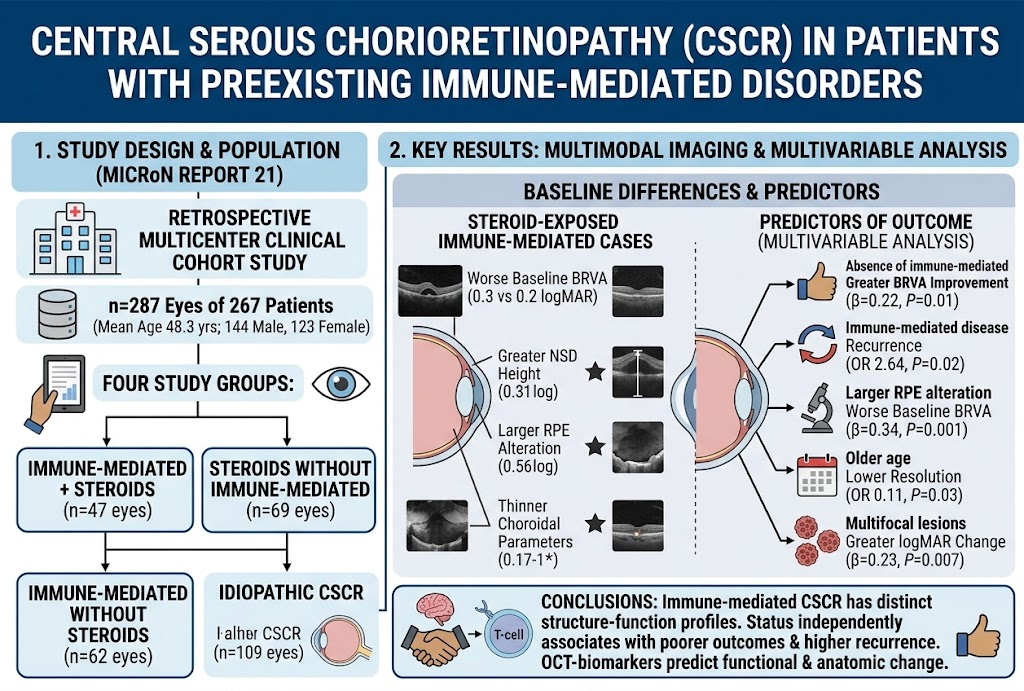
1. Central serous chorioretinopathy (CSCR) in patients with immune-mediated disorders shows distinct structural and functional features compared to idiopathic CSCR.
2. Prior corticosteroid exposure in immune-mediated disease patients correlates with worse baseline visual acuity, larger neurosensory detachment, and more extensive retinal pigment epithelium (RPE) alterations.
3. Immune-mediated disease independently predicts higher recurrence rates and poorer visual improvement despite multimodal imaging changes.
4. Optical coherence tomography (OCT) biomarkers, including RPE alterations and lesion multifocality, are significant predictors of disease course and visual outcomes.
Study Background
Central serous chorioretinopathy (CSCR) is a chorioretinal disorder characterized by serous detachment of the neurosensory retina and associated retinal pigment epithelium (RPE) alterations. Although typically idiopathic, CSCR has been frequently associated with corticosteroid use and systemic conditions that involve immune dysregulation. Immune-mediated diseases, such as autoimmune disorders, often require systemic corticosteroid therapy—both factors that may modify CSCR pathophysiology and prognosis.
Despite the established link between corticosteroid exposure and CSCR, the influence of preexisting immune-mediated diseases on the clinical characteristics and outcomes of CSCR remains underexplored. Understanding the interaction of immune status and corticosteroid exposure is critical to optimizing management strategies, predicting prognosis, and tailoring treatments for CSCR patients with complex systemic comorbidities.
Study Design
This retrospective multicenter clinical cohort study leveraged data from the Macula Society CSCR Study Group (MICRoN). It included 287 eyes from 267 patients diagnosed with CSCR. The cohort was stratified into four groups based on immune-mediated disease status and corticosteroid exposure: (1) immune-mediated disease with corticosteroid use, (2) corticosteroid use without immune-mediated disease, (3) immune-mediated disease without corticosteroid use, and (4) idiopathic CSCR without either condition.
Baseline and longitudinal assessments were performed using best-recorded visual acuity (BRVA) measurements and multimodal imaging parameters, such as central macular thickness (CMT), subfoveal choroidal thickness (SFCT), neurosensory detachment (NSD) height, and extent of retinal pigment epithelium (RPE) alterations. Multivariable regression models evaluated predictors of visual outcomes, disease persistence, recurrence, and resolution.
Key Findings
The mean patient age was 48.3 ± 10.8 years, comprising 144 males and 123 females. The distribution of eyes in each subgroup was: immune-mediated with steroids (47), steroids without immune-mediated disease (69), immune-mediated without steroids (62), and idiopathic CSCR (109).
Baseline visual acuity was significantly worse in steroid-exposed immune-mediated patients (mean logMAR 0.3 ± 0.4) compared to other groups (p=0.03). Imaging revealed increased NSD height and larger RPE alterations in this group, accompanied by thinner subfoveal choroidal thickness.
Multivariable analyses demonstrated several important associations:
- Absence of immune-mediated disease predicted greater improvement in BRVA (β=0.22, p=0.01), indicating better visual recovery in idiopathic cases.
- Immune-mediated disease independently predicted increased risk of recurrence (odds ratio 2.64, p=0.02), suggestive of more chronic or relapsing disease patterns.
- Larger RPE alterations correlated with worse baseline BRVA (β=0.34, p=0.001), highlighting its role as a key structural biomarker of visual function impairment.
- Older age was associated with lower resolution rates of disease (OR 0.11, p=0.03).
- Multifocal lesions predicted greater changes in logMAR visual acuity (β=0.23, p=0.007), signaling more extensive retinal involvement.
During follow-up, reduction in central macular thickness and subfoveal choroidal thickness occurred uniformly across all groups, but immune-mediated cohorts exhibited sustained poorer visual improvement and lower rates of complete disease resolution.
Expert Commentary
The MICRoN study highlights the complex relationship between systemic immunity, corticosteroid therapy, and CSCR pathophysiology. The significantly worse visual outcomes and higher recurrence rates in immune-mediated groups—especially those exposed to steroids—may reflect combined effects of immune dysregulation, choroidal vascular alteration, and corticosteroid-induced susceptibility to retinal pigment epithelium dysfunction.
These findings underscore the clinical challenge of managing CSCR in patients with immune-mediated diseases, who require cautious corticosteroid use and close ophthalmic monitoring. The identification of OCT biomarkers, such as RPE alteration and multifocality, as predictors reinforces the value of advanced retinal imaging in risk stratification and personalized treatment planning.
Limitations of the study include its retrospective design and possible heterogeneity in immune-mediated disease types and corticosteroid regimens, which could influence outcomes variably. Nonetheless, the large multicenter dataset and comprehensive imaging analysis lend robustness to the conclusions.
Conclusion
Central serous chorioretinopathy in patients with preexisting immune-mediated disorders presents a distinctive clinical and imaging phenotype characterized by poorer baseline vision, higher recurrence, and suboptimal visual recovery compared to idiopathic CSCR. Corticosteroid exposure further exacerbates these adverse outcomes.
Recognition of immune-mediated status and careful interpretation of multimodal OCT biomarkers are essential for prognostication and therapeutic decision-making in these patients. Future prospective studies evaluating tailored interventions and steroid-sparing therapies will be critical to improving outcomes in this complex patient population.
Funding and Clinicaltrials.gov
The MICRoN Report 21 study did not specify funding sources or clinical trial registration details in the published report.
References
1. Lall SR, et al. Central Serous Chorioretinopathy in patients with preexisting immune-mediated disorders: MICRoN report 21. Am J Ophthalmol. 2026 Aug 24. PMID: 42636996.
2. Nicholson B, Noble J, Forooghian F, Meyerle C. Central serous chorioretinopathy: update on pathophysiology and treatment. Surv Ophthalmol. 2013 Nov-Dec;58(6):103-126.
3. Daruich A, Matet A, Dirani A, et al. Central serous chorioretinopathy: recent findings and new physiopathology hypothesis. Prog Retin Eye Res. 2015 Nov;48:82-118.
This article was created using several editorial tools, including AI, as part of the process. Human editors reviewed this content before publication.