High-Frequency 10-kHz Spinal Cord Stimulation: Advancing Pain Relief and Sensory Recovery in Painful Diabetic Neuropathy
Highlight
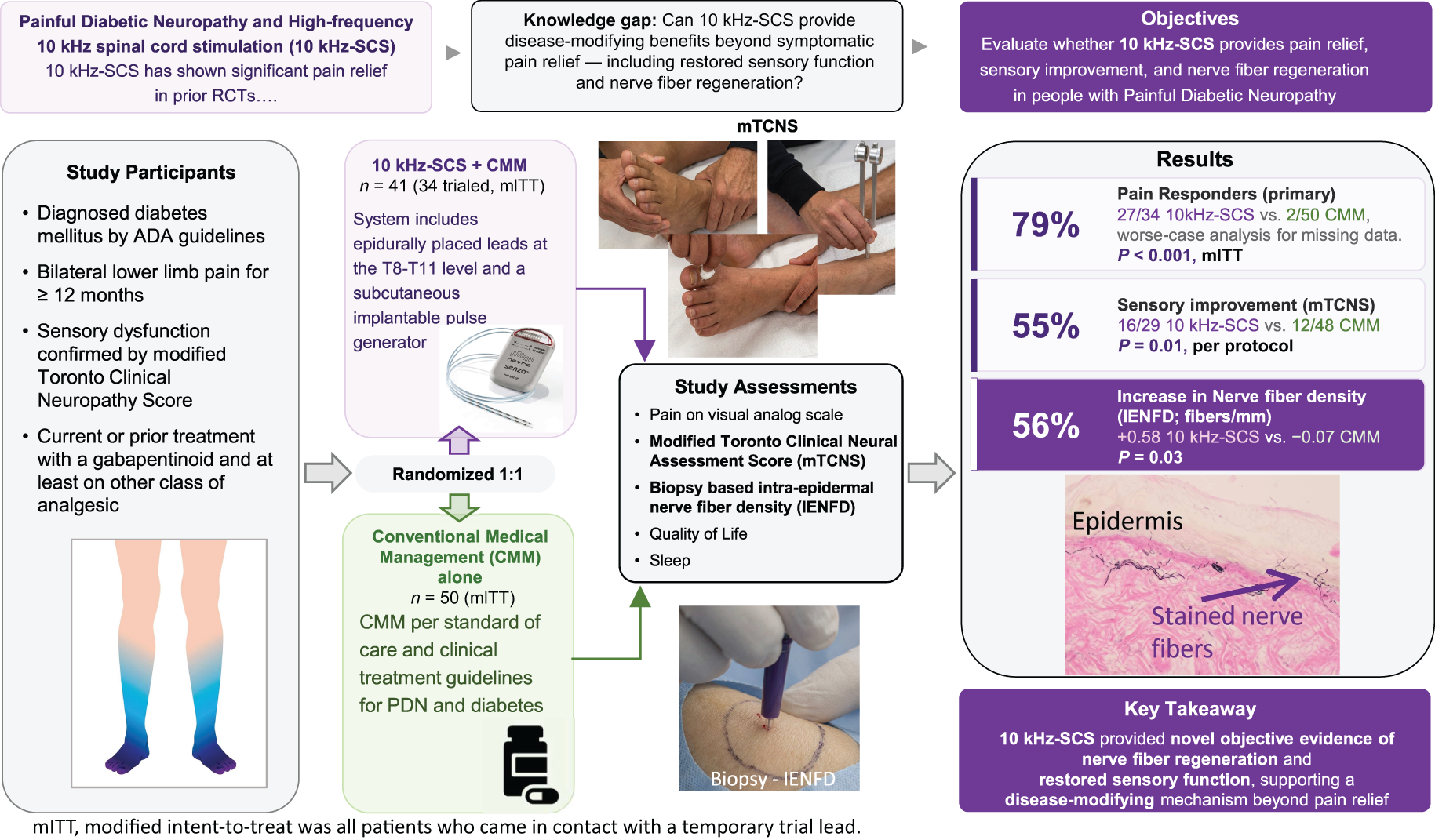
This multicenter randomized controlled trial establishes that high-frequency (10-kHz) spinal cord stimulation (SCS) combined with conventional medical management (CMM) leads to significant pain reduction and objective improvements in sensory function for patients with painful diabetic neuropathy (PDN). Notably, SCS treatment increased intraepidermal nerve fiber density (IENFD), indicating possible nerve regeneration. These findings support the potential of 10-kHz SCS as a disease-modifying therapeutic option for PDN beyond symptomatic pain relief.
Study Background
Diabetic neuropathy, specifically painful diabetic neuropathy (PDN), is a prevalent chronic complication of diabetes mellitus characterized by nerve damage causing debilitating pain and sensory disturbances. Up to 50% of individuals with diabetes develop neuropathy, and around 20-30% experience painful symptoms that significantly impair quality of life, sleep, and functional status. Conventional medical management primarily focuses on symptomatic pain control with limited efficacy and substantial side effects, leaving a critical unmet need for therapies that can alleviate pain and improve sensory nerve function.
Spinal cord stimulation (SCS) at high frequency (10-kHz) has emerged as a promising intervention for neuropathic pain, previously showing efficacy in PDN pain relief. However, evidence on its impact on sensory nerve function, including objective biomarker changes like nerve fiber density, remained limited. The PDN-Sensory trial was designed to rigorously evaluate whether 10-kHz SCS combined with CMM could improve both pain and sensory function in PDN patients, potentially indicating disease-modifying properties.
Study Design
The PDN-Sensory trial was a multicenter, randomized, controlled study enrolling 91 participants diagnosed with painful diabetic neuropathy. Subjects were randomized in a 1:1 ratio to receive either conventional medical management (CMM) alone or 10-kHz spinal cord stimulation plus CMM. The 10-kHz SCS device was implanted following a temporary trial period to assess patient suitability and response.
Primary endpoint: Proportion of participants achieving at least 50% lower limb pain relief (pain response).
Key secondary endpoint: Proportion achieving sensory improvement defined as ≥3-point reduction in the modified Toronto Clinical Neuropathy Score (mTCNS), a validated clinical measure encompassing sensory symptoms and signs.
Other hierarchical secondary outcomes included intraepidermal nerve fiber density (IENFD) measurements from skin biopsies, sleep quality assessments, and patient-reported health and neuropathy-related quality of life (QoL). Sensory and IENFD assessments were blinded to treatment allocation to reduce bias.
Key Findings
Of the 91 participants, 41 were assigned to 10-kHz SCS plus CMM and 50 to CMM alone. Analysis utilized a modified intention-to-treat worst-case model.
Pain Response: Among the 34 participants in the SCS group who completed the temporary trial, 27 (79.4%) achieved the primary outcome of ≥50% lower limb pain relief versus only 2 of 50 (4%) in the CMM-alone group, achieving strong statistical significance (P < 0.001). This confirms robust analgesic efficacy of 10-kHz SCS.
Sensory Function: Sensory improvement per mTCNS occurred in 16 of 29 (55.2%) SCS participants compared with 12 of 48 (25%) in CMM alone, a statistically significant difference (P = 0.01). This finding demonstrates meaningful clinical improvement in sensory neuropathic signs and symptoms beyond pain relief.
Intraepidermal Nerve Fiber Density: Skin biopsy analyses showed the mean change in lower-calf IENFD was +0.58 fibers/mm in the SCS group versus a slight decrease (-0.07 fibers/mm) with CMM alone. This difference was statistically significant (P = 0.03), indicating nerve fiber regeneration or restoration in the stimulated group.
Secondary Outcomes: Out of 10 hierarchical secondary endpoints (including sleep measures and QoL scales), eight were met successfully, underscoring broad therapeutic benefits of 10-kHz SCS combined with CMM.
Safety: The study reported no major safety concerns, consistent with known profiles of SCS therapy.
Expert Commentary
These findings corroborate and expand prior evidence demonstrating that 10-kHz SCS is an effective treatment modality for neuropathic pain in PDN. The novel demonstration of sensory function improvement and increased intraepidermal nerve fiber density provides compelling evidence of potential disease modification—a coveted therapeutic milestone in diabetic neuropathy often considered irreversible.
Mechanistically, 10-kHz SCS may promote neuroplasticity and regeneration via modulation of spinal dorsal horn neurons and neuroimmune pathways, enhancing peripheral nerve recovery. The blinded, controlled design and objective biomarker integration strengthen the scientific rigor of the PDN-Sensory trial.
Nevertheless, limitations include the relatively short 6-month follow-up. Longer-term studies are required to confirm durable disease-modifying effects and safety. Moreover, replication in larger, diverse populations is needed to generalize findings broadly.
Current clinical guidelines acknowledge SCS as an option for refractory neuropathic pain but do not yet incorporate sensory or regenerative outcomes. This evidence advocates for future guideline updates incorporating these outcomes and potentially earlier SCS consideration in PDN management algorithms.
Conclusion
The PDN-Sensory RCT robustly confirms that high-frequency 10-kHz spinal cord stimulation combined with conventional medical management significantly reduces pain and improves sensory function in individuals with painful diabetic neuropathy. Objective evidence of increased intraepidermal nerve fiber density suggests potential disease-modifying capability beyond symptomatic control. These findings herald a paradigm shift, positioning 10-kHz SCS as a promising therapeutic advance addressing both symptoms and underlying neuropathy pathology.
Future investigations should focus on long-term outcomes, mechanisms of action, and comparative effectiveness with existing therapies to optimize PDN clinical care and improve patient quality of life.
Funding and ClinicalTrials.gov
The PDN-Sensory trial was supported by relevant institutional and research funding as reported by the investigators. The trial registration details and funding sources are available in the original publication.
References
Hurley RW, Siraj ES, Sills S, et al. Evaluating Improvement in Pain and Sensory Function When Using High-Frequency (10-kHz) Spinal Cord Stimulation in Individuals With Painful Diabetic Neuropathy: A Multicenter Randomized Controlled Trial (PDN-Sensory). Diabetes Care. 2026 Sep 9. PMID: 42713876. https://pubmed.ncbi.nlm.nih.gov/42713876/
Pop-Busui R, Boulton AJ, Feldman EL, et al. Diabetic Neuropathy: A Position Statement by the American Diabetes Association. Diabetes Care. 2017 Apr;40(1):136-154.
de Vos CC, Meier K, Senadheera S, et al. Neuromodulation and Mechanisms for Pain Relief in Diabetic Neuropathy: Emerging Evidence. Front Neurosci. 2021;15:668948.
This article was created using several editorial tools, including AI, as part of the process. Human editors reviewed this content before publication.