High-Dose Rocuronium Enhances First-Attempt Intubation Success in Critically Ill ICU Patients: Insights from Secondary Analysis of Multicenter Trials
Highlight
- High-dose rocuronium (>1.2 mg/kg) is associated with increased first-attempt intubation success in critically ill patients requiring emergency airway management.
- This beneficial effect is evident primarily in intensive care unit (ICU) settings rather than emergency department (ED) settings.
- Propensity-matched analysis reveals a modest but statistically significant adjusted relative risk improvement in first-attempt success with higher rocuronium dosing.
- Findings emphasize the need for a prospective randomized controlled trial to confirm causality and guide dosing protocols in critical care airway management.
Study Background
Emergency tracheal intubation in critically ill patients is a high-risk procedure requiring optimal neuromuscular blockade to facilitate rapid, successful airway control. Rocuronium, a non-depolarizing neuromuscular blocking agent, is frequently used during rapid sequence intubation (RSI) due to its onset and duration profile. The dosing of rocuronium can vary, and the amount administered may influence intubation conditions, success rates, and ultimately patient outcomes. Failed or multiple attempts at intubation could lead to hypoxia, hemodynamic instability, and other complications. Despite this, the ideal rocuronium dose for maximizing first-attempt intubation success in critically ill adults remains unclear. This knowledge gap is pertinent as real-world dosing practices vary substantially between emergency departments (EDs) and intensive care units (ICUs). Understanding this relationship is critical for improving airway management strategies in emergency and critical care settings.
Study Design
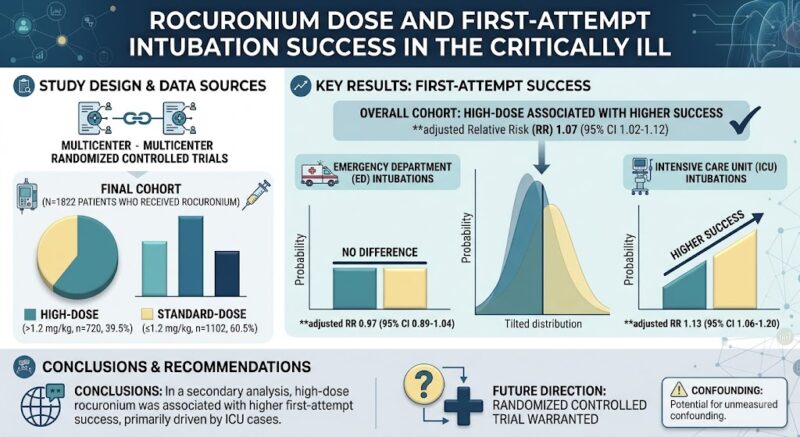
This investigation is a secondary analysis of patient-level data aggregated from two large multicenter randomized controlled trials focused on airway management in the ED and ICU across the United States. The dataset included 2440 adult patients undergoing emergency tracheal intubation, from which 1822 patients who received rocuronium as the neuromuscular blocking agent were analyzed. Patients were stratified based on rocuronium dose received: a high-dose group (>1.2 mg/kg) and a standard-dose group (≤1.2 mg/kg). The study population encompassed 9 emergency departments and 24 intensive care units, ensuring diverse clinical scenarios. The primary endpoint was successful intubation on the first attempt, a clinically meaningful outcome linked to procedural safety and efficiency. To minimize confounding, propensity score matching adjusted for measured patient and procedural factors, with analyses stratified by clinical setting (ED vs. ICU).
Key Findings
Of the 1822 patients analyzed, 720 (39.5%) received high-dose rocuronium, whereas 1102 (60.5%) received standard-dose rocuronium. Overall, the high-dose group demonstrated a statistically significant 7% relative increase in first-attempt intubation success compared to the standard-dose group (adjusted relative risk [RR] 1.07; 95% confidence interval [CI] 1.02–1.12). When stratified by clinical setting, this effect was heterogeneous:
- ICU Setting: The benefit of high-dose rocuronium was pronounced, with a 13% increase in first-attempt success rates (adjusted RR 1.13; 95% CI 1.06–1.20), indicating a clinically relevant improvement in airway management outcomes.
- ED Setting: No significant difference in first-attempt success was observed between high- and standard-dose rocuronium groups (adjusted RR 0.97; 95% CI 0.89–1.04), suggesting setting-specific factors influence efficacy.
These results suggest the pharmacologic effects of rocuronium dosing may be more impactful in the ICU population, possibly due to differences in patient acuity, airway anatomy, or procedural context. Secondary outcomes, including complication rates and procedural times, were not detailed in this analysis but warrant further study.
Expert Commentary
The findings of this secondary analysis add valuable data regarding the dosing strategy of rocuronium during emergency intubations. The demonstrated association between higher doses of rocuronium and improved first-attempt success in ICU patients aligns with the pharmacodynamic principle that deeper neuromuscular blockade enhances intubation conditions. However, the lack of similar findings in the ED underscores the complexity of airway management, where patient heterogeneity, operator experience, and urgency may modulate outcomes.
Experts caution that the observed associations do not establish causality due to the observational nature and potential for residual confounding despite rigorous propensity matching. Unmeasured variables such as the choice of induction agents, clinician skill level, and intubation techniques could influence results. Additionally, the optimal dose balancing rapid onset with recovery time and safety remains to be defined.
Current airway management guidelines acknowledge rocuronium as a preferred agent when succinylcholine is contraindicated but offer limited guidance on dosing variances. This study supports revisiting dosing recommendations and suggests ICU providers might consider higher rocuronium doses to optimize intubation success, pending further confirmation.
Conclusion
This secondary analysis of two large multicenter trials indicates that administering high-dose rocuronium (>1.2 mg/kg) in critically ill patients undergoing emergency tracheal intubation is associated with higher rates of first-attempt success, particularly in the ICU setting. These findings have meaningful clinical implications for airway management protocols aiming to reduce procedural complications and improve patient safety. Nevertheless, due to the retrospective and observational design limitations, prospective randomized controlled trials are essential to definitively establish dose-response relationships and to formulate evidence-based rocuronium dosing guidelines for emergency airway management in diverse clinical environments.
Funding and ClinicalTrials.gov
Details on funding sources and trial registration are available in the original published articles of the parent multicenter randomized controlled trials. Interested readers are encouraged to consult the original study citation for further trial identifiers and funding disclosures.
References
April MD, Butler H, Demasi SC, Aggarwal NR, Andrea LJ, Barker AB, et al. Rocuronium dose and first-attempt intubation success in the critically ill: secondary analysis of two multicenter trials. Am J Respir Crit Care Med. 2026 Aug 1;212(8):1740–1749. doi:10.1164/rccm.202601-0076OC. PubMed PMID: 42149702.
Additional relevant literature:
1. Tran DQH, Newton EK, Trinh J, et al. Neuromuscular blockade for airway management in the critically ill adult: summary of evidence and recommendations. Anesthesiology. 2022;136(1):99-112.
2. Cook TM, Woodall N, Frerk C; Fourth National Audit Project. Major complications of airway management in the UK: results of the Fourth National Audit Project of the Royal College of Anaesthetists and the Difficult Airway Society. Br J Anaesth. 2011;106(5):617-31.
3. Simpson GD, Ross MJ, McKeown DW, Mackenzie SJ, Nagle SE, Bennett ED. Length of neuromuscular blocking agent effect during rapid sequence induction: impact on intubating conditions. Intensive Care Med. 2004;30(11):2060-6.
These references contextualize rocuronium use within broader airway management practice and safety profiles.
This article was created using several editorial tools, including AI, as part of the process. Human editors reviewed this content before publication.