GLP1R R131Q Variant: A Genetic Key to Preserving β-Cell Function and Enhancing GLP-1RA Efficacy in Type 2 Diabetes
Highlight
This comprehensive study identifies the GLP1R R131Q variant as a gain-of-function mutation that preserves pancreatic β-cell function over two decades and augments glycemic response to GLP-1 receptor agonists (GLP-1RAs) in type 2 diabetes (T2D). It provides robust translational evidence from population cohorts, clinical pharmacogenetics, mechanistic clamp studies, and cellular assays, positioning this variant as a promising pharmacogenetic biomarker for precision diabetes management.
Study Background and Disease Burden
Type 2 diabetes is a chronic metabolic disorder characterized primarily by insulin resistance and progressive pancreatic β-cell dysfunction, leading to hyperglycemia and its myriad complications. Preservation of β-cell function is critical for delaying disease onset and progression. Glucagon-like peptide 1 receptor agonists (GLP-1RAs) are a cornerstone in T2D pharmacotherapy due to their ability to enhance glucose-dependent insulin secretion and other pleiotropic effects. However, interindividual variability in therapeutic response complicates clinical decision-making. Genetic variants in the GLP1R gene have emerged as potential modulators of disease susceptibility and drug efficacy. Among these, the R131Q polymorphism has been implicated in reduced T2D risk in genome-wide association studies but lacked functional and clinical corroboration until now. Understanding the impact of GLP1R R131Q on β-cell function and therapeutic response could enable personalized treatment strategies tailored to genetic profiles, thereby optimizing patient outcomes.
Study Design
This investigation utilized multiple complementary approaches:
- Population-based longitudinal cohort: A 20-year prospective community study in Korea involving 6,373 participants undergoing biennial 2-hour 75-g oral glucose tolerance tests (OGTT). The disposition index was calculated as a surrogate marker for β-cell function trajectory.
- Pharmacogenetic cohort: A hospital-based Korean T2D cohort (n=177) was assessed for glycemic response to GLP-1RA treatment, with HbA1c changes measured over six months.
- Mechanistic human studies: Hyperglycemic clamp studies in 17 individuals and ex vivo experiments on human islets from 21 donors were performed to investigate allele-dependent insulin secretion response to GLP-1RA stimulation.
- In vitro receptor signaling assays: Functional characterization of GLP1R R131Q effect on cAMP production and signaling bias was conducted.
Key Findings
1. Preservation of β-Cell Function in Non-Diabetic Individuals
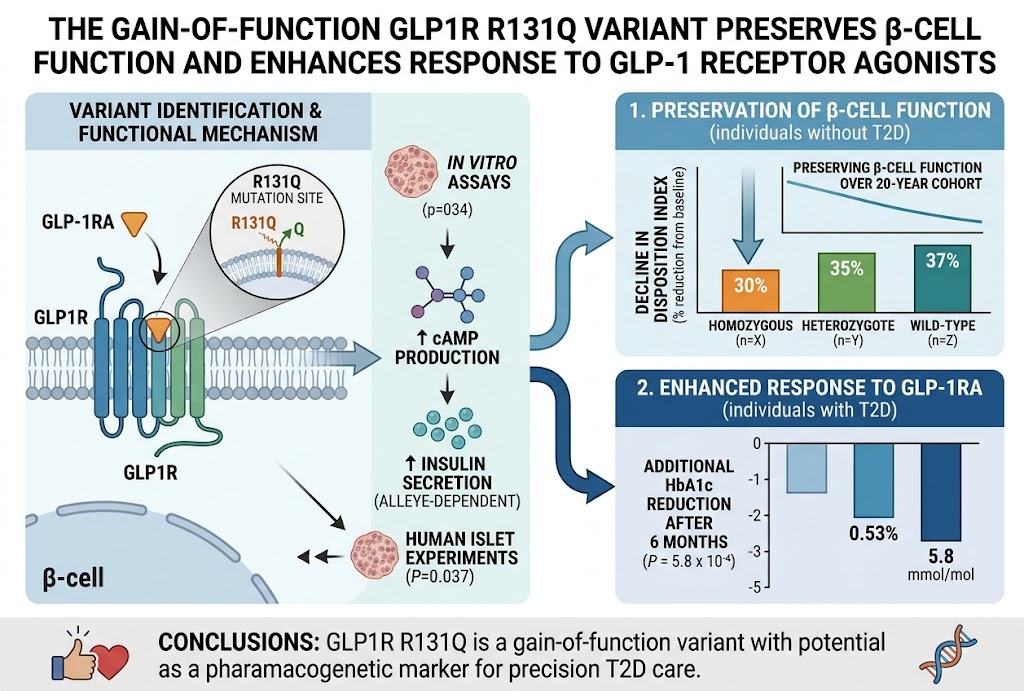
The GLP1R R131Q variant was associated with a significantly slower decline in the disposition index over 20 years in individuals without diabetes. Specifically, homozygous carriers exhibited a 30% reduction from baseline decline, heterozygotes 35%, while wild-type individuals showed a 37% decline. This suggests enhanced intrinsic capacity for insulin secretion and β-cell resilience linked to this variant.
2. Enhanced Glycemic Response to GLP-1RAs in T2D
Among patients treated with GLP-1RAs, each copy of the R131Q allele correlated with an additional 0.53% reduction in HbA1c (5.8 mmol/mol) after six months (P=5.8×10⁻⁴). This demonstrates a pharmacogenetic effect of the variant, amplifying the glucose-lowering efficacy of GLP-1RA therapy.
3. Mechanistic Evidence from Clamp and Islet Studies
Hyperglycemic clamp studies and ex vivo human islet experiments substantiated an allele-dependent enhancement of GLP-1RA-stimulated insulin secretion (P=0.050 and P=0.037, respectively). These data provide direct physiological evidence that the R131Q variant augments β-cell responsiveness to GLP-1 receptor activation.
4. Molecular Insights: Gain-of-Function and Pathway Bias
In vitro assays revealed that GLP1R R131Q increased receptor-mediated cyclic AMP (cAMP) production following GLP-1RA stimulation, indicating gain-of-function properties. Observed directional trends consistent with signaling pathway bias suggest that the variant may preferentially activate beneficial downstream pathways, though detailed mechanistic pathways warrant further elucidation.
Expert Commentary
This study elegantly bridges genetic epidemiology, clinical pharmacogenetics, and functional biology, marking a significant advance in understanding how GLP1R genetic variation modulates T2D pathophysiology and treatment. The use of a well-characterized longitudinal cohort with repeated metabolic testing robustly demonstrates the protective effect of R131Q on β-cell function, which is clinically relevant given the durability challenges in diabetes management. Pharmacogenetic analysis in a real-world GLP-1RA-treated population confirms translational significance, offering a potential biomarker to predict therapeutic response and personalize therapy.
Limitations include relatively small sample sizes in clamp and islet studies, which may constrain generalizability. Furthermore, the study population is ethnically homogenous (Korean), and replication in diverse cohorts is needed to confirm allele frequency and effect size across populations. The mechanistic underpinnings of signaling pathway bias associated with R131Q require deeper exploration, possibly involving β-arrestin recruitment and G protein coupling assays. Despite these, the integrated multi-modal evidence lends robustness to conclusions.
From a clinical standpoint, genotyping for GLP1R R131Q could be incorporated into risk stratification and treatment algorithms, optimizing selection and dosing of GLP-1RAs to maximize efficacy and possibly reduce costs and adverse effects associated with trial-and-error prescribing. This aligns well with precision medicine goals in endocrinology.
Conclusion
The GLP1R R131Q variant emerges as a compelling gain-of-function allele that preserves β-cell function and enhances responsiveness to GLP-1 receptor agonists in type 2 diabetes. This landmark study supports the potential utility of R131Q genotyping as a pharmacogenetic biomarker to guide personalized diabetes therapy, promoting better glycemic control and potentially reducing progression to insulin dependence. Further multicenter and multiethnic studies, coupled with expanded mechanistic research, are warranted to consolidate and extend these findings into clinical practice.
Funding and Clinicaltrials.gov
Details on funding sources and clinical trial registration were not provided in the primary publication. Further information may be available from the original article or corresponding authors.
References
- Lee H, Christie HE, Lee JS, et al. The Gain-of-Function GLP1R R131Q Variant Preserves β-Cell Function and Enhances Response to GLP-1 Receptor Agonists. Diabetes Care. 2026 Aug 6. PMID: 42561183.
- Marso SP, Daniels GH, Brown-Frandsen K, et al. Liraglutide and Cardiovascular Outcomes in Type 2 Diabetes. N Engl J Med. 2016;375(4):311-322.
- Drucker DJ. Mechanisms of Action and Therapeutic Application of Glucagon-like Peptide-1. Cell Metab. 2018;27(4):740-756.
- Wang Z, Sweet IR, Lin RC, et al. Pharmacogenomics of the Incretin-based Therapies: Glucagon-like Peptide-1 Receptor Agonists and Dipeptidyl Peptidase-4 Inhibitors. Curr Diabetes Rep. 2020;20(10):58.
This article was created using several editorial tools, including AI, as part of the process. Human editors reviewed this content before publication.