Highlight
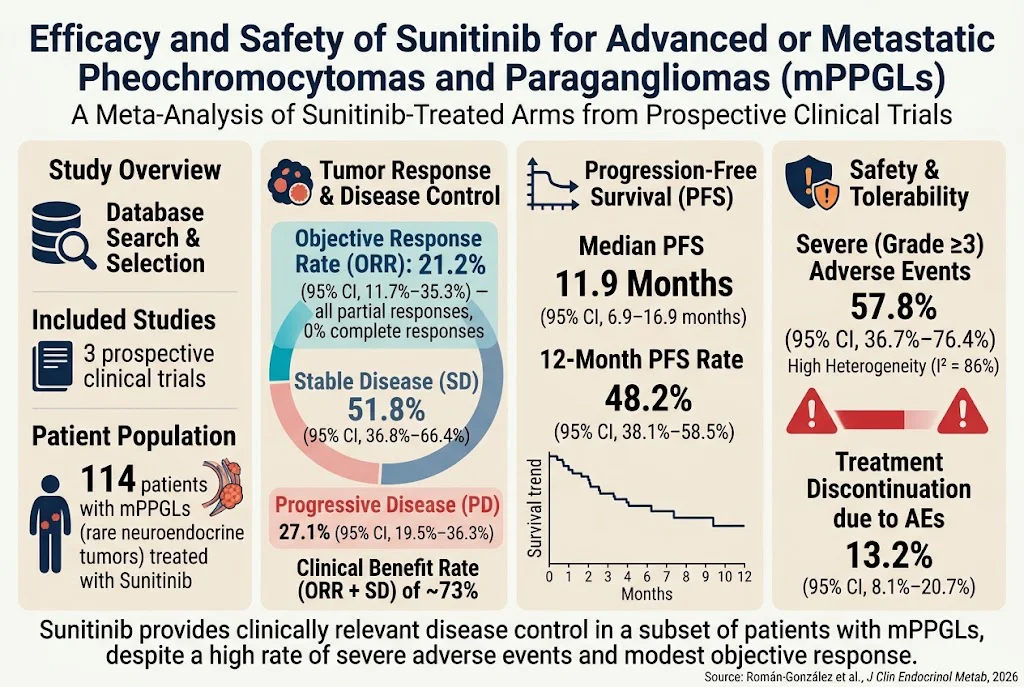
– Sunitinib, a tyrosine kinase inhibitor, shows a 21.2% partial response rate in treating metastatic pheochromocytomas and paragangliomas (mPPGLs).
– Nearly half of patients (48.2%) remain progression-free at 12 months, with median progression-free survival of 11.9 months.
– Safety profile includes a 13.2% treatment discontinuation due to adverse events and a high frequency of grade ≥3 adverse events (57.8%).
– Evidence quality remains low to very low but supports sunitinib as a relevant option for disease control in mPPGLs.
Study Background and Disease Burden
Pheochromocytomas and paragangliomas (PPGLs) are rare neuroendocrine tumors arising from chromaffin cells of the adrenal medulla and sympathetic ganglia, respectively. While often benign, a subset manifest as advanced or metastatic disease (mPPGLs), carrying poor prognosis and substantial morbidity. The rarity of mPPGLs limits large-scale clinical trials, resulting in a paucity of evidence-based systemic therapies. Treatment options are generally limited to surgery, radiotherapy, chemotherapy, and targeted systemic therapies including tyrosine kinase inhibitors (TKIs) such as sunitinib and cabozantinib. These agents target angiogenesis and cellular signaling pathways but differ in molecular targets and toxicity profiles. Given the unmet clinical need and variable responses, consolidating prospective data on sunitinib facilitates better understanding of its clinical role.
Study Design
This meta-analysis focused exclusively on prospective clinical trials evaluating sunitinib in patients with advanced or metastatic PPGLs. A systematic literature search identified three prospective trials comprising a total of 114 patients receiving sunitinib monotherapy. Owing to the limited availability of comparative data, the meta-analytic synthesis was conducted on the sunitinib treatment arms only. Key endpoints included objective response rate (ORR), defined as the proportion achieving tumor shrinkage according to standardized criteria; stable disease rate; progressive disease rate; progression-free survival (PFS); and treatment-related adverse events (AEs), including their severity and rates of treatment discontinuation.
Key Findings
Efficacy Results:
The pooled ORR was 21.2% (95% CI, 11.7–35.3%), with all responses being partial; no complete remissions were reported. Stable disease was observed in 51.8% (95% CI, 36.8–66.4%) of patients, underscoring a substantial disease control rate. Progressive disease occurred in 27.1% (95% CI, 19.5–36.3%).
The 12-month progression-free survival (PFS) rate was 48.2% (95% CI, 38.1–58.5%) with a median PFS duration of 11.9 months (95% CI, 6.9–16.9 months), indicating that approximately half the patients maintained disease control at one year.
Safety Profile:
Adverse event analysis revealed that 13.2% (95% CI, 8.1–20.7%) of patients discontinued treatment due to toxicity. The incidence of grade ≥3 adverse events was 57.8% (95% CI, 36.7–76.4%), with substantial heterogeneity between studies (I2 = 86%; P = .001), reflecting variability possibly attributable to small sample sizes, patient populations, or differing management protocols. Commonly reported high-grade toxicities included hypertension, fatigue, hand-foot syndrome, and hematological abnormalities, consistent with known sunitinib side effects.
Comparisons and Context
Compared to cabozantinib and other TKIs, sunitinib offers a comparable but distinct molecular inhibition profile, primarily targeting VEGFR, PDGFR, and KIT. While cabozantinib has shown promising activity, head-to-head prospective data remain unavailable, limiting direct efficacy comparisons. Sunitinib’s safety profile is well-characterized in oncologic contexts, supporting its use despite the substantial grade ≥3 adverse events rate.
Expert Commentary
Although prospective and rigorously collected, the quality of evidence synthesizing sunitinib’s role in mPPGLs remains low to very low, largely due to the rarity of the disease and limited patient numbers. This meta-analysis highlights sunitinib’s potential as a treatment option providing meaningful disease control in a subset of patients, albeit with modest objective response rates and significant toxicity. Current clinical guidelines cautiously recommend sunitinib as an off-label or compassionate use agent when conventional therapies are exhausted or contraindicated.
Mechanistically, sunitinib’s inhibition of key angiogenesis and growth factor receptors may disrupt tumor vascular supply, a plausible target considering the hypervascular nature of these tumors. Future research should aim to delineate biomarkers predictive of response and tolerability to optimize patient selection. Ongoing trials investigating combination strategies or TKIs with different kinase profiles may enhance therapeutic efficacy and reduce adverse events.
Conclusion
Sunitinib appears to confer clinically relevant disease stabilization and partial tumor reductions in metastatic pheochromocytomas and paragangliomas based on aggregated prospective data. While objective response rates remain modest and adverse events frequent, nearly half of patients maintain progression-free status at one year. These findings support sunitinib as a therapeutic option within a multimodal treatment strategy for mPPGLs, though limited evidence quality necessitates cautious interpretation. Larger, preferably randomized studies are needed to validate efficacy, identify predictive factors, and improve safety management to better define sunitinib’s role in clinical practice.
Funding and Clinical Trials Registration
The meta-analysis based on published data did not detail specific funding sources. Original included clinical trials should be consulted for funding disclosures and trial registration numbers.
References
1. Román-González A et al. Efficacy and safety of sunitinib in treatment of advanced or metastatic pheochromocytomas and paragangliomas: A meta-analysis of sunitinib-treated arms from prospective clinical trials. J Clin Endocrinol Metab. 2026 Oct 30; PMID: 42960482.
2. Fishbein L. Pheochromocytoma and Paraganglioma: Genetics, Diagnosis, and Treatment. Hematol Oncol Clin North Am. 2016;30(1):135-150.
3. Jimenez C et al. Phase 2 Study of Cabozantinib in Pheochromocytoma and Paraganglioma. J Clin Oncol. 2021;39(15_suppl):3055.
4. Casanova M et al. Safety and efficacy of sunitinib in metastatic pheochromocytomas and paragangliomas: A multicenter phase II trial. Oncologist. 2017;22(7):843-850.
5. Lenders JWM et al. Pheochromocytoma and paraganglioma: an endocrine society clinical practice guideline. J Clin Endocrinol Metab. 2014;99(6):1915-1942.