Highlights
Izalontamab brengitecan (iza-bren), a bispecific antibody-drug conjugate targeting EGFR and HER3 with a topoisomerase I inhibitor payload, showed significant progression-free survival (PFS) improvement over standard chemotherapy in heavily pretreated HR+/HER2- breast cancer.
The PANKU-Breast01 trial conducted exclusively in China offers important regional clinical evidence in a population with limited treatment options after endocrine therapy, CDK4/6 inhibitors, and chemotherapy.
Hematological toxicities were the predominant adverse events with iza-bren, underscoring the need for supportive care strategies focusing on platelet management.
Overall survival data remain immature; future global studies may elucidate long-term benefits and inform earlier line use in HER2-negative breast cancer.
Background
Hormone receptor–positive (HR+), human epidermal growth factor receptor 2–negative (HER2-) breast cancer constitutes the majority of breast cancer subtypes worldwide. Despite advances in endocrine therapy combined with cyclin-dependent kinase (CDK) 4/6 inhibitors improving survival, patients who experience disease progression after these therapies and subsequent chemotherapy face limited treatment options with suboptimal efficacy. Targeted therapies exploiting novel mechanisms remain urgently needed to improve clinical outcomes in this heavily pretreated population.
Izalontamab brengitecan (iza-bren) is an innovative bispecific antibody-drug conjugate (ADC) that simultaneously targets epidermal growth factor receptor (EGFR) and HER3. It is conjugated to a potent topoisomerase I inhibitor payload (Ed-04), facilitating selective delivery to tumor cells expressing these receptors, thereby potentially overcoming resistance mechanisms and enhancing cytotoxicity.
Key Content
Trial Design and Patient Population
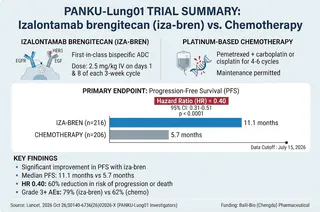
The PANKU-Breast01 trial was a randomized, open-label, phase 3 study conducted across 72 hospitals in China. Eligible patients had HR+/HER2- advanced breast cancer with progression following endocrine therapy, CDK4/6 inhibitors, and one or two lines of chemotherapy, including taxanes. The trial randomized 383 female Chinese patients (median age 54 years) in a 1:1 ratio to either iza-bren (2.5 mg/kg intravenously on days 1 and 8 every 3 weeks) or chemotherapy of physician’s choice (eribulin, vinorelbine, gemcitabine, or capecitabine) following identical schedules.
Primary endpoint was progression-free survival (PFS) per Blinded Independent Central Review (RECIST v1.1) in the modified intention-to-treat population (all randomized and treated patients). Secondary endpoints included safety and overall survival (OS), although OS data were immature at cutoff.
Efficacy Outcomes
At median follow-up of 15.2 months, iza-bren significantly improved PFS compared with chemotherapy, with median PFS of 8.2 months (95% CI 6.9-8.6) versus 4.0 months (2.9-4.3), respectively. The hazard ratio for progression or death was 0.41 (95% CI 0.33-0.53; log-rank p<0.0001), indicating a 59% risk reduction. This effect is clinically meaningful in a heavily pretreated population with few remaining options.
OS data remain immature and no definitive survival benefit was established. Nonetheless, improvements in PFS provide a rationale for further investigation of iza-bren potentially in earlier lines.
Safety Profile
Treatment-related adverse events (TRAEs) of grade 3 or higher were more frequent with iza-bren (85%) compared with chemotherapy (66%). Hematological toxicities, primarily neutropenia and thrombocytopenia, predominated in both arms but were particularly notable with iza-bren. Management included platelet-elevating agents (73%), platelet transfusions (15%), and blood transfusions (10%). Two treatment-related deaths occurred in the iza-bren group.
Non-hematologic toxicities were manageable but warrant close monitoring. The safety profile underscores the need for robust supportive care and toxicity surveillance when employing iza-bren.
Comparative Therapeutic Context
Existing guidelines endorse endocrine therapy plus CDK4/6 inhibitors as first-line and second-line approaches for HR+/HER2- metastatic breast cancer. Chemotherapy remains the principal treatment option upon progression but has limited efficacy and tolerability. ADCs such as sacituzumab govitecan (an anti-Trop-2 ADC with SN-38 payload) have shown activity in triple-negative subtypes but less evidence exists for HR+/HER2- subtypes post-multiple therapies.
Iza-bren’s unique bispecific targeting of EGFR and HER3, coupled with a topoisomerase inhibitor payload, represents a novel mechanistic approach with promising efficacy in this refractory setting. The PANKU-Breast01 trial advances this class of ADCs by demonstrating meaningful PFS improvements versus standard chemotherapy in a robustly powered, randomized phase 3 trial.
Expert Commentary
The PANKU-Breast01 trial contributes significant clinical evidence supporting iza-bren as a new therapeutic option for HR+/HER2- breast cancer patients with extensive prior treatment exposure. The magnitude of PFS benefit (HR 0.41) is notable and compares favorably to historical control chemotherapy outcomes in similar populations, reflecting potent antitumor activity.
However, the safety signal, especially hematologic toxicity, is substantial and warrants careful patient selection, dose monitoring, and supportive interventions. The trial’s all-Chinese cohort provides specific regional insight but also denotes a need for global validation to assess ethnicity-related pharmacodynamics and potential variability.
Mechanistically, the bispecific antibody approach targeting both EGFR and HER3 is rational given the role of HER signaling in endocrine resistance and tumor progression. Future translational analyses should explore biomarkers predictive of response, resistance mechanisms, and potential synergy with other targeted agents.
The absence of mature OS data necessitates caution before widespread adoption, and future studies should explore iza-bren in earlier treatment lines and in combinatorial regimens.
Conclusion
The PANKU-Breast01 phase 3 trial demonstrates that izalontamab brengitecan significantly prolongs progression-free survival compared to chemotherapy in heavily pretreated HR+/HER2- breast cancer patients in China, with manageable but notable hematological toxicities. These findings justify further clinical development and potential integration of iza-bren into treatment paradigms, pending validation of survival benefits and expanded global assessment.
References
Lan B, Shi Y, Shao X, Wu F, Wang S, Xie W, Zhang Q, Ouyang Q, Cui J, Ling X, Yu H, Li H, Tang X, Ding S, Hao C, Zhao B, Li Y, Yang H, Yan M, Han G, Wang X, Li F, Peng P, Gong C, Liu Y, Guo J, Yin Y, Li M, Teng Y, Zhao J, Gao Y, Wang J, Luo J, Han X, Li X, Liu B, Zhang S, Li B, Yang L, Xiao S, Zhu H, Zhu Y, Xu B; PANKU-Breast01 Investigators. Izalontamab brengitecan for HR+/HER2- breast cancer in China (PANKU-Breast01): a randomised, phase 3 trial. Lancet. 2026 Oct 26:S0140-6736(26)02096-9. doi: 10.1016/S0140-6736(26)02096-9. Epub ahead of print. PMID: 42933459.