Highlight
Soft-tissue augmentation during implant placement in the aesthetic zone significantly increases soft-tissue thickness compared to no augmentation. Both connective tissue grafts (CTG) and volume-stable collagen matrices (VCMX) show favorable histological integration. Despite augmentation, buccal bone thickness reduces similarly across groups. Patient-reported outcomes are comparable, although CTG shows slightly higher morbidity.
Study Background
Implant-supported restorations in the aesthetic zone present unique challenges, chiefly due to the need for optimal soft-tissue and bone contour to ensure favorable aesthetic and functional outcomes. Soft-tissue thickness (STT) around implants plays a crucial role in preserving mucosal seal, preventing recession, and enhancing long-term esthetics. Connective tissue grafts derived from autogenous palate tissue have long been considered the gold standard for soft-tissue augmentation but are associated with donor site morbidity and surgical complexity. Volume-stable collagen matrices (VCMX) have emerged as alternative biomaterials aiming to simplify the procedure and potentially reduce morbidity. However, comprehensive clinical, radiographic, histological, and patient-centered data comparing these materials during implant placement in the aesthetic zone remain limited. This study addresses this critical gap by systematically evaluating these factors in a randomized controlled trial (RCT).
Study Design
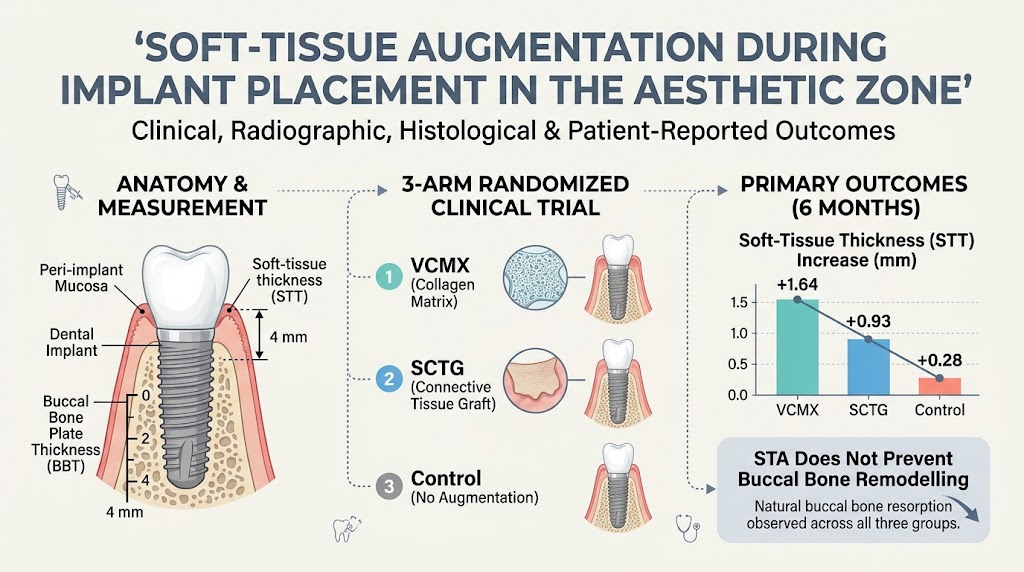
This was a three-arm randomized controlled clinical trial enrolling 25 patients requiring implant placement in the aesthetic zone. Participants were randomized to one of three groups: volume-stable collagen matrix (VCMX), subepithelial connective tissue graft (SCTG), or no soft-tissue augmentation (control). Key inclusion criteria entailed indications for implant therapy in areas with aesthetic concerns. Soft-tissue thickness (STT) was measured by ultrasonography, a non-invasive and precise method, whereas buccal bone thickness (BBT) was assessed via cone-beam computed tomography (CBCT). Assessments were conducted at baseline (implant placement) and at 6-month follow-up. Clinical parameters such as peri-implant probing depths and keratinized tissue width were recorded. Patient-reported outcome measures (PROMs) evaluated post-operative morbidity and satisfaction. Histological analysis investigated integration and tissue reaction to graft materials. Statistical analysis utilized repeated-measures general linear models at the patient level, accounting for within-subject variability.
Key Findings
Soft-Tissue Thickness Outcomes
Both VCMX and SCTG groups demonstrated statistically significant increases in STT compared with the control group (p < 0.001). Numerically, the VCMX group exhibited slightly greater gains in soft-tissue thickness compared to SCTG, although this difference was not statistically emphasized. The augmentation effect persisted at 6 months, suggesting stable tissue volume enhancement.
Buccal Bone Thickness Changes
Despite increased soft-tissue thickness, buccal bone thickness decreased significantly over time in all groups, with no difference found between VCMX, SCTG, and control groups. This indicates that soft-tissue augmentation does not prevent physiological buccal bone remodeling post implant placement.
Clinical Parameters and Patient-Reported Outcomes
Clinical parameters such as probing depths and tissue health remained stable and comparable across groups. PROMs revealed a similar level of patient satisfaction and comfort; however, CTG was associated with slightly higher post-operative morbidity, likely due to the secondary donor site.
Histological Findings
Histological analysis showed excellent biocompatibility and integration for both SCTG and VCMX. Both materials demonstrated vascularization and stable connective tissue architecture consistent with healthy peri-implant mucosa.
Expert Commentary
The results underscore that soft-tissue augmentation, whether using autogenous grafts or volume-stable collagen matrices, effectively increases soft-tissue thickness around implants in the aesthetic zone. This volumetric improvement likely benefits the long-term aesthetic outcome by enhancing gingival contour and potentially masking underlying bone resorption. The absence of protective effect on buccal bone thickness aligns with prior reports noting inevitable bone remodeling despite interventions. The slight morbidity associated with CTG may influence material selection in clinical practice, offering VCMX as a less invasive yet effective alternative. Limitations include the relatively short 6-month observation period; longer-term studies are necessary to correlate these early findings with sustained esthetic success and implant survival. Additionally, the small sample size warrants cautious interpretation and calls for larger confirmatory trials.
Conclusion
In this randomized controlled trial, soft-tissue augmentation performed concomitantly with implant placement in the aesthetic zone significantly increased soft-tissue thickness compared to no augmentation. Both connective tissue graft and volume-stable collagen matrix yielded favorable clinical, histological, and patient-reported outcomes. Neither method prevented buccal bone remodeling, highlighting the complex interplay between hard and soft tissue healing. Choice of augmentation material may consider patient morbidity and surgical preferences. Further well-powered, long-term studies are required to validate these findings and optimize strategies for aesthetic implant rehabilitation.
Funding and Clinical Trial Registration
This study is registered at ClinicalTrials.gov (Identifier: NCT06622759; URL: https://clinicaltrials.gov/study/NCT06622759). Funding sources were not specified in the abstract.
References
1. Papantonatou L, Batas L, Delantoni A, Anagnostou E, Vouros I. Soft-Tissue Augmentation During Implant Placement in the Aesthetic Zone: Clinical, Radiographic, Histological and Patient-Reported Outcomes From a Randomised Controlled Trial Using Connective Tissue Graft and a Volume-Stable Collagen Matrix. J Clin Periodontol. 2026 Jul 28;53(10):1585-1595. PMID: 42521470.
2. Thoma DS, Benić GI, Zwahlen M, et al. Soft Tissue Augmentation Procedures in Implant Dentistry: A Systematic Review. Clin Oral Implants Res. 2014 Jan;25(1):14-25.
3. Hwang D, Wang HL. Flap Thickness as a Predictor of Root Coverage: A Systematic Review. J Periodontol. 2006 Apr;77(4):1625-34.
4. Thoma DS, Naenni N, Figuero E, et al. Efficacy of Soft Tissue Augmentation Procedures Around Dental Implants: A Systematic Review. Clin Oral Implants Res. 2017 Dec;28(12):146-162.