Evaluating Preoperative High-Dose Corticosteroids in Digestive Cancer Surgery: Insights from a Large Multicenter Randomized Trial
Highlight
- The CORTIFRENCH trial randomized 1210 patients undergoing elective surgery for digestive cancer to receive either high-dose methylprednisolone or placebo preoperatively.
- No statistically significant difference was found in major postoperative complication rates or secondary infection outcomes between corticosteroid and placebo groups.
- The findings suggest that routine preoperative pulse corticosteroid administration does not improve clinical outcomes and should not be standard practice in digestive cancer surgery.
Study Background
Major digestive surgery for cancer often results in significant postoperative morbidity, with complications such as infections, anastomotic leaks, and wound healing problems contributing to increased hospital stay and mortality. Perioperative inflammation plays a pivotal role in these complications, and modulation of this inflammatory response has been theorized to improve outcomes. Corticosteroids, potent anti-inflammatory agents, have been proposed as perioperative adjuncts to modulate this inflammatory cascade. However, evidence for their clinical benefit remains inconclusive and controversial, particularly in oncologic digestive surgery where immune modulation might carry risks. This randomized controlled study aimed to clarify the role of preoperative high-dose corticosteroids in improving postoperative outcomes for patients undergoing curative surgery for digestive cancers.
Study Design
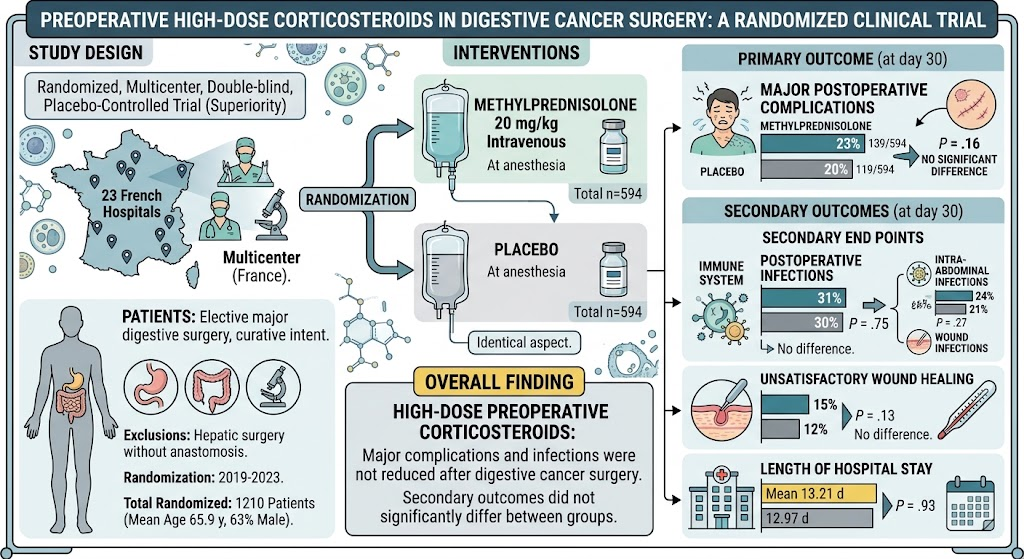
This multicenter, double-blind, placebo-controlled, superiority randomized clinical trial was conducted across 23 French centers specializing in digestive surgical oncology from 2019 to 2023. The study population included adults undergoing elective surgery for digestive cancers with curative intent; those undergoing hepatic surgery without digestive anastomosis were excluded. A total of 1210 patients (mean age 65.9 years, 63% male) were randomly assigned to receive either a single high-dose intravenous pulse of methylprednisolone (20 mg/kg) at anesthesia induction or placebo with identical appearance.
The primary endpoint was the occurrence of major postoperative complications within 30 days, defined by established complication grading systems. Secondary endpoints included rates of postoperative infections (overall, intra-abdominal, wound infections), unsatisfactory wound healing, and length of hospital stay.
Key Findings
Among the 1188 patients with complete 30-day postoperative follow-up (594 per group), major postoperative complications occurred in 23% of the corticosteroid group versus 20% in the placebo group (p=0.16), indicating no statistical benefit. Secondary outcomes were similarly neutral between groups: postoperative infections (31% vs. 30%, p=0.75), intra-abdominal infections (24% vs. 21%, p=0.27), unsatisfactory wound healing (15% vs. 12%, p=0.13), and mean hospital stay (13.21 days vs. 12.97 days, p=0.93).
Detailed subgroup analyses did not reveal any population segment that significantly benefited from preoperative corticosteroid administration. No new safety concerns or corticosteroid-associated adverse events were reported, supporting the intervention’s safety profile.
Expert Commentary
The CORTIFRENCH trial represents one of the largest and most rigorous investigations into corticosteroid use in oncological digestive surgery. These robust findings challenge prior smaller studies and meta-analyses that suggested potential benefits of perioperative corticosteroids in reducing inflammation-related complications. Mechanistically, while corticosteroids blunt systemic inflammatory responses, this trial’s data imply that such modulation does not translate into meaningful clinical improvement, possibly due to complex tumor-immune interactions, surgical stress, and diverse host factors.
Furthermore, the null findings caution against routine corticosteroid use, especially given the concerns about immune suppression potentially facilitating infections or impairing oncologic outcomes. Current clinical guidelines do not recommend routine high-dose corticosteroids for this purpose, aligning with these results. The trial’s multicenter design and large sample size enhance generalizability, although exclusion criteria should be noted when extrapolating to hepatic surgery without anastomosis or other subpopulations.
Conclusion
Preoperative administration of high-dose methylprednisolone in elective surgery for digestive cancers does not reduce major postoperative complications or infectious outcomes, nor does it shorten hospital stay. This well-conducted randomized clinical trial provides definitive evidence against the routine use of preoperative pulse corticosteroids for improving postoperative course in digestive cancer surgery. Future research may focus on identifying specific patients who might benefit from tailored anti-inflammatory strategies or exploring alternative approaches to modulate perioperative inflammation safely and effectively.
Funding and Trial Registration
This trial was conducted with support and coordination from 23 French hospitals specializing in digestive cancer surgery. The study was registered at ClinicalTrials.gov under identifier NCT03875690.
References
Ortega-Deballon P, Bourredjem A, Régimbeau JM, et al. Preoperative High-Dose Corticosteroids in Digestive Cancer Surgery: A Randomized Clinical Trial. JAMA Surg. 2026 Aug 19. PMID: 42616512. https://pubmed.ncbi.nlm.nih.gov/42616512/
Additional relevant literature on perioperative corticosteroids and surgical outcomes can be found in:
– Marik PE, et al. “Perioperative steroid administration in patients undergoing major abdominal surgery: A meta-analysis.” Ann Surg. 2017.
– Wan L, et al. “Effects of corticosteroids on surgical outcomes: a systematic review and meta-analysis.” Ann Surg Oncol. 2019.
These studies suggest variable results and underscore the need for high-quality, large randomized trials such as CORTIFRENCH.
This article was created using several editorial tools, including AI, as part of the process. Human editors reviewed this content before publication.