Evaluating LACE and HOSPITAL Scores for Predicting 30-day Readmissions in a Pakistani Tertiary Care Setting
Highlight
The study assessed the predictive accuracy of LACE and HOSPITAL scores for 30-day readmissions in over 35,000 Pakistani internal medicine patients.
Both scores showed statistically significant differences in mean values between readmitted and non-readmitted patients, with higher scores in the readmission group.
Receiver operating characteristic analysis demonstrated fair discrimination with AUCs of 0.670 for LACE and 0.655 for HOSPITAL scores.
Results endorse the applicability of these tools in a lower-middle-income country (LMIC) hospital setting to identify patients at higher risk and tailor interventions accordingly.
Study Background
Unplanned hospital readmissions within 30 days of discharge contribute substantially to worsened patient outcomes, increased healthcare costs, and resource strain globally. The burden is particularly significant in low- and middle-income countries (LMICs), where healthcare infrastructure and post-discharge care may be limited. Identification of patients at higher risk for readmission is critical in developing targeted interventions to reduce preventable readmissions, improve quality of care, and decrease mortality.
Various predictive tools have been developed and validated primarily in high-income countries, including the LACE index and HOSPITAL score. The LACE index considers Length of stay, Acuity of admission, Comorbidity, and Emergency department visits, while the HOSPITAL score incorporates Hemoglobin at discharge, discharge from an Oncology service, Sodium level at discharge, Procedures during the index admission, Index Type of admission, prior Admissions within the last 12 months, and Length of stay. However, their performance and utility in LMIC healthcare settings remain under-explored.
Study Design
This investigation was a retrospective cohort study conducted at a tertiary care hospital in Karachi, Pakistan. It included adult patients (aged 18 years or older) admitted to internal medicine services, both via emergency and elective routes, over a five-year span from 2016 to 2020. A total of 35,496 patients met inclusion criteria, with follow-up data available for 30-day readmission rates. The primary endpoint was unplanned hospital readmission within 30 days post-discharge.
The study computed LACE and HOSPITAL scores using routinely collected clinical and laboratory data available in the hospital electronic medical records. Statistical analyses compared mean scores between readmitted and non-readmitted groups using appropriate tests. Predictive accuracy was assessed by calculating the area under the receiver operating characteristic curve (AUC) for each scoring system.
Key Findings
The cohort had a mean age of 55.3 years (SD 18.9), with slightly more males (53.4%). The overall 30-day readmission rate was 8.0% (2,822/35,496). Patients readmitted within 30 days had significantly higher mean LACE scores (8.9 vs. 7.4, p<0.001) and HOSPITAL scores (3.4 vs. 2.6, p<0.001) compared to those not readmitted.
The LACE index demonstrated an AUC of 0.670 (95% CI 0.65 to 0.69), reflecting fair discriminatory ability. Similarly, the HOSPITAL score showed an AUC of 0.655 (95% CI 0.63 to 0.67), also indicating fair discrimination. These findings suggest that while both scores outperform chance alone, their predictive accuracy is moderate, which is consistent with existing literature from other healthcare settings.
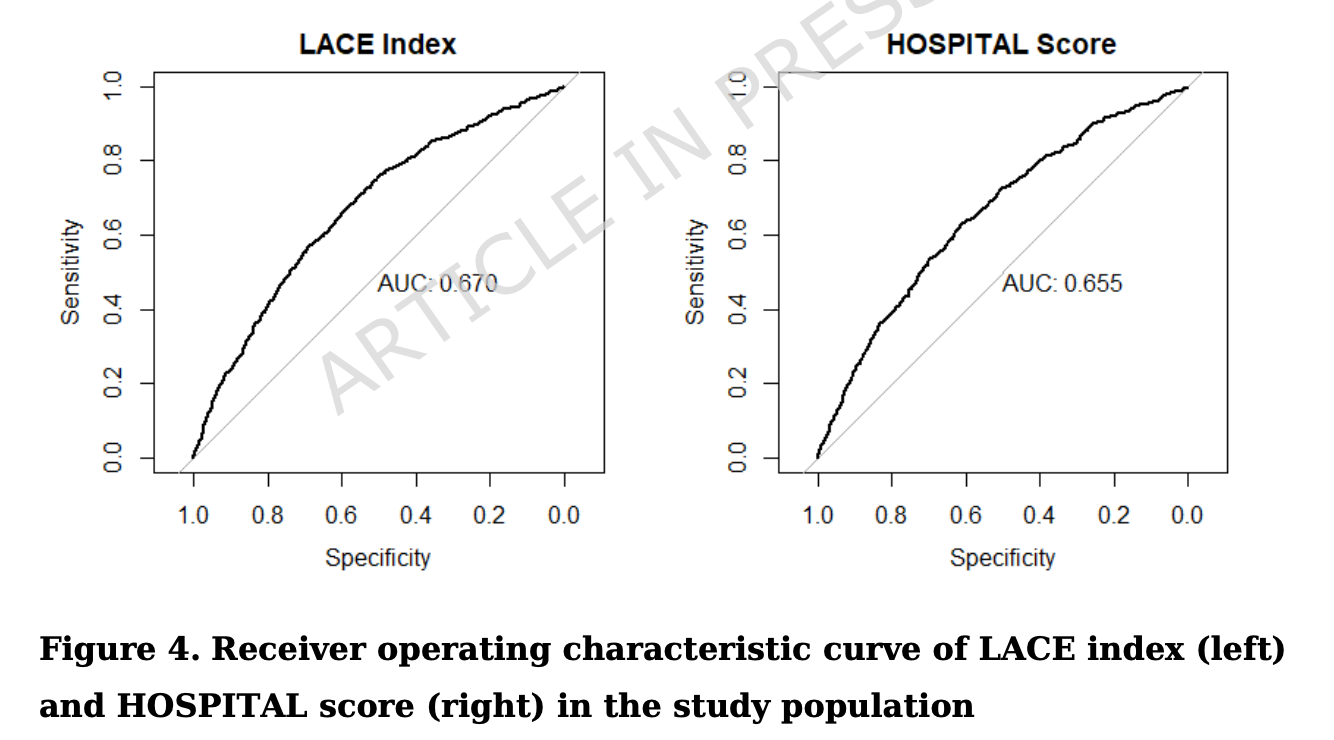
The comparable performance of these two tools in this LMIC setting underscores their clinical relevance. Their simplicity and reliance on routinely available clinical variables make them practical for integration into hospital workflows to identify high-risk patients early.
Expert Commentary
This large-scale study contributes valuable evidence supporting the external validity of the LACE and HOSPITAL scoring systems in LMIC contexts. Prior validations have predominantly focused on high-resource settings; thus, demonstrating effectiveness in Pakistan enhances their generalizability. However, the fair classification performance highlights the need for complementary risk stratification approaches, possibly including social determinants of health or local healthcare system factors.
Limitations of this study include its retrospective design and reliance on a single-center dataset, which may limit wide applicability. Furthermore, potential unmeasured confounders, such as outpatient follow-up access and patient adherence, may affect readmission risk but were not captured. Future prospective studies could refine these models or develop hybrid scores tailored to LMIC populations.
Conclusion
This investigation establishes that both the LACE index and HOSPITAL score are useful, practical tools with fair performance for predicting 30-day readmissions among adult internal medicine patients in a tertiary hospital in Pakistan. Their adoption could facilitate targeted interventions, optimize resource allocation, and improve patient outcomes in LMIC healthcare environments. Continued research to enhance predictive accuracy and integrate these tools into clinical decision support systems is warranted to reduce avoidable readmissions effectively.
Funding and Clinical Trials Registration
The original study did not report specific funding sources or clinical trial registration. Future studies with prospective design and external funding may further validate these findings.
References
Abbas M, Arshad H, Mahar MU, Hassan J, Tahir I, Aziz N, Jafri L, Riaz M, Almas A. Assessing effectiveness of HOSPITAL score and LACE index for predicting 30-day readmissions in a tertiary care hospital in Pakistan: a retrospective cohort study. BMC Health Serv Res. 2026 Jul 2. doi: 10.1186/s12913-026-15070-4. Epub ahead of print. PMID: 42393711.
Additional Referenced Literature:
– van Walraven C, Dhalla IA, Bell C, et al. Derivation and validation of an index to predict early death or unplanned readmission after discharge from hospital to the community. CMAJ. 2010 Apr 6;182(6):551-7.
– Donzé J, Aujesky D, Williams D, Schnipper JL. Potentially avoidable 30-day hospital readmissions in medical patients: derivation and validation of a prediction model. JAMA Intern Med. 2013 Apr 22;173(8):632-8.
– Kansagara D, Englander H, et al. Risk Prediction Models for Hospital Readmission: A Systematic Review. JAMA. 2011 Oct 19;306(15):1688–98.
This article was created using several editorial tools, including AI, as part of the process. Human editors reviewed this content before publication.