Highlight
ReacStick testing of simple reaction time and inhibitory control effectively distinguishes recurrent fallers from nonfallers among older adults.
Parameters reflecting short-latency inhibitory control, especially accuracy on light-off trials normalized to reaction time, demonstrated highest diagnostic accuracy (AUC ~0.80) for faller classification.
Knee extensor strength showed a protective association against falls, while functional balance measures exhibited only nonsignificant trends.
The combination of ReacStick inhibitory control testing and strength evaluation may enhance clinical risk stratification for falls in community-dwelling elders.
Study Background
Falls among older adults constitute a major public health issue, frequently leading to injury, functional decline, loss of independence, and increased mortality. Despite multifactorial etiologies, impaired sensorimotor integration, reduced cognitive processing speed, and deficits in inhibitory control are recognized contributors to fall risk. Traditional clinical assessments such as the Timed Up and Go (TUG) test and Berg Balance Scale (BBS) provide some predictive value but lack sufficient sensitivity and specificity for recurrent fallers. There is a pressing need for easily administered, sensitive, and specific tools to identify older adults at elevated fall risk to inform targeted prevention strategies. The ReacStick device offers a portable method to quantify rapid reaction times and inhibitory control via a timed ruler-drop task with light cues, potentially reflecting central nervous system processing speed and executive function relevant to fall risk.
Study Design
This was a cross-sectional study conducted in an outpatient rehabilitation clinic of a tertiary hospital. Ninety community-dwelling older adults were enrolled through convenience sampling and classified into recurrent fallers (more than one fall in the prior year) and nonfallers, matched by age and sex. Participants underwent comprehensive evaluations including sensorimotor functions (visual acuity, vibratory sensation, knee extensor strength), cognitive assessments, and standard functional fall-risk measures (Timed Up and Go and Berg Balance Scale).
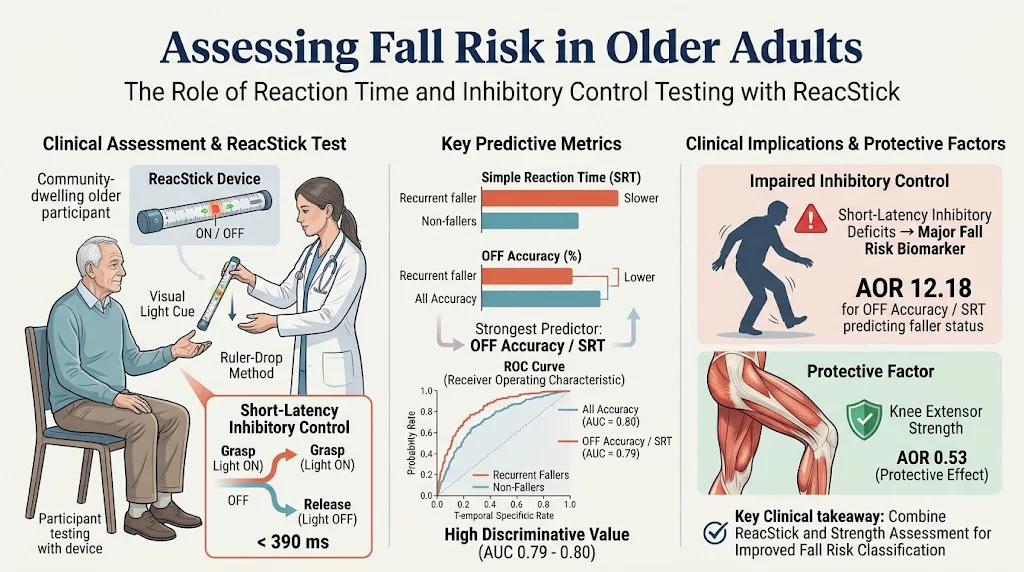
The core intervention involved ReacStick testing, measuring simple reaction time (SRT) by a ruler-drop method and rapid inhibitory control by instructing participants to either grasp or release the device within 390 milliseconds in response to a light-on or light-off cue. Outcome parameters included ON Accuracy (correctly grasping on light-on trials), OFF Accuracy (correctly releasing on light-off trials), All Accuracy (combination of both), and ratios such as OFF Accuracy normalized to SRT. The discriminatory power of these parameters for recurrent faller status was evaluated using group comparisons, receiver operating characteristic (ROC) curve analyses, and multivariate logistic regression to identify independent predictors.
Key Findings
The study revealed that recurrent fallers exhibited significantly worse performance on ReacStick parameters associated with short-latency inhibitory control compared to nonfallers. Specifically, simple reaction time was longer, and the accuracy on light-off trials, reflecting the ability to inhibit a grasp reflex quickly, was poorer. The combined parameter All Accuracy and the normalized ratio OFF Accuracy/SRT showed the highest diagnostic precision, with area under the ROC curve (AUC) values of 0.80 and 0.79, respectively. This indicates good discrimination between recurrent fallers and nonfallers.
Multivariate analysis demonstrated that OFF Accuracy/SRT was the strongest independent predictor of recurrent faller status, with an adjusted odds ratio of 12.18 (95% CI, 3.75 to 39.53), suggesting that diminished short-latency inhibitory control markedly increases fall risk. In contrast, traditional fall-risk functional measures such as TUG and BBS revealed nonsignificant trends toward worse performance in fallers. Notably, greater knee extensor strength was protective, reducing fall risk by approximately 47% (adjusted odds ratio 0.53; 95% CI 0.29 to 0.97).
These findings emphasize the relevance of rapid inhibitory control deficits in the pathophysiology of recurrent falls and suggest that ReacStick testing captures a critical and previously undermeasured dimension of fall risk.
Expert Commentary
The integration of cognitive and motor assessments into fall risk evaluation is gaining momentum, as emerging evidence implicates executive function deficits, including inhibitory control impairments, in falls. The ReacStick provides a novel, cost-effective, and quick bedside tool harnessing these concepts, potentially facilitating early identification of high-risk individuals.
Limitations include the cross-sectional design, restricting causality inference, and the convenience sampling, which may limit generalizability. Larger longitudinal studies are warranted to validate ReacStick predictive utility and to explore integration with multi-domain fall prevention programs. Furthermore, comparison with other cognitive testing modalities could define its relative advantage or complementary role.
Conclusion
This study demonstrates that assessment of short-latency inhibitory control and reaction accuracy using the ReacStick device strongly discriminates recurrent fallers from nonfallers among community-dwelling older adults. When combined with strength measures, particularly knee extensor strength, this approach improves fall-status classification beyond conventional clinical tests. Incorporating ReacStick testing into routine geriatric evaluation represents a promising avenue for enhancing fall risk stratification, potentially enabling more individualized and effective prevention strategies.
Funding and Trial Registration
The article does not specify funding sources or clinical trial registration details.
References
1. Ayudhya PPN, Pongmala C, Richardson JK, Stonsaovapak C, Piravej K. Assessing Fall Risk in Older Adults: The Role of Reaction Time and Inhibitory Control Testing With ReacStick. Arch Phys Med Rehabil. 2026;107(10):2851-2859. PMID: 42248232.
2. Mirelman A, Herman T, Brozgol M, et al. Executive function and falls in older adults: new findings from a five-year prospective study link fall risk to cognition. PLoS One. 2012;7(6):e34076.
3. Montero-Odasso M, Muir SW, Speechley M. Dual-task complexity affects gait in people with mild cognitive impairment: the interplay between gait variability, dual tasking, and executive function. J Gerontol A Biol Sci Med Sci. 2012;67(6):628-35.
4. Lord SR, Ward JA, Williams P, Anstey KJ. An epidemiological study of falls in older community-dwelling women: the Randwick falls and fractures study. Aust J Public Health. 1993;17(3):240-5.
5. Sekhon H, Keogh JW, Seibel M, et al. Systematic review of performance-based functional assessment tools in older adults with impaired cognition. Exp Gerontol. 2019;120: 68-79.