Highlight
– Hip arthroscopy for femoroacetabular impingement (FAI) shows favorable safety and efficacy in adolescents with borderline developmental dysplasia of the hip (BDDH) over a minimum 5-year follow-up.
– Although measurable hip function scores were statistically lower in the BDDH group, the rates of clinically meaningful improvement and patient satisfaction were equivalent to those without BDDH.
– Revision surgery rates were low overall, with no conversions to periacetabular osteotomy required in either group.
– These findings support arthroscopic intervention as a viable option for managing FAI in adolescent patients with borderline dysplasia.
Study Background
Femoroacetabular impingement (FAI) is a common cause of hip pain and dysfunction in adolescents and young adults and frequently necessitates surgical intervention to prevent joint degeneration. Borderline developmental dysplasia of the hip (BDDH), characterized by a lateral center-edge angle (LCEA) of 18°–25°, represents a subtle acetabular undercoverage that might affect hip biomechanics and response to surgery. While hip arthroscopy has become increasingly utilized to address FAI, the impact of concurrent BDDH on long-term outcomes after arthroscopic treatment in growing adolescents remains uncertain. Establishing the efficacy and safety of arthroscopy in this specific subgroup is clinically relevant to optimize surgical decision-making and postoperative expectations.
Study Design
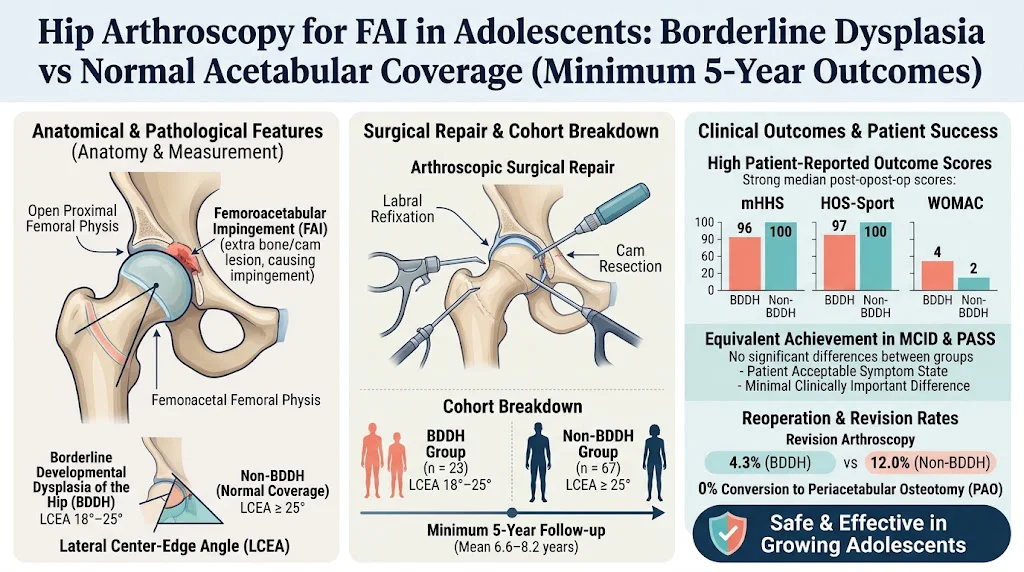
This retrospective cohort study analyzed 122 adolescent patients (≤19 years old with open proximal femoral physes) who underwent primary hip arthroscopy for symptomatic FAI performed by a single senior surgeon from February 2007 to December 2016. Patients were stratified into two groups based on acetabular coverage measured by lateral center-edge angle (LCEA) on imaging: a BDDH group (LCEA 18°–25°) and a non-BDDH group (LCEA ≥25°). A minimum postoperative follow-up duration of 5 years was required. Hip function and quality-of-life outcomes were assessed prospectively using validated scales: modified Harris Hip Score (mHHS), Hip Outcome Score Activities of Daily Living (HOS-ADL), Hip Outcome Score Sport-Specific Subscale (HOS-Sport), Short Form-12 Health Survey (SF-12), and Western Ontario and McMaster Universities Osteoarthritis Index (WOMAC). Revision surgery rates and the need for conversion to periacetabular osteotomy (PAO) were documented.
Key Findings
A total of 90 patients met inclusion criteria: 23 with BDDH and 67 without dysplasia. Mean follow-up was 6.6 years (range, 5.24–9.73) for BDDH and 8.17 years (range, 6.39–10.08) for the non-BDDH group (P = .063). Postoperative evaluations revealed statistically lower median mHHS scores in the BDDH group compared to the non-BDDH group (96 vs 100, P = .027) and similarly lower HOS-Sport scores (97 vs 100, P = .014). The WOMAC scores, which measure pain and function, were higher (indicating worse outcomes) in the BDDH group (4 vs 2, P = .021). However, analyses of clinical significance through percentages of patients achieving minimal clinically important difference (MCID) and Patient Acceptable Symptom State (PASS) in mHHS, HOS-ADL, and HOS-Sport showed no statistically significant differences between groups at 5 years.
Operational outcomes showed only one patient (4.3%) in the BDDH cohort required revision hip arthroscopy, compared to eight patients (12%) in the non-BDDH cohort. Importantly, no patients from either group required conversion to PAO during the follow-up period.
Expert Commentary
This study contributes valuable longitudinal data supporting the use of arthroscopic treatment for FAI in adolescents with borderline hip dysplasia. Although subtle acetabular undercoverage may pose theoretical risks for suboptimal biomechanical correction or residual instability, the similar clinical improvement rates and low revision requirements suggest that careful patient selection enables arthroscopy to be a safe and efficacious option. The presence of borderline dysplasia was associated with some reduced functional scores but did not translate to diminished clinically meaningful benefit or increased secondary surgery. These findings align with emerging literature emphasizing the nuanced role of acetabular coverage in preoperative planning and postoperative rehabilitation.
Limitations to consider include the retrospective design, relatively small BDDH sample size, and lack of detailed radiographic progression or biomechanical assessment over time. Moreover, the cohort was treated by a single experienced surgeon, potentially limiting generalizability. Future prospective studies and comparative trials incorporating advanced imaging metrics and longer follow-up may better elucidate outcomes across the spectrum of dysplasia severity.
Conclusion
Hip arthroscopy for femoroacetabular impingement in adolescents with borderline developmental dysplasia of the hip provides durable clinical improvement comparable to that seen in patients with normal acetabular coverage. Despite modest reductions in certain functional scores, patients achieve similar levels of symptom relief and satisfaction at a minimum 5-year follow-up without increased risk of revision arthroscopy or need for osteotomy. These outcomes support the inclusion of arthroscopic surgery as a valuable treatment modality for FAI in the setting of borderline hip dysplasia during adolescence, emphasizing tailored patient assessment and surgical expertise.
Reference
Nishimura H, Afetse EK, Brown J, Felan NA, Garcia AR, Fukase N, Melugin H, Speshock A, Dornan GJ, Philippon MJ. Clinical Outcomes of Arthroscopic Femoroacetabular Impingement Surgery for Adolescent Patients With Borderline Hip Dysplasia With a Minimum 5-Year Follow-up. Am J Sports Med. 2026 Oct 26:3635465261491021. doi: 10.1177/03635465261491021. Epub ahead of print. PMID: 42929514.