Evaluating Antibody Detection Methods in Myasthenia Gravis: Insights from the ADAM Study
Highlight
- Live cell-based assay (L-CBA) shows superior sensitivity and specificity in detecting acetylcholine receptor (AChR) antibodies compared to fixed cell-based assay (F-CBA) and ELISA in suspected myasthenia gravis (MG).
- ELISA assays have notably lower specificity, leading to a higher rate of false positives, particularly detrimental in clinical diagnosis.
- Muscle-specific kinase (MuSK) antibody detection shows similar sensitivity and perfect specificity across all assay types, indicating consistent reliability.
- The study emphasizes the practicality of F-CBA as a routine diagnostic tool with performance close to L-CBA, providing a balance between accuracy and feasibility.
Study Background
Myasthenia gravis (MG) is a chronic autoimmune neuromuscular disorder characterized by fluctuating muscle weakness due to autoantibodies targeting the neuromuscular junction, principally acetylcholine receptors (AChR) and muscle-specific kinase (MuSK). Antibody testing is critical for diagnosis, classification, and management of MG; however, variations in testing methodologies and their diagnostic accuracies present challenges in clinical practice. While cell-based assays (CBAs) have improved antibody detection sensitivity, particularly live CBAs (L-CBAs) that detect conformational epitopes, their use is limited by technical demands. Fixed CBAs (F-CBAs) and ELISA tests are more accessible but possibly less accurate. Real-world comparative data on these methods are lacking, particularly regarding their specificity and sensitivity in diverse clinical settings.
Study Design
The ADAM study was a prospective, multicenter investigation conducted from July 2023 through December 2025 across four Italian centers. It enrolled consecutively adult and pediatric patients presenting with suspected MG. Key exclusion criteria included prior immunotherapy, incomplete diagnostic workup, or inadequate serum samples. The study compared three antibody detection techniques: an in-house live cell-based assay (L-CBA), a commercially available fixed cell-based assay (F-CBA), and an indirect ELISA, analyzing their ability to detect AChR and MuSK antibodies.
Diagnostic confirmation of MG was determined by neurologists blinded to antibody results, based on clinical neurological evaluation, electrophysiologic testing, sustained symptomatic response to standard therapies (pyridostigmine or corticosteroids), and exclusion of alternative diagnoses. Serum from each patient was processed blindly with the three assays. Diagnostic metrics including sensitivity, specificity, and receiver operating characteristic (ROC) curves were calculated using the final clinical diagnosis as the gold standard.
Key Findings
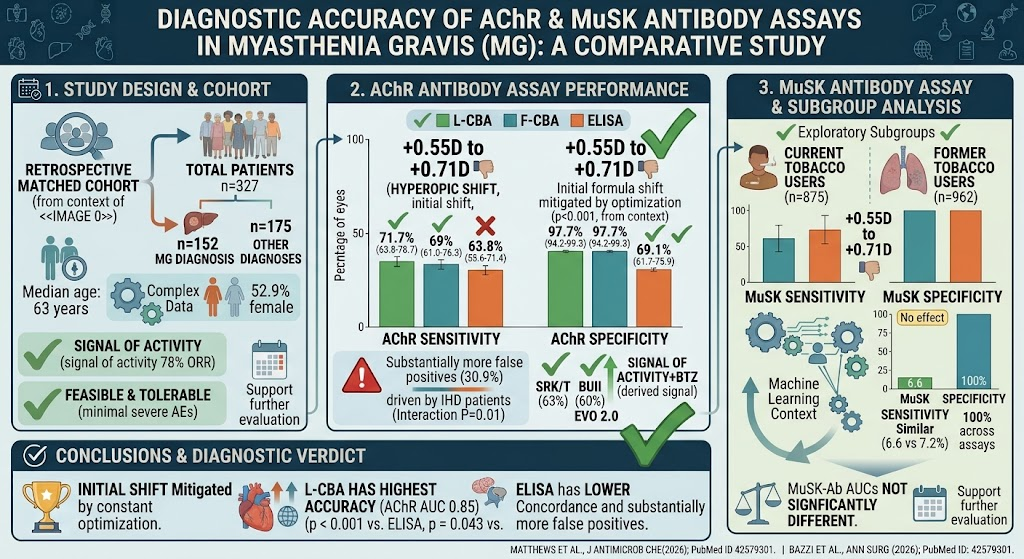
The study included 327 patients, with a median age of 63 years and a slight female predominance (52.9%). Of these, 152 were diagnosed with MG, while 175 had other conditions.
Acetylcholine receptor antibodies: Sensitivity of L-CBA was 71.7% (95% CI: 63.8-78.7), marginally higher than F-CBA at 69.0% (61.0-76.3), and noticeably higher than ELISA at 63.8% (55.6-71.4). Both CBAs demonstrated excellent specificity at 97.7% (94.2-99.3), compared to 69.1% (61.7-75.9) for ELISA. ELISA generated a substantial false positive rate (30.9%), undermining its reliability in clinical diagnosis.
MuSK antibodies: Sensitivity was low but comparable between assays (6.6% vs 7.2%), while specificity was uniformly 100%, indicating high test reliability for MuSK antibody detection regardless of the assay employed.
Receiver operating characteristic (ROC) curve analysis affirmed the superior diagnostic accuracy of L-CBA for AChR antibodies (AUC 0.85), statistically surpassing both F-CBA (AUC 0.83) and ELISA (AUC 0.72). Differences for MuSK antibody testing were not statistically significant across techniques.
Significantly, L-CBA showed better performance even in ocular MG, a subgroup where diagnostic sensitivity is typically challenging.
Expert Commentary
The ADAM study provides robust Class I evidence favoring live and fixed CBAs over ELISA for AChR antibody detection in myasthenia gravis diagnosis. The higher specificity and sensitivity of CBAs particularly address the problem of false positives inherent in ELISA tests, which can lead to misdiagnosis and inappropriate treatment initiation. L-CBA’s modest yet significant advantage emphasizes the value of preserving the native conformation of AChR in antigen presentation, key to detecting pathogenic antibodies.
Nonetheless, L-CBA requires specialized laboratory expertise and infrastructure, which may limit widespread availability. Fixed CBAs offer a practical compromise, delivering near-equivalent diagnostic accuracy with greater feasibility for routine laboratory implementation.
The uniformly perfect specificity across assays for MuSK antibodies supports the reliability of current methods, though the low sensitivity reflects the rarity of MuSK-positive MG cases. The study’s exclusion of patients on immunotherapy and those with incomplete data may limit applicability to treated or diagnostically ambiguous populations.
Moreover, the study underscores caution in interpreting ELISA results, especially given its propensity for false positivity. This finding encourages clinicians to rely on CBAs when available and integrate antibody results with clinical and electrophysiological findings for comprehensive assessment.
Conclusion
The ADAM study rigorously compares antibody detection assays in myasthenia gravis, establishing live cell-based assays as the gold standard with the highest diagnostic accuracy. Fixed cell-based assays are a viable, widely accessible alternative with minimal compromise on performance. In contrast, ELISA, although commonly used, demonstrates lower specificity and should be interpreted cautiously to avoid misdiagnosis.
These findings hold significant clinical implications for improving diagnostic precision in MG, facilitating timely and appropriate management. They also highlight the need for wider availability of advanced CBA technologies and further research to optimize antibody detection methodologies for diverse clinical settings.
Funding and ClinicalTrials.gov
The study was conducted with institutional funding in participating Italian centers. No external funding or clinical trial registration was reported in the publication.
References
1. Giannoccaro MP, Serra L, Grondona AG, et al. Accuracy of Antibody Testing in Myasthenia Gravis: The ADAM Study. Neurology. 2026 Aug 11;107(5):e218301. PMID: 42579824.
2. Sanders DB, Wolfe GI, Benatar M, et al. International consensus guidance for management of myasthenia gravis: 2020 update. Neurology. 2021;96(3):114-122.
3. Lindstrom JM, Seybold ME, Lennon VA, et al. Antibody to acetylcholine receptor in myasthenia gravis. Diagnostic and clinical significance. Neurology. 1976;26(11):1054-1059.
4. Hoch W, McConville J, Helms S, et al. Auto-antibodies to the receptor tyrosine kinase MuSK in patients with myasthenia gravis without acetylcholine receptor antibodies. Nat Med. 2001;7(3):365-368.
This article was created using several editorial tools, including AI, as part of the process. Human editors reviewed this content before publication.