AI-ECG for Detecting Structural Heart Disease in the Community: Evaluating Real-World Applicability in the PREVUE-VALVE Study
Study Background
Structural heart disease (SHD), including acquired valvular abnormalities and myocardial dysfunction, represents a significant contributor to morbidity and mortality in older adults. Early and accurate detection is crucial to timely intervention and improved outcomes. Traditionally, diagnostic confirmation relies on echocardiography, which, while sensitive and specific, requires specialized equipment and trained personnel, limiting broad community screening.
Artificial intelligence (AI)-enabled electrocardiogram analysis (AI-ECG) has emerged as a promising, accessible adjunct tool capable of identifying SHD signatures from standard ECGs. However, most AI-ECG models were developed and validated in hospital-based cohorts with relatively high disease prevalence and more advanced phenotypes. The performance of such models in community-dwelling populations, where disease prevalence is lower and manifestations milder, remains uncertain. Understanding the effects of disease spectrum and prevalence on diagnostic accuracy is essential to ensure safe and effective model transportability into routine community settings.
Study Design
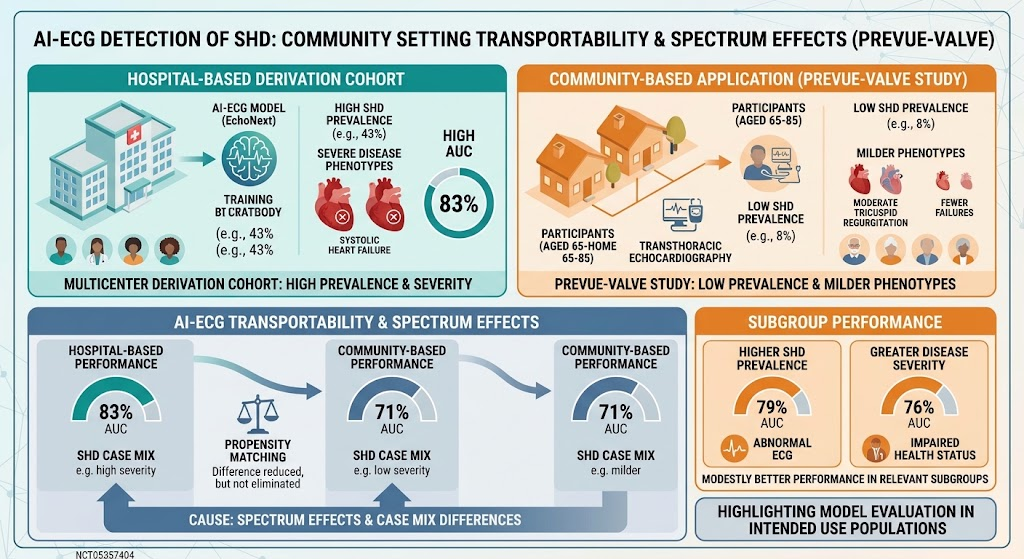
The PREVUE-VALVE (Age and Sex-Specific PREValence of AcqUirEd VALVular Heart DiseasE) Study prospectively enrolled 3,000 community-dwelling adults aged 65 to 85 years who underwent in-home resting ECG and transthoracic echocardiography. The goal was to assess the performance of EchoNext, an AI-ECG algorithm previously trained on multicenter, hospital-based cohorts, for detecting SHD in this real-world community setting.
Participants meeting inclusion criteria (n=2,402) were analyzed. The study compared AI-ECG diagnostic accuracy against echocardiographic findings, focusing on discrimination metrics such as area under the receiver operating characteristic curve (AUC). Propensity matching techniques adjusted for differences in disease prevalence and phenotype between hospital-derived and community cohorts. Subgroup analyses examined performance in clinically relevant populations such as those with abnormal conventional ECGs or impaired health status.
Key Findings
The prevalence of SHD in PREVUE-VALVE participants was markedly lower than in hospital-based cohorts (8% vs. 43%), with less severe disease and a distinctive phenotypic profile characterized by more moderate tricuspid regurgitation and fewer cases of systolic heart failure. Reflecting these population differences, the AI-ECG model performance was significantly attenuated in the community setting; the AUC decreased from 83% [95% CI: 82%-83%] in hospitals to 71% [95% CI: 66%-76%] in PREVUE-VALVE.
Even after adjusting for prevalence and case mix via propensity matching, the gap in model performance persisted, indicating that disease spectrum and clinical context critically influence AI diagnostic accuracy. Performance remained consistent across external hospital cohorts, reinforcing these factors as key drivers rather than algorithm instability.
Notably, diagnostic accuracy improved moderately in higher-risk subgroups within PREVUE-VALVE, such as participants with abnormal ECGs (AUC 79% [95% CI: 75%-83%]) or compromised health status (AUC 76% [95% CI: 70%-82%]), suggesting that targeted application of AI-ECG in enriched populations may yield better clinical utility.
Expert Commentary
The PREVUE-VALVE study highlights a critical issue in AI-driven diagnostics: the influence of disease prevalence and spectrum on model performance. AI algorithms trained on hospital populations may overestimate accuracy when applied directly to community settings where patients have milder or early-stage disease and lower overall risk. This phenomenon, termed “spectrum effect,” necessitates careful external validation tailored to the intended use population.
These findings align with established principles in diagnostic test evaluation, underscoring the risk of spectrum bias in AI model deployment. Importantly, the study also offers a practical insight that AI-ECG may have improved yield when used as a rule-in tool among individuals with suggestive ECG abnormalities or clinical indicators, rather than broad indiscriminate screening.
Limitations include the single geographic setting for PREVUE-VALVE and potential challenges in generalizing results to other community populations with different demographic or comorbidity profiles. Further prospective studies and real-world implementation research are necessary to optimize AI-ECG integration into community cardiovascular care pathways.
Conclusion
AI-enabled ECG analysis is a promising, non-invasive modality for detecting structural heart disease; however, this study demonstrates attenuated accuracy when hospital-trained models are transported to a community setting with lower prevalence and milder disease presentations. Spectrum effects and case mix differences significantly impact diagnostic performance, underscoring the imperative for rigorous validation in intended target populations. Clinicians and healthcare systems should consider these factors before widespread AI-ECG deployment for community screening, emphasizing context-driven application to maximize clinical benefit.
Funding and ClinicalTrials.gov
The PREVUE-VALVE Study (NCT05357404) was conducted under institutional and grant support detailed in the original publication. No direct funding details were provided in the abstract.
References
1. Poterucha TJ, Hughes JW, Brener MI, et al. AI-ECG Detection of Structural Heart Disease in the Community Setting: Transportability and Spectrum Effects in the PREVUE-VALVE Study. J Am Coll Cardiol. 2026;88(7):752–764. PMID: 42615442.
2. Topol EJ. High-performance medicine: the convergence of human and artificial intelligence. Nat Med. 2019;25(1):44–56.
3. Bossuyt PM, Cohen JF, Gatsonis CA. STARD 2015 guidelines for reporting diagnostic test accuracy studies: explanation and elaboration. BMJ Open. 2018;8(10):e021488.
4. Allen J, Rajpurkar P, Langlotz CP, et al. Deep learning in cardiology: promise and challenges. Nat Rev Cardiol. 2020;17(10):679–692.
This article was created using several editorial tools, including AI, as part of the process. Human editors reviewed this content before publication.