We use cookies

Our website uses essential cookies and, with your consent, additional cookies to measure performance and improve our services. Cookie Policy.

You can change your choice at any time.

MMedXYNews
HomeVideos
MedXY AI/MedXY News/Section: Gastroenterology

Epigenetic Silencing of Hepatocyte FoxO1: A Novel Mechanism Disrupting Liver Immune Balance and Driving Inflammation
MedXY Editorial Team•Aug 18, 2026•Gastroenterology
FoxO1ImmunoregulationNKT cellsLiver inflammationEpigenetics

Highlight

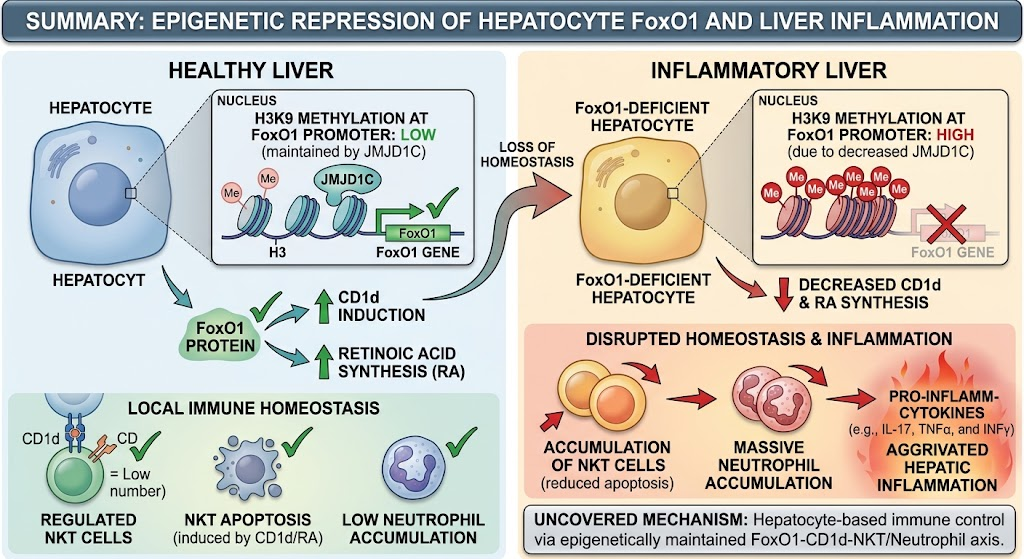
  • Hepatocyte FoxO1 expression is epigenetically repressed via JMJD1C-regulated histone H3K9 dimethylation during liver inflammation.
  • Loss of FoxO1 in hepatocytes disrupts local immune homeostasis by altering NKT cell apoptosis and promoting neutrophil accumulation.
  • FoxO1 induces hepatocyte CD1d expression through retinoic acid synthesis, a critical pathway for controlling NKT cells.
  • Targeting the FoxO1-JMJD1C-CD1d axis offers a novel therapeutic avenue for inflammatory liver diseases such as alcoholic hepatitis and hepatic schistosomiasis.

Study Background

MedXY registered readers

Sign in free to continue reading

Create or use your MedXY account to unlock the complete article.

This article was created using several editorial tools, including AI, as part of the process. Human editors reviewed this content before publication.

Related articles

Open language-specific specialty feeds and department pages.

Unveiling PUS7’s Role in Pulmonary Hypertension: A Novel Epigenetic Driver of Vascular RemodelingThis article explores how PUS7-induced pseudouridylation of TGFBI mRNA promotes pulmonary hypertension via epigenetic regulation, revealing promising new therapeutic targets.Sep 5, 2026Enhancing Prognostic Accuracy in Acute Myeloid Leukemia through DNA Methylation SignaturesDNA methylation profiling in AML patients reveals epigenetic subtypes that mirror genetic mutations, improving risk stratification and outcome prediction beyond standard genetic markers.Aug 28, 2026Gut: Targeting Kupffer Cell Autophagy May Be A Novel Approach to Modulate CD8+ T Cell Activation in Primary Biliary CholangitisThis article explores how autophagy in Kupffer cells influences CD8+ T cell activation and contributes to primary biliary cholangitis, highlighting potential therapeutic interventions targeting macrophage autophagy to alleviate liver inflamAug 24, 2026Blood-Based DNA Methylation Models May Improve Cardiovascular Risk Prediction in Type 2 Diabetes
Loading comments...
MedXY briefing

Get the free newsletter

Evidence-led clinical news, trends, and analysis—delivered to your inbox.

Ask MedXY AI

Most popular

Intimate Health
Five Benefits for Women Continuing Sexual Activity After Menopause
Intimate Health
Why Some Women Have a Strong Sex Drive—And Why Men Shouldn't Worry About It
Nursing & care
How often should a couple have sex?
Intimate Health
Classic Intimacy Recommendations: How to Help Women Reach Orgasm and Enjoy Mutual Pleasure
Intimate Health
What Makes a Woman "Physiologically Addicted" Is Never Money, But These Two Relationship Qualities
© 2026 MedXY
Contact usAbout usPrivacy PolicyMedXY story
A study of 305 individuals with type 2 diabetes found that blood-based DNA methylation models predicted 5-year major adverse cardiovascular events with high accuracy, suggesting potential for improved risk stratification.
Jul 25, 2026
Blood DNA Methylation Maps Atherosclerosis Across Vascular Beds: Strong Signals, but Mostly a Record of Cumulative Risk ExposureIn 2 prospective cohorts, blood DNA methylation was associated with carotid, coronary, and peripheral atherosclerosis, but most signals overlapped with smoking and cardiometabolic risk factors rather than vessel-specific biology.Jun 19, 2026
Beyond the Wrinkles: Unveiling 3 Hidden Accelerators of Aging After 50Stanford scientists identify smoking, cadmium, and lead as major environmental factors accelerating biological aging, revealing new insights into how lifestyle and environment shape health beyond genetics.Oct 7, 2025