Enlicitide: A Breakthrough Oral PCSK9 Inhibitor Offering Superior LDL-C Reduction Compared to Established Oral Nonstatin Therapies
Highlight
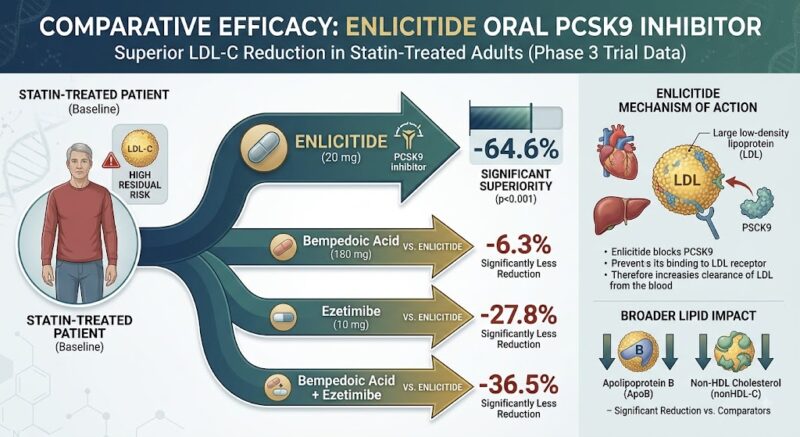
• Enlicitide, a novel oral PCSK9 inhibitor, achieved a 64.6% mean LDL-C reduction in statin-treated adults, outperforming bempedoic acid, ezetimibe, and their combination.
• Significant reductions in apolipoprotein B and non-HDL cholesterol were also observed with enlicitide compared to oral nonstatin comparators.
• Enlicitide’s safety and tolerability profile was comparable to established oral therapies, supporting its potential as an add-on option.
• This trial establishes oral PCSK9 inhibition as a promising strategy to overcome LDL-C treatment gaps in high-risk patients.
Study Background and Disease Burden
Atherosclerotic cardiovascular disease (ASCVD) remains the leading cause of morbidity and mortality worldwide. Lowering low-density lipoprotein cholesterol (LDL-C) is central to ASCVD risk reduction, and statins are the cornerstone of lipid-lowering therapy. However, despite statin use, many adults fail to achieve guideline-recommended LDL-C targets, necessitating additional nonstatin therapies to attain adequate lipid control.
Among nonstatin therapies, ezetimibe and bempedoic acid are widely used oral agents, each with modest LDL-C lowering effects. PCSK9 inhibitors markedly reduce LDL-C but until recently have been limited to injectable monoclonal antibodies, posing barriers to broader use. Enlicitide is an investigational oral PCSK9 inhibitor that offers potent LDL-C reduction, potentially expanding therapeutic options for patients not reaching LDL-C goals on statins alone.
Study Design
This was a phase 3, randomized, double-blind, active-comparator clinical trial evaluating the efficacy and safety of enlicitide versus oral nonstatin therapies in adults on background statin treatment. The study enrolled adults aged ≥18 years with LDL-C levels ≥55 mg/dL who had a prior major ASCVD event, or LDL-C levels ≥70 mg/dL with intermediate to high risk for a first ASCVD event.
Participants (n=301) were randomized in a 2:1:1:2 ratio to receive one of four regimens once daily for 56 days: 20 mg enlicitide (n=101), 180 mg bempedoic acid (n=50), 10 mg ezetimibe (n=50), or combined 180 mg bempedoic acid plus 10 mg ezetimibe (n=100).
The primary endpoint was the mean percentage change in LDL-C from baseline to day 56. Secondary endpoints included mean percentage changes in apolipoprotein B (ApoB) and non-high-density lipoprotein cholesterol (nonHDL-C). Safety endpoints included the incidence of overall adverse events (AEs) and discontinuations attributed to AEs.
Key Findings and Results
Of the 301 randomized participants, 298 (99.0%) completed the trial. The cohort had a mean age of 64.4 years, 37% were female, and 98% were on moderate- to high-intensity statins.
Enlicitide reduced LDL-C by a mean of 64.6% (95% confidence interval [CI]: -68.3% to -60.9%), a significantly greater reduction compared with bempedoic acid (-6.3%, 95% CI: -13.5% to 0.8%), ezetimibe (-27.8%, 95% CI: -32.3% to -23.4%), and the combination of bempedoic acid plus ezetimibe (-36.5%, 95% CI: -40.8% to -32.2%) (all P < 0.001).
Similar patterns emerged for other lipid parameters. Enlicitide resulted in greater reductions in ApoB and nonHDL-C compared to the other oral nonstatin treatments (all P < 0.001). These results underscore enlicitide’s robust effect on atherogenic lipid particles beyond LDL-C alone.
Regarding safety, the proportions of participants experiencing adverse events and those discontinuing therapy due to adverse events were similar across all treatment arms. No unexpected safety signals were observed with enlicitide, suggesting a tolerability profile comparable to existing oral nonstatin therapies.
Expert Commentary
These findings mark a significant advance in lipid management, demonstrating that oral PCSK9 inhibition with enlicitide can achieve LDL-C reductions previously attainable mainly with injectable agents. The magnitude of LDL-C lowering (-64.6%) in a statin-treated population with high cardiovascular risk surpasses the reductions seen with widely used oral therapies.
Dr. Alphonse Catapano, the study lead, notes, “Enlicitide could fill the unmet need for an effective, convenient oral nonstatin lipid-lowering agent, potentially improving adherence and outcomes in patients who do not reach LDL-C goals with statins alone.”
This trial’s results are expected to influence future guideline updates that may incorporate oral PCSK9 inhibitors as important adjuncts.
Limitations include the relatively short 56-day treatment duration and the absence of direct cardiovascular outcome data. Long-term safety, durability of LDL-C reduction, and impact on cardiovascular events warrant further investigation. Generalizability to broader patient populations outside clinical trial settings also requires confirmation.
Conclusion
In conclusion, this phase 3 study establishes enlicitide as a potent and well-tolerated oral PCSK9 inhibitor, significantly outperforming current oral nonstatin therapies in LDL-C lowering among statin-treated adults at elevated cardiovascular risk. Enlicitide holds promise as a transformative add-on treatment to help patients achieve lipid targets, potentially mitigating residual ASCVD risk in clinical practice.
Ongoing research should clarify its long-term cardiovascular benefits, safety, and optimal therapeutic positioning in lipid management algorithms.
Funding and Trial Registration
The study was funded by Merck & Co., Inc., developer of enlicitide (MK-0616). The clinical trial is registered on ClinicalTrials.gov under NCT06450366 (CORALreef AddOn).
References
- Catapano AL, Mikhailova E, Navar AM, et al. Oral PCSK9 Inhibitor Enlicitide Versus Oral Nonstatin Therapies: A Phase 3 Randomized Clinical Trial. J Am Coll Cardiol. 2026;88(3):340-352. PMID: 42017875.
- Stone NJ, Robinson JG, Lichtenstein AH, et al. 2018 ACC/AHA Guideline on the Management of Blood Cholesterol. J Am Coll Cardiol. 2018;73(24):e285-e350.
- Ference BA, Ginsberg HN, Graham I, et al. Low-density lipoproteins cause atherosclerotic cardiovascular disease. Eur Heart J. 2017;38(32):2459-2472.
This article was created using several editorial tools, including AI, as part of the process. Human editors reviewed this content before publication.