Sustained Cardiovascular Protection With Evolocumab in Patients Without Prior MI or Stroke: Insights From the VESALIUS-CV Trial
Highlight
– Evolocumab reduces the risk of first and subsequent major adverse cardiovascular events (MACE) in high-risk patients without prior myocardial infarction (MI) or stroke.
– In the VESALIUS-CV trial, evolocumab lowered total 4-point MACE by 20% and 3-point MACE by 27%, demonstrating sustained cardiovascular protection.
– Patients experienced a substantial number of recurrent events, underscoring the importance of therapies targeting both first and subsequent MACE.
– Benefits were consistent across subgroups regardless of statin intensity or qualifying atherosclerosis status.
Study Background
Cardiovascular disease remains the leading cause of morbidity and mortality globally. Patients at high cardiovascular risk but without prior myocardial infarction (MI) or stroke represent a critical group for primary prevention. Low-density lipoprotein cholesterol (LDL-C) is a well-established causal factor in atherosclerosis progression and cardiovascular events. Despite statin therapy, many high-risk individuals maintain elevated LDL-C levels, necessitating adjunctive lipid-lowering strategies.
PCSK9 inhibitors such as evolocumab have emerged as powerful agents to reduce LDL-C beyond statins, with proven benefit in secondary prevention. However, data on their ability to prevent both first and subsequent major adverse cardiovascular events (MACE) in patients without prior MI or stroke has been limited. The VESALIUS-CV trial sought to address this knowledge gap by evaluating evolocumab’s effect on total MACE events, including recurrent events, in a high-risk primary prevention population.
Study Design
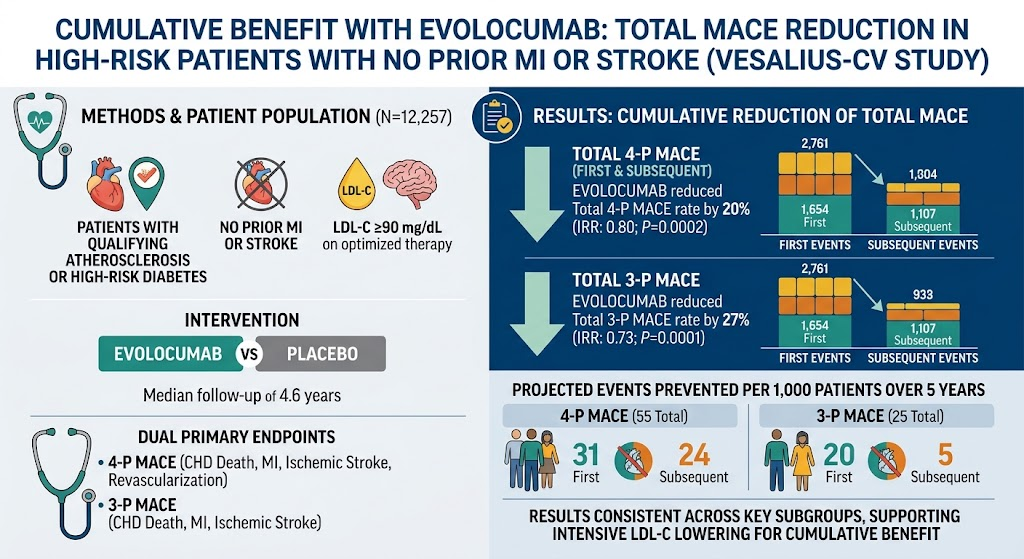
VESALIUS-CV was a randomized, placebo-controlled trial enrolling 12,257 patients with either qualifying atherosclerosis or high-risk diabetes but no history of MI or stroke. Eligible patients had LDL-C levels 60;90 mg/dL despite optimized lipid-lowering therapy. Participants were randomized to receive evolocumab or placebo and were followed for a median of 4.6 years.
The trial’s dual primary endpoints were: (1) a composite of coronary heart disease death, MI, ischemic stroke, or ischemia-driven arterial revascularization (4-point MACE); and (2) a composite excluding revascularization (3-point MACE). Importantly, analyses accounted for all events (first and subsequent), using negative binomial regression models to better capture the cumulative cardiovascular benefit over time.
Key Findings
During follow-up, there were 1,654 first 4-point MACE and an additional 1,107 subsequent events, totaling 2,761 events. For 3-point MACE, 779 first events and 146 subsequent events were recorded. Evolocumab significantly reduced the rate of first 4-point MACE by 19% (hazard ratio [HR]: 0.81; 95% confidence interval [CI]: 0.73-0.89; P < 0.0001). Subsequent events were reduced by 25% (incidence rate ratio [IRR]: 0.75; 95% CI: 0.61-0.91), resulting in a 20% reduction in total events (IRR: 0.80; 95% CI: 0.71-0.90; P = 0.0002).
For 3-point MACE, evolocumab lowered first events by 25% (HR: 0.75; 95% CI: 0.65-0.86; P < 0.0001) and subsequent events by 37% (IRR: 0.63; 95% CI: 0.42-0.94), culminating in a 27% reduction in total events (IRR: 0.73; 95% CI: 0.63-0.86; P = 0.0001). Based on annualized incidence rates, evolocumab is projected to prevent 55 total first and subsequent 4-point MACE events per 1,000 patients treated over five years, and 25 total 3-point MACE events per 1,000 patients over the same period.
These benefits were consistent irrespective of baseline statin intensity or presence of qualifying atherosclerosis, underscoring the broad applicability of evolocumab in diverse high-risk primary prevention cohorts.
Expert Commentary
The VESALIUS-CV trial adds important nuance to our understanding of cardiovascular risk management in patients without prior MI or stroke. The inclusion of subsequent MACE events in the analysis highlights evolocumab’s role not only in preventing initial cardiovascular events but also in mitigating the considerable burden of recurrent events, which significantly affect patient quality of life and healthcare resources.
Previous lipid-lowering trials focused mainly on first events; however, the accumulation of total events more accurately reflects the chronic and progressive nature of atherosclerosis. The robust reductions in both first and subsequent events with evolocumab reinforce intensive LDL-C lowering as a cornerstone of high-risk cardiovascular care.
Nevertheless, limitations include the trial’s median follow-up of 4.6 years, which, while substantial, may underestimate lifetime benefits. The study was also limited to patients with LDL-C ≥90 mg/dL despite intense background therapy, so applicability to those with lower baseline LDL-C remains to be defined. Additionally, cost and access to PCSK9 inhibitors remain practical considerations for widespread implementation.
Conclusion
The VESALIUS-CV study demonstrates that evolocumab significantly reduces both first and subsequent MACE in high cardiovascular risk patients without prior MI or stroke. These findings support the role of intensive LDL-C lowering with PCSK9 inhibition as an effective strategy to reduce cumulative cardiovascular burden beyond primary event prevention.
Future research should explore long-term outcomes, cost-effectiveness, and the integration of PCSK9 inhibitors into broader primary prevention paradigms, including in patients with evolving risk profiles.
Funding and clinicaltrials.gov
The VESALIUS-CV trial (NCT03872401) was supported by appropriate funding bodies including the pharmaceutical sponsor responsible for evolocumab development. Detailed funding disclosures and potential conflicts of interest can be found in the original publication.
References
Nicolau JC, Murphy SA, Giugliano RP, et al. Cumulative Benefit With Evolocumab in Patients With No Prior Myocardial Infarction or Stroke in the VESALIUS-CV Study. J Am Coll Cardiol. 2026 Aug 28. PMID: 42663360. https://pubmed.ncbi.nlm.nih.gov/42663360/
This article was created using several editorial tools, including AI, as part of the process. Human editors reviewed this content before publication.