Enhancing Patient Experience and Understanding in Pulmonary Function Testing: A Qualitative Study on Patient-Centered Education
Introduction
Pulmonary function tests (PFTs) are pivotal diagnostic tools that assess lung capacity and airway function, essential for diagnosing and managing respiratory diseases such as asthma, chronic obstructive pulmonary disease (COPD), and interstitial lung disease. Despite their clinical utility, the patient experience during PFTs remains underexplored, with limited emphasis on pre-test education. Anxiety, misunderstanding of test maneuvers, and physical discomfort can compromise test quality and patient adherence. This study aims to elucidate patients’ lived experiences during PFTs and develop a patient-centered educational pamphlet to improve preparedness, comprehension, and overall testing experience.
Background and Clinical Need
Respiratory diseases impose a substantial global health burden, with accurate diagnostics being crucial for effective treatment and prognosis. PFTs require active patient cooperation involving specific breathing maneuvers that can be physically demanding and unfamiliar. Inadequate pre-test counseling often leads to emotional distress and poor test performance, resulting in unreliable data that can affect clinical decisions. This underscores an unmet need for tailored educational interventions that address patients’ informational and emotional needs in routine pulmonary function assessment.
Study Design and Methods
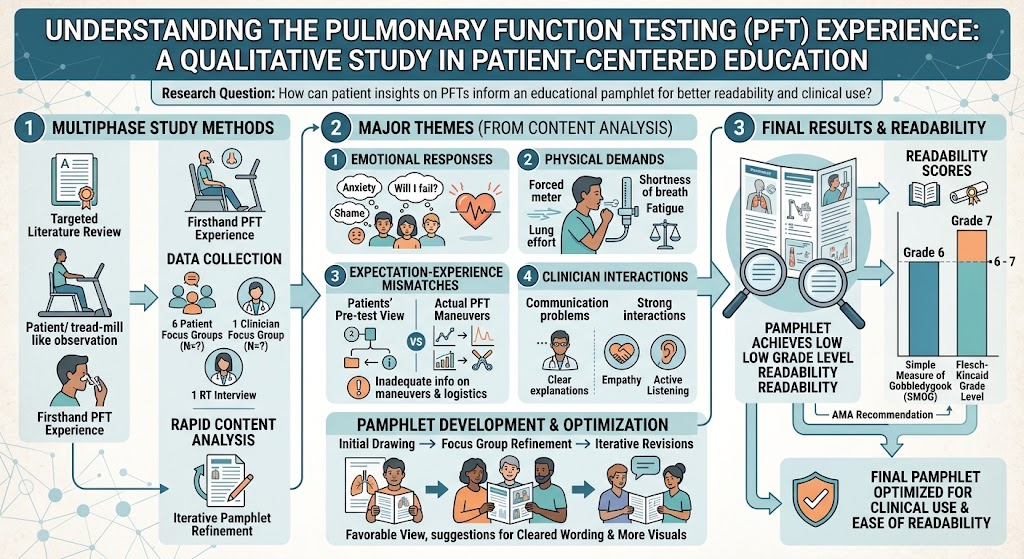
This was a multiphase qualitative study conducted at a large academic safety-net hospital. The initial phase involved developing a draft educational pamphlet through a targeted literature review, direct observation of PFT procedures, and firsthand experience to identify pertinent informational gaps. Subsequently, six patient focus groups, one clinician focus group, and one respiratory therapist interview were conducted to capture diverse perspectives on the PFT experience. Thematic content analysis was performed on transcribed discussions, enabling iterative refinement of the pamphlet. The readability of the final version was quantitatively assessed using the Simple Measure of Gobbledygook (SMOG) and Flesch-Kincaid grade-level tools to ensure suitability for a broad patient population.
Key Findings
Analysis yielded four prominent themes characterizing the patient PFT experience:
1. Emotional Responses: Patients frequently reported anxiety and feelings of shame, largely attributed to lack of preparation and unfamiliarity with the testing maneuvers. Anxiety was noted to potentially hinder full test effort.
2. Physical Demands: The forced expiratory and inspiratory maneuvers were described as strenuous, exacerbating discomfort especially among individuals with advanced respiratory conditions.
3. Expectation-Experience Mismatches: Patients commonly encountered discrepancies between what they anticipated and the actual testing process, largely due to insufficient prior information.
4. Clinician Interactions: The quality of communication with respiratory therapists and clinicians markedly influenced patient comfort and cooperation.
Patients uniformly reported that pre-test information was minimal and inadequately addressed the logistics, physical requirements, and rationale of PFTs. The draft pamphlet was positively received; however, patient feedback emphasized the need for clearer language, inclusion of illustrative visuals, and diversified formats (e.g., digital, print). Consequently, the pamphlet was revised to a SMOG reading grade level of 6 and Flesch-Kincaid grade level of 7, meeting American Medical Association recommendations for patient education materials.
Interpretation and Expert Commentary
This study highlights a critical, yet under-recognized, dimension of pulmonary diagnostics: patient informational and emotional challenges during PFTs. The findings reinforce that suboptimal pre-test education can contribute to anxiety and subpar test execution. Engaging patients and clinicians collaboratively to produce accessible, concise educational content holds promise to enhance patient understanding, alleviate anxiety, and potentially improve the reliability of test results.
While the study’s qualitative design offers rich insights into patient experiences, generalizability may be limited to similar hospital settings and demographics. Further research, including randomized controlled trials assessing the pamphlet’s impact on test performance metrics and clinical outcomes, is warranted. Notably, integrating multimedia and interactive educational tools may offer additional benefits and should be explored.
Conclusions and Future Directions
Patients undergoing PFTs face multifaceted challenges—emotional, physical, and informational—that have traditionally been overlooked. A patient-centered, co-developed educational pamphlet effectively addresses these needs, improving comprehension and comfort. Incorporation of such tools into routine clinical practice could enhance patient-centered care and test fidelity. Subsequent studies should investigate measurable effects on PFT quality and long-term patient outcomes, alongside adaptation across diverse clinical contexts and populations.
Funding and Clinical Trials
The study was conducted at a large academic safety-net hospital; specific funding sources were not detailed in the publication. No clinical trials registration was reported.
References
Shin S, Tan M, Sure A, Ieong M, Kearney LE. Understanding the Pulmonary Function Testing Experience: A Qualitative Study in Patient-Centered Education. Chest. 2026 Aug 20. PMID: 42624246. Available at: https://pubmed.ncbi.nlm.nih.gov/42624246/.
Additional references for background and methodology were not provided but pertinent literature includes American Thoracic Society guidelines on PFT standardization and patient education frameworks in respiratory diagnostics.
This article was created using several editorial tools, including AI, as part of the process. Human editors reviewed this content before publication.