Enhancing Hepatitis B Treatment: Pegylated Interferon After Nucleos(t)ide Withdrawal Boosts HBsAg Loss in HBeAg-Negative Patients
Highlight
Adjuvant pegylated interferon (PEG-IFN) following nucleos(t)ide analogue (NA) withdrawal enhances the sustained hepatitis B surface antigen (HBsAg) loss in HBeAg-negative chronic hepatitis B (CHB).
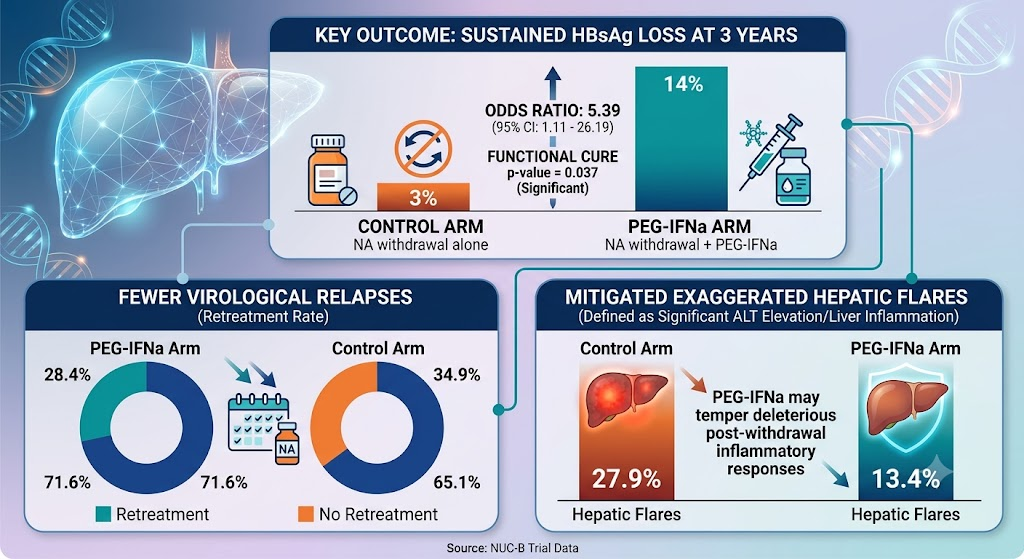
Three-year follow-up data demonstrate a 14% HBsAg loss with PEG-IFN adjunct therapy versus 3% with NA withdrawal alone.
PEG-IFN reduces the incidence of exaggerated hepatic flares and lowers retreatment rates compared to NA withdrawal alone.
This regimen offers a finite therapeutic strategy aiming at functional cure, representing progress beyond lifelong NA therapy.
Study Background
Chronic hepatitis B virus (HBV) infection remains a major global health burden, with over 250 million affected individuals worldwide. Achieving a functional cure, defined as sustained loss of hepatitis B surface antigen (HBsAg), is the ultimate therapeutic goal due to its association with reduced risk of cirrhosis, hepatocellular carcinoma, and liver-related mortality. Current standard treatment relies heavily on long-term nucleos(t)ide analogue (NA) therapy suppressing viral replication but infrequently achieves HBsAg loss, necessitating lifelong medication with substantial cost and adherence considerations.
For HBeAg-negative patients, NA withdrawal has been explored as a strategy to stimulate host immune-mediated viral clearance, attaining HBsAg loss rates of 5-20% after three years. Pegylated interferon-alpha (PEG-IFNa), an immunomodulatory agent with intrinsic antiviral properties, is recognized as a finite treatment alternative but with heterogeneous efficacy and tolerability issues. Combining NA withdrawal with subsequent PEG-IFNa aims to synergistically augment immune control and functional cure rates while potentially reducing adverse viral flares.
Study Design
The NUC-B trial was a randomized, multi-center, open-label study conducted between 2017 and 2021 across several clinical sites involving NA-treated, non-cirrhotic patients with HBeAg-negative CHB. The trial aimed to recruit 240 patients but enrolled 156 participants (median age 45 years, 24% female) with diverse HBV genotypes (A through E and others).
Participants were randomized to one of two arms:
1. Control arm: NA withdrawal alone.
2. PEG-IFNa arm: NA withdrawal followed by a 16-week course of PEG-IFNa 180 µg weekly, initiated 4 weeks after NA cessation.
The primary endpoint was the rate of HBsAg loss at 3 years post-NA withdrawal. Secondary endpoints included retreatment rates, incidence of hepatic flares, and safety assessments.
Key Findings
At the 3-year follow-up, the HBsAg loss rate was significantly higher in the PEG-IFNa arm at 14% compared to 3% in the control arm (odds ratio 5.39; 95% CI, 1.11 to 26.19; p=0.037). This finding illustrates a nearly fivefold increase in functional cure likelihood when applying adjunct PEG-IFNa after NA cessation.
Retreatment with NA was required less frequently in the PEG-IFNa arm (28.4%) versus control (34.9%), indicating fewer virological relapses necessitating reinitiation of antiviral therapy.
Importantly, exaggerated hepatic flares, defined as significant ALT elevations indicating immune-mediated liver inflammation, occurred in 27.9% of the control group compared to only 13.4% in patients receiving PEG-IFNa. This suggests the immunomodulatory PEG-IFNa treatment may temper deleterious inflammatory responses post-NA withdrawal.
Adverse event profiles were consistent with known PEG-IFNa toxicities, with no new safety signals reported. Overall, the combined therapeutic approach was feasible and tolerable in this patient population.
Expert Commentary
This study provides compelling evidence supporting the integration of PEG-IFNa as an adjuvant to NA withdrawal in non-cirrhotic, HBeAg-negative CHB. The enhanced HBsAg loss rates represent a pivotal advance toward finite treatment strategies aimed at true viral control rather than indefinite suppression.
The reduction in exaggerated flares and retreatment highlights a potential immunological recalibration during PEG-IFNa therapy, possibly inducing sustained immune control over HBV reservoirs or covalently closed circular DNA (cccDNA). These findings align with mechanistic hypotheses that transient immune activation post-NA withdrawal may expose viral antigens facilitating immune clearance.
Study limitations include underpowered recruitment with 156 of 240 planned patients, which may temper generalizability. Additionally, the patient cohort lacked cirrhosis and predominantly included certain HBV genotypes, limiting extrapolation to other groups. Longer-term follow-up and biomarker studies could further dissect predictors of response and optimize timing or duration of PEG-IFNa therapy.
Current guidelines recognize finite PEG-IFNa therapies but still emphasize individualized decision-making due to tolerability concerns. This trial’s data encourage clinicians to consider adjunct PEG-IFNa in select patients undergoing NA cessation to increase the chance of HBsAg seroclearance.
Conclusion
The NUC-B trial demonstrates that pegylated interferon as an adjunct following nucleos(t)ide analogue withdrawal significantly improves the rate of sustained HBsAg loss in HBeAg-negative CHB patients while mitigating severe hepatic flares and reducing retreatment. This combination approach provides a promising finite therapeutic pathway towards functional cure in chronic HBV infection. Future research should focus on identifying optimal candidates, refining PEG-IFNa protocols, and extending findings to broader patient populations to maximize clinical impact.
Funding and Trial Registration
Details on study funding and clinical trials registration were not provided in the abstract and should be reviewed in the full publication for transparency and potential conflicts of interest.
References
Thursz M, Lemoine M, Brown A, et al. Nucleos(t)ide withdrawal vs Nucleos(t)ide withdrawal with adjuvant pegylated-interferon in HBeAg-negative hepatitis B virus infection (NUC-B Trial). Hepatology (Baltimore, Md.). 2026 Aug 4. PMID: 42549812. Available at: https://pubmed.ncbi.nlm.nih.gov/42549812/
Additional context and evidence can be drawn upon from current hepatitis B guidelines by EASL and AASLD, and recent systematic reviews on antiviral withdrawal and pegylated interferon use in CHB.
This article was created using several editorial tools, including AI, as part of the process. Human editors reviewed this content before publication.