Enhancing Heart Failure Care: Impact of Get With The Guidelines-Heart Failure Hospital Participation on Medical Therapy and Patient Outcomes
Highlight
- Hospital participation in Get With The Guidelines-Heart Failure (GWTG-HF) modestly improves adherence to guideline-directed medical therapy (GDMT) in heart failure with reduced ejection fraction.
- Participation is associated with increased use of beta-blockers, renin-angiotensin system inhibitors, and mineralocorticoid receptor antagonists postdischarge.
- Enrollment correlates with reduced all-cause mortality at 30 days and 1 year, though mortality benefits attenuate under certain analytical models.
- Supports the value of structured quality improvement programs to address persistent care gaps in heart failure management.
Study Background
Heart failure with reduced ejection fraction (HFrEF) is a prevalent clinical syndrome marked by impaired cardiac systolic function, associated with high morbidity, frequent hospitalizations, and substantial mortality. Despite robust evidence from randomized clinical trials and guidelines recommending specific pharmacologic treatments — including beta-blockers, renin-angiotensin system inhibitors (ACE inhibitors or ARBs), mineralocorticoid receptor antagonists, and angiotensin receptor-neprilysin inhibitors (ARNIs) — real-world implementation remains suboptimal. Clinical inertia, system-level barriers, and care variability contribute to treatment gaps, leading to worse outcomes.
The American Heart Association’s Get With The Guidelines-Heart Failure (GWTG-HF) program aims to improve adherence to evidence-based therapies through hospital-level quality improvement interventions, data collection, and performance feedback. This retrospective cohort analysis evaluated whether hospital participation in GWTG-HF from 2013 to 2021 enhanced GDMT intensity and clinical outcomes among Medicare beneficiaries hospitalized with HFrEF.
Study Design
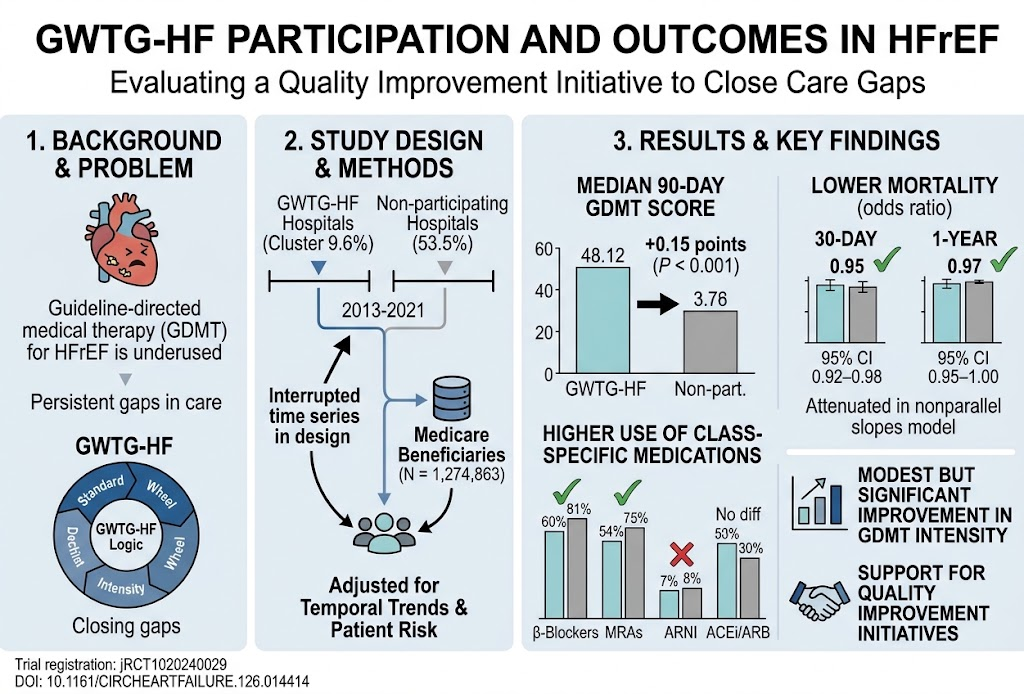
This observational study included 1,274,863 Medicare beneficiaries with both Part A and Part D coverage who were hospitalized for HFrEF between 2013 and 2021. Hospitals were classified as participating or nonparticipating in the GWTG-HF program. A multiple baseline time series design was employed to compare GDMT prescription patterns and outcomes before and after hospital enrollment in GWTG-HF, using hospitals that never participated as controls.
Primary outcomes focused on a 90-day postdischarge GDMT score reflecting intensity and adherence to guideline medications. Secondary outcomes included fills of specific medication classes, achievement of at least 50% target dosing for these therapies, and clinical endpoints such as 30-day, 90-day, and 1-year all-cause and heart failure readmissions and mortality. Mortality and first heart failure rehospitalization were further analyzed using Cox proportional hazards models. Analyses adjusted for baseline hospital performance metrics, patient demographics and comorbidities, and temporal trends.
Key Findings
Among the entire cohort, 53.5% received care at nonparticipating hospitals, while 9.6% were treated in hospitals enrolled in GWTG-HF. Baseline median GDMT scores at 90 days postdischarge were identical (3.0) across groups. However, over time, unadjusted median GDMT scores increased to 4.0 in nonparticipating hospitals and to 4.5 in participating hospitals, a statistically significant difference (P<0.001).
Adjusted analyses demonstrated that hospital enrollment in GWTG-HF was associated with a modest but significant increase in the 90-day GDMT score (+0.15 points; 95% CI: 0.12-0.20; P<0.001). Participation promoted higher utilization of beta-blockers, renin-angiotensin system inhibitors, and mineralocorticoid receptor antagonists postdischarge. However, no significant increase in angiotensin receptor-neprilysin inhibitors (ARNIs) use was observed, potentially reflecting their more recent introduction and uptake barriers during the study period.
Clinical outcomes favored GWTG-HF hospitals, with lower all-cause mortality at 30 days (odds ratio [OR] 0.95; 95% CI: 0.92-0.98) and at 1 year (OR 0.97; 95% CI: 0.95-1.00). However, when using a nonparallel slopes statistical model accounting for changing baseline trends, the mortality benefit became attenuated and statistically nonsignificant, suggesting that other temporal factors may influence outcomes.
Readmission rates at various intervals showed trends but were not significantly different after adjustment.
Expert Commentary
This large-scale real-world study affirms that structured quality improvement programs such as GWTG-HF can enhance GDMT adherence — a necessary but insufficient condition for improved clinical outcomes. The modest effect size in GDMT score increase (+0.15) reflects persistent challenges in translating guidelines into practice, including patient-level contraindications, medication tolerability, and systemic barriers.
The observed mortality reduction supports clinical benefit, although attenuation in sensitivity analyses highlights the need for cautious interpretation. The lack of ARNI uptake increase endorses ongoing efforts to address prescription inertia and cost/access issues for newer agents.
Limitations include the retrospective design, reliance on administrative and pharmacy claims data which may omit clinical nuances such as ejection fraction changes or symptom severity, and potential residual confounding despite adjustment for temporal trends and baseline performance.
Overall, the findings underscore the critical role of hospital-level quality initiatives, audit, and feedback in addressing treatment gaps in HFrEF, complementing physician education and system-level reforms. Future efforts should aim at expanding ARNI adoption and facilitating optimal dosing strategies.
Conclusion
Hospital participation in the GWTG-HF quality improvement program is associated with modest but statistically significant improvements in the intensity of guideline-directed medical therapy at 90 days postdischarge among Medicare beneficiaries with HFrEF. This participation correlates with reduced short- and long-term mortality in unadjusted models, supporting quality initiatives as valuable tools for closing enduring treatment gaps. Continued emphasis on comprehensive care delivery, incorporation of new therapeutics, and overcoming barriers to medication optimization remain priorities to further enhance outcomes in this high-risk population.
Funding and Clinical Trials
The study was supported by institution-level data collection initiatives and Medicare databases. Specific funding sources and clinical trial registrations were not reported in the original publication.
References
1. Yancy CW, Jessup M, Bozkurt B, et al. 2017 ACC/AHA/HFSA Focused Update of the 2013 ACCF/AHA Guideline for the Management of Heart Failure. Circulation. 2017;136(6):e137-e161.
2. Fonarow GC, Yancy CW, Heywood JT, et al. Adherence to guideline-recommended therapies in patients hospitalized for heart failure. J Am Coll Cardiol. 2010;55(9):903-911.
3. Ambrosy AP, Fonarow GC, Butler J, et al. The global health and economic burden of hospitalizations for heart failure. J Am Coll Cardiol. 2014;63(12):1123-1133.
4. Heidenreich PA, Bozkurt B, Aguilar D, et al. 2022 AHA/ACC/HFSA Guidelines for the Management of Heart Failure. Circulation. 2022;145(18):e895–e1032.
5. Sandhu AT, Fonarow GC, et al. Get With The Guidelines-Heart Failure Hospital Participation and Its Association With Guideline-Directed Medical Therapy and Outcomes. Circulation. Heart Failure. 2026 Sep 2:e014414. PMID: 42683539.
This article was created using several editorial tools, including AI, as part of the process. Human editors reviewed this content before publication.